2 months ago
21
2 months ago
21
Washington: The slow rate of American shipbuilding is “borderline frightening” and remains a major obstacle to fulfilling the AUKUS pact, a senior Pentagon official has said, as defence ministers meeting in the United States agreed to rein in the unwieldy second pillar of the agreement after industry complaints.
Defence Minister Richard Marles also confirmed for the first time that the Pentagon’s AUKUS review contains “granular and specific” recommendations to improve the deal, though he would not outline what those were.
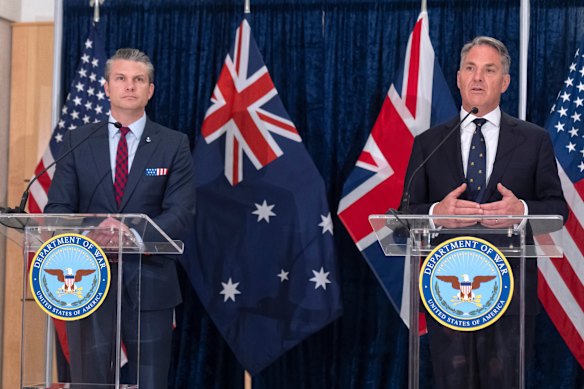
Defence Minister Richard Marles and US Secretary of Defence Pete Hegseth speak to reporters.Credit: AP
Speaking at a defence conference in Washington, senior advisor to the deputy secretary of war William Toti said the slow rate of US shipbuilding was “borderline frightening” and remained the major challenge to fulfilling the AUKUS agreement.
“I think that’s the only obstacle – can we get our submarine shipbuilding capacity up to the rate where we can afford to give up [the vessels] – because we need every submarine we can get,” Toti said.
“That’s a political decision, way above my pay grade. My job is to help get the shipbuilding capacity up to the rate where we can indeed transfer submarines to Australia. I fully support that initiative.”
Asked whether he thought the rate of submarine production was beginning to increase, Toti said: “I think so.”
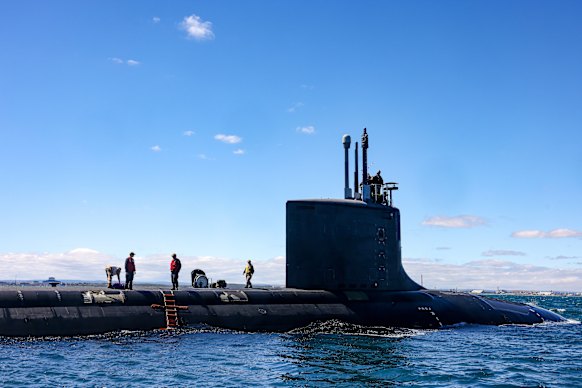
The USS Minnesota, a Virginia-class submarine, sails off Western Australia last month.Credit: Getty Images
The US is producing about 1.2 Virginia-class, nuclear-powered submarines a year and needs to lift that to 2-2.3 a year to meet AUKUS obligations while prioritising the development of its new Columbia-class submarines.
Marles completed a three-day visit to Washington on Wednesday (Thursday AEDT), where he met with his US and British counterparts Pete Hegseth and John Healey, among other Pentagon officials – including, for the first time, undersecretary of war for policy Elbridge Colby, who led the AUKUS review.
Marles and Australian ambassador to the US Kevin Rudd also met President Donald Trump’s deputy chief of staff, Stephen Miller, at the White House, as well as Army Secretary Dan Driscoll and Navy Secretary John Phelan.
At a news conference, Marles confirmed the second pillar of the AUKUS agreement – under which Australia, the US and United Kingdom share advanced defence technologies – will be slimmed down. The move follows industry complaints that the venture has become too broad, unwieldy and slow.
Pillar two deals in capabilities as wide-ranging as artificial intelligence, undersea technology, hypersonic and counter-hypersonic capabilities and information-sharing.
“Focusing on particular projects is something that we need to be doing,” Marles said. “Without going into what they are, that was a focus of our meeting today – giving a sharpness, if I could put it that way, about what we are seeking to do in relation to pillar two.”
Marles has refused to speak publicly about the contents of the Pentagon’s AUKUS review – which is classified – but on Thursday (AEDT) said it contained specific proposals on how to “do AUKUS better”, rather than dealing generally with issues or concerns.
“It is very much within the frame of being full steam ahead of delivering AUKUS and how we can do this better, and it is granular and it is specific about how it looks at that,” he said.
Marles added that Australia approached the process in “a very self-critical way … we want to make sure that we are learning, and we are improving”.
Ahead of their trilateral meeting at the Pentagon, UK Defence Secretary John Healey said AUKUS was “quite simply the most important military collaboration for the last 70 years” for Britain. The three countries were determined to “reboot” AUKUS, Healey said.
The ministers did not take questions at their joint appearance. It comes days after a former British navy chief, Rear Admiral Philip Mathias, said AUKUS should be cancelled immediately.
Loading
“The UK is no longer capable of managing a nuclear submarine program,” he said, as reported by the London Telegraph. “SSN-AUKUS is a submarine which is not going to deliver what the UK or Australia needs in terms of capability or timescale.”
The SSN-AUKUS is a new class of nuclear-powered submarine to be developed by the UK and Australia in the 2040s. Healey said it would be “the most powerful, most feared attack submarine the world has ever seen – the apex predator of the seas”.
Get a note directly from our foreign correspondents on what’s making headlines around the world. Sign up for our weekly What in the World newsletter.
Most Viewed in World
Loading