2 months ago
19
2 months ago
19
The largest known marsupial ever to live was about the size of a minivan, and with jaws with the bite force of a garbage compacter. Her two bucked teeth extended far out from the face and yet she only ever grazed on grass, leaves and bark, consuming up to 20 kilos a day.
Diprotodon optatum roamed Australia until 40,000 years ago, when the relatives of the kangaroo walked, not hopped, and had fangs and claws.
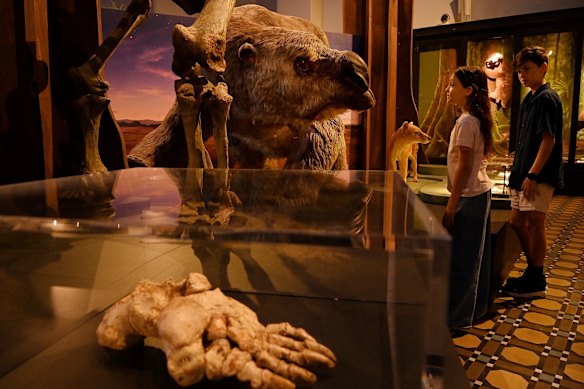
Indigo and Riley Hannam eyeball the Diprotodon optatum, the largest marsupial that ever lived. Credit: Kate Geraghty
The same climate changes that rendered the dinosaur extinct dried out the tropical rainforests of Australia and turned them into grasslands which homed and fed these oversize marsupials, cousins of the koalas, kangaroos and wombats.
Dinosaurs get all the publicity, but the Australian Museum’s summer exhibition, Surviving Australia, opening on Saturday, aims to put Australia’s megafauna on the map.
“Most people jump to North American species when they think of fossils, but Australia had its own unique prehistoric species,” says Dr Matt McCurry, the museum’s curator of palaeontology.
At the same time as the sabre-toothed tiger roamed the northern hemisphere, the marsupial lion was one Australia’s apex predators. Thylacoleo carnifex had a long-bladed tooth perfect for slicing meat and was built for power but disappeared from Australia about 40,000 years ago.
“It’s still debated whether climate change or hunting was the cause of extinction,” McCurry says.
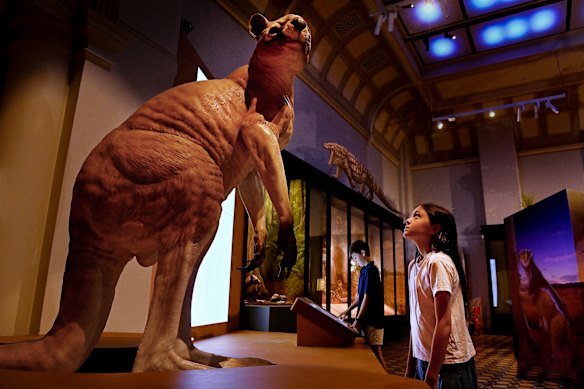
The procoptodon, a giant short faced kangaroo will be on display in the Surviving Australia exhibition at the Australian Museum in Sydney.Credit: Kate Geraghty
The exhibition features 350 specimens, including a rare fossilised spider. Spiders normally break apart before they can turn into fossils, but in this case, the spider was so well-preserved, it still has hairs attached to its legs.
It’s five times the size of its nearest relatives that are now only found in wet forest habitats in Singapore and PNG, according to McCurry. The spider was discovered in Gulgong, NSW, a fossil hotspot famous for its preserved spiders, plants and freshwater fish, and once a lush rainforest.
The Australian Museum is on track to welcome more than 1.3 million visitors this year, its second-highest figures after posting record visitor numbers for the 2023/24 Ramses & The Gold of the Pharaohs blockbuster.
Loading
According to its annual report, self-generated revenues of $15.6 million were $2.3 million lower last financial year due to “reduced exhibition provider reimbursements” for the import, Machu Picchu and the Golden Empires of Peru, which sold 200,0000 tickets, half that of Ramses. This revenue fall was offset by lower exhibition expenses, resulting in no net impact on its financial performance or service delivery capacity, the museum said.
Surviving Australia is a homegrown exhibition that utilises the museum’s depths of scientific research and collections comprising 22 million objects and specimens, valued at more than $1 billion. Almost 300 new species were discovered by scientists and associates of the museum’s research institute in 2024-25.
NSW Arts Minister John Graham pitched the museum to international tourists seeking out Australia for its dangerous thrills.
“This continent has got so much to teach the rest of the world, both our First Nations’ history but also our natural history,” he said.
Surviving Australia opens on Monday, December 15, free admission.
Start the day with a summary of the day’s most important and interesting stories, analysis and insights. Sign up for our Morning Edition newsletter.
Most Viewed in Culture
Loading