3 months ago
36
3 months ago
36
By ELAINE KURTENBACH
January 20, 2026 — 7.28am
The Australian sharemarket is expected to open in the red on Tuesday, after European shares slumped as trade tensions between the US and Europe flared over President Donald Trump’s push to take control of Greenland.
European shares mostly fell and U.S. stock futures are ponting to falls on Wall Street’s next session, after Trump at the weekend threatened to slap a 10 per cent extra tariff on imports from eight European countries because they oppose having America take control of Greenland.

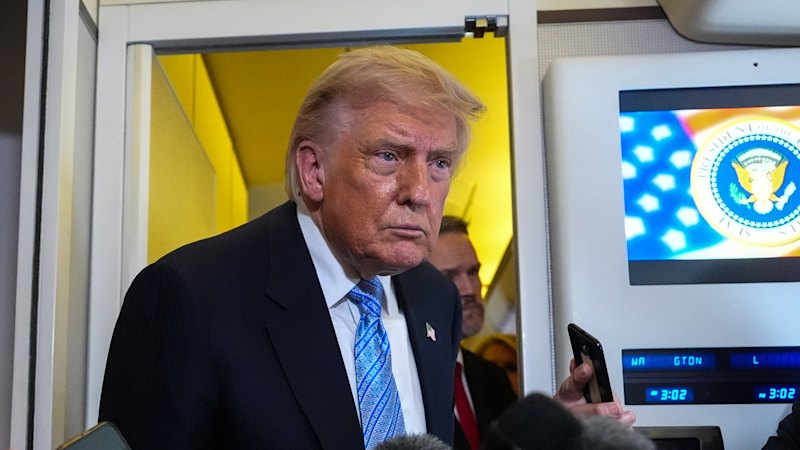
Tensions over Donald Trump’s push to acquire Greenland have dragged down sharemarkets.Credit: Getty Images
Germany’s DAX lost 1.3 per cent, the CAC 40 in Paris fell 1.9, and Britain’s FTSE 100 declined 0.4 per cent. U.S. stockmarkets were closed for Martin Luther King Jr. Day, futures are pointing to a 1 per cent fall in the S&P 500.
On the ASX, futures are pointing to a decline of 0.4 per cent or 34 points when the market opens, after the bourse declined 0.3 per cent on Monday.
The European countries targeted by Trump blasted his threat to raise tariffs, saying they “undermine transatlantic relations and risk a dangerous downward spiral.” The unusually strong joint statement was the most forceful rebuke from the European allies since Trump returned to the White House almost a year ago.
Trump’s moves are testing the strategic alignment and institutional trust underlying support from Europe, the largest trading partner and provider of financing to the United States, Stephen Innes of SPI Asset Management said.
Loading
“In a world where geopolitical cohesion within the Western alliance is no longer taken for granted, the willingness to recycle capital indefinitely into U.S. assets becomes less automatic. This is not a short-term liquidation story. It is a slow rebalancing story, and those are far more consequential,” Innes said.
Trump’s threat to impose levies on countries opposing his bid to claim authority over Greenland risks reigniting the volatility that rattled markets in the early months of his second term. The selloff deepened after European officials signalled they were unlikely to back down and were considering retaliation.
“The nervousness is palpable,” said Alexandre Baradez, chief market analyst at IG in Paris. “All in all, you have so many issues piling up — from credit cards to the independence of the Fed and tariffs — that I really don’t see the case for stock markets to keep on breaching new records.”
The standoff is happening at a time when risk appetite has been supported by resilient earnings and sustained investment in artificial intelligence. The outlook will hinge in part on the European Union’s response, with the bloc in talks to impose tariffs on €93 billion ($161.3 billion) of US goods.
French President Emmanuel Macron intended to request the activation of the EU’s so-called anti-coercion instrument, Bloomberg reported over the weekend. German leader Friedrich Merz, however, said Monday that Germany’s heavier dependence on exports means it’s less willing to unleash the countermeasure.
“The key element to watch in the coming days is whether the message translates into formal measures or remains purely rhetorical, which would make a clear difference in the market reaction,” said Francisco Simón, European head of strategy at Santander Asset Management.
US 10-year Treasury futures fell, implying a two basis-point increase in the corresponding cash yield. German rates retreated at the short end as traders bet a sustained trade war could open room for interest-rate cuts. Longer-dated yields rose on concerns governments may issue more debt to support growth.
Loading
The tensions are also adding to the significance of a pending US Supreme Court ruling on some of Trump’s earlier tariffs, with a decision possible as soon as Tuesday (US time).
Trump’s threats raise the possibility of European governments trimming their holdings of US assets, supporting the euro, according to George Saravelos, Deutsche Bank’s global head of FX research.
Europe is the US’s largest lender, owning US$8 trillion ($11.9 trillion) of US bonds and equities, almost twice as much as the rest of the world combined.
“The key thing to watch will be whether the EU decides to activate its anti-coercion instrument,” Saravelos said. “It is a weaponisation of capital, rather than trade flows, that would by far be the most disruptive to markets.”
Most Viewed in Business
Loading