3 months ago
10
3 months ago
10
Sydney is growing, fast. The state’s population is expected to climb to 10 million in the next 15 years. Housing, climate change, liveability, congestion, healthcare and social cohesion will represent a nexus of challenges for our city.
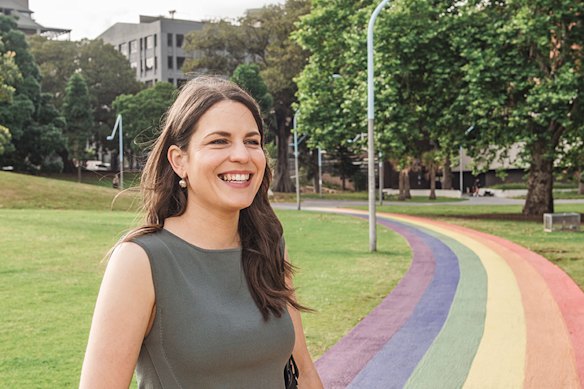
Natalia Krysiak wants Sydney to become a more playful city.
But Sydneysiders have a way of seeing problems as opportunities. Next month’s annual Sydney Summit, hosted by the Committee for Sydney with the support of this masthead, allows Sydneysiders to pitch big ideas to meet these challenges.
Green, liveable laneways replete with climate-proof drainage systems. Residential high-rise development, minus the car parks. Games and puzzles on every street corner. Small primary care clinics in every community, powered by rent-free spaces for GPs. These are four big ideas for Sydney’s neighbourhoods.
Living laneways
How can we climate-proof Sydney, increase housing affordability, and make sure our neighbourhoods remain liveable amid higher-density living?
Landscape architect and UNSW urbanism researcher Melissa Cate Christ proposes “living laneways” as one answer.
For Cate Christ, this means expanding laneway housing (granny flats), supporting community-led greening initiatives, upgrading laneway surfaces and implementing improved drainage through water-sensitive urban design and revitalisation through art.
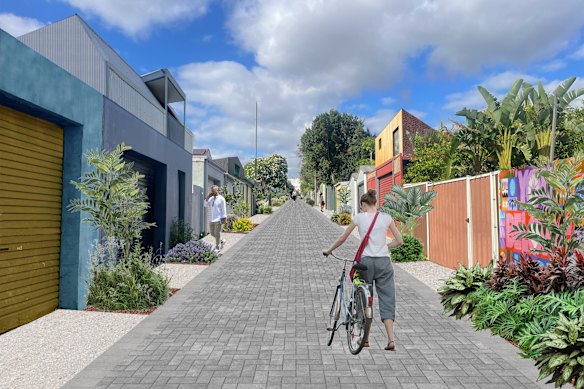
An artist’s impression of what a living laneway might look like.
Bringing living laneways to Sydney is not without its challenges, Cate Christ said. “We have multiple councils, and [each] have different rules. And there are multiple companies that build granny flats” she said, along with NSW Government legislation about secondary dwellings.
A collaborative effort involving local and state governments, developers, architects and urban planners, and the communities themselves would bring these living laneways to life.
Examining foreign examples – such as Chicago’s laneway project, “a municipally funded strategy where they do one laneway … per district, per year” - is crucial for learning how to implement living laneways, said Cate Christ. Melbourne also offers lessons. Whilst laneway activation there focused on festivals and nightlife, Melbourne’s “great study of greening laneways” would be useful.
Car-free residential high-rises
NSW could reach 10.1 million residents in the next 15 years, according to NSW Government estimates. Without reducing car dependency, we are headed for overburdened infrastructure and huge amounts of CO₂.
Landcom chief executive Alex Wendler proposes parking-free residential high-rise development as one solution. “When we remove the mandate for car parking, it on one hand reduces construction costs [and] speeds up delivery,” he said, “but it also breaks the cycle of mandated car parks leading to more cars, which then lead to more congestion”.
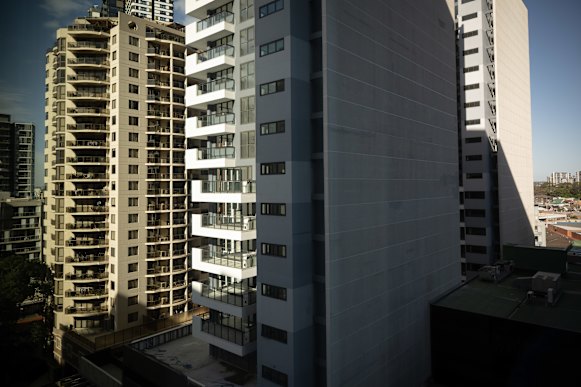
Imagine high rises in our city without car parking.Credit: Wolter Peeters
With billions of dollars invested in the expansion of public transport in recent years, Wendler believes now is the time to act.
“It needs to be a well-located area … well serviced by public transport, active transport, and amenities,” he said.
“It’s really for particular people,” he said, “people who prioritise location affordability over car ownership … people who embrace that idea and who want to live in a less-car dependent way.” When cars are needed, car-share arrangements could fill the gap.
Wendler pointed to Europe as an example of functional car-free development. Amsterdam, Berlin and Paris, he said, were good examples. “In Paris, they even converted … big roads into active transport corridors, where people walk and cycle,” facilitated by high-density, car-light development.
The world’s most playful city
Architect and play consultant Natalia Krysiak thinks Sydney should become “the most playful city in the world”.
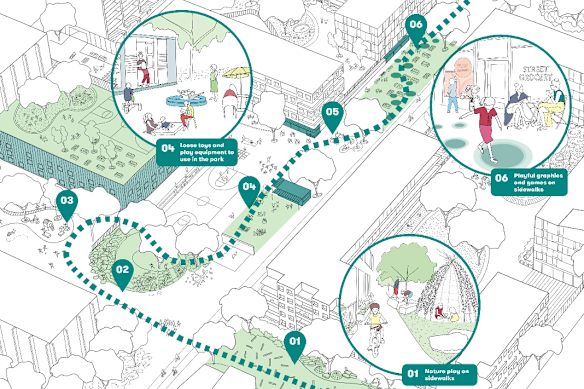
An impression of how a neighbourhood could be designed to incorporate playful spaces.
This would involve “shared public play opportunities”. Think council libraries building “a mini theatre … to create opportunities for acting out the books” and play-based gardening programs. It could even mean “games [and] puzzles … implemented in our public spaces,” such as bus stops and pedestrianised streets.
“Play is often seen as quite a frivolous sort of behaviour, something that we observe only in children,” Krysiak said. But, she said, play “really promotes physical activity, both in children and adults … we also know that it’s very good for our mental health.”
Play also combines “people of different ages, different socioeconomic backgrounds, different cultural backgrounds,” she said, “coming together to create … social connections”. This, Krysiak said, fosters social cohesion and innovation.
Krysiak has a three-point plan. First, devising a “play strategy” encompassing Sydney and its local governments and community groups. Second, “a few pilot play districts within the city” to create community-specific exemplars. Third is “creating a playful city toolkit – a sort of pre-approved toolkit of things that communities could do to improve their streets and their public spaces.”
Krysiak pointed to Barcelona as an example of a playful city. There, she said, intergenerational play spaces on street corners incorporate chess sets, comfortable seating, umbrellas, community gardens and playgrounds.
Free rent for GPs
An ageing population, increasing incidence of complex health conditions, and growing healthcare costs are straining Sydney’s primary healthcare system.
Alison Huynh, an architect who specialises in wellbeing and urban design, has a solution: free rent for GPs to set up clinics in urban developments. “When you actually look into the reasons why GPs can’t offer services,” Huynh said, “a lot of it comes down to their basic costs”.
Loading
Incentivising developers to give small spaces to GPs for free would reduce that burden, she said.
These spaces would increase “access to primary care in areas where populations are growing,” Huynh said. Additionally, “extended hours or part-time models that better reflect how today’s workforce operates” would make these rent-free clinics more accessible.
The rent-free clinics would also support car-free neighbourhoods, Huynh said, taking sick people off public transport by creating primary care within walking distance.
These clinics would be located “in spaces that you can’t put apartments anyway,” Huynh said. “They don’t have good orientation … they might be on the ground floor, they might in the deeper parts of a building,” she said. “So this is a low value space for developers anyway.”
Huynh said developers would also win: just as including pools and gyms adds value to an apartment building, a GP clinic on site could be a major selling point for a flat.
The Sydney Summit is on Friday, February 6, at the ICC.