3 months ago
37
3 months ago
37
Port Fairy residents knew they had a serious problem when discarded household goods began emerging from the dunes.
In 2012, rubbish started appearing on the beach as coastal erosion ate into the dunes and exposed an old tip site buried long ago.
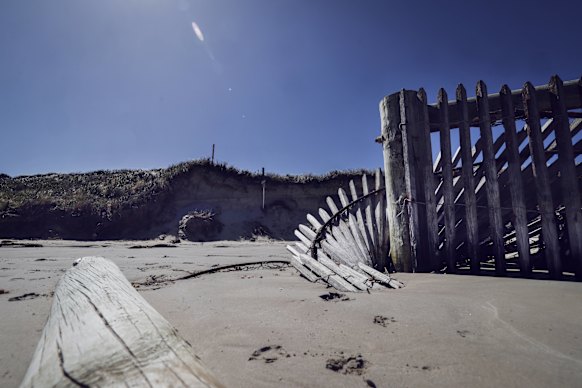
Damage caused by coastal erosion at Port Fairy. Credit: Joe Armao
Port Fairy resident Nick Abbott remembers old fridges and appliances, pieces of tin and lengths of wire turning up on the beach.
“The concern was that we were seeing the tip of the iceberg and soon the beach could be littered with unsightly rubbish,” he said.
The following year, Abbott joined other Port Fairy residents in measuring the impact of erosion on local beaches, using posts, rope and laser levels. In 2018, they began using drones, hoping to better understand the problem.
With the power of Southern Ocean waves and strong winds battering the shoreline, Port Fairy, in Victoria’s south-west, remains highly susceptible to coastal erosion, a challenge that is accelerating with climate change.
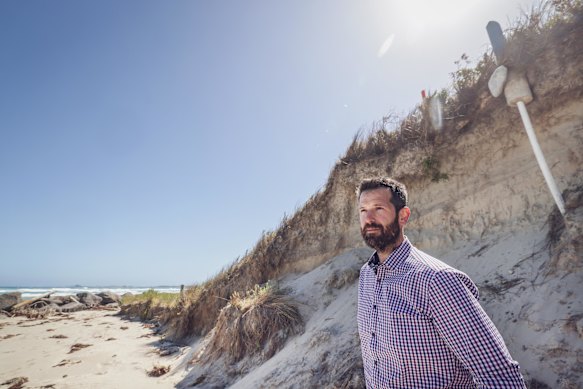
Deakin University’s Blake Allan at Port Fairy, where erosion has hit beach areas hard. Credit: Nicole Cleary
While Port Fairy is among the areas hardest hit by sea level rise, new research focusing on a stretch of beach in bayside Melbourne is providing a ray of hope. It shows human intervention can help to stabilise beaches in the face of coastal erosion, particularly when those efforts are in concert with the natural marine environment.
At another Port Fairy beach known as the night soil site, erosion uncovered waste including old toilet cans, some of which rolled down the dunes. But vegetation matting has since been installed to stabilise and promote vegetation growth.
Deakin University national coastal drone program scientific lead Blake Allan said the matting had helped protect the old night soil site. But erosion has continued to eat away at the dunes near the former tip site. A rock wall installed in front of the former tip has protected some of the dune but deflected energy from the waves, resulting in aggressive erosion on either side of the wall.
Allan has also been monitoring the effects of coastal erosion at Port Fairy and providing the data to policymakers.
“You can’t rely on memories. And we don’t want decisions to be based on one event, because those knee-jerk reactions are really just Band-Aids,” he said.
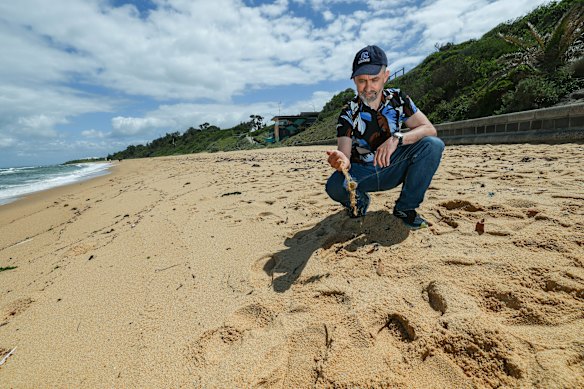
Coastal erosion expert David Kennedy in Sandringham. Credit: Joe Armao
Recently published research by University of Melbourne coastal geomorphologist David Kennedy found strategies for managing erosion at Sandringham on Port Phillip Bay had been largely successful in the past 20 years.
The peer-reviewed research, published in the Frontiers in Earth Science journal, examined the impact of human-made structures at Sandringham going back more than 140 years.
Initially, sea walls were built to stop the cliff eroding. Kennedy said there was wild fluctuation in erosion in the following decades at Sandringham until the 1990s, when a program of sand replenishment began and the rate of erosion then slowed.
In the 2000s, the installation of structures known as rock groynes, which extend into the water perpendicular to the shore, helped further stabilise the beach.
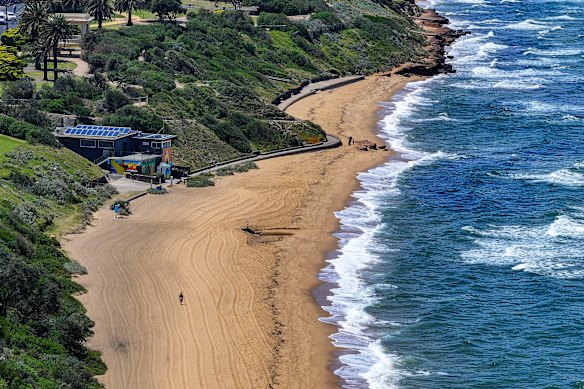
Sandringham beach from the air.Credit: Joe Armao
“What we want to do with the groynes is keep the sand on that beach for longer, because over time it’s moving from south to north. That’s where the sand is all going. It’s all ending up in South Melbourne over decades,” he said.
Kennedy described the movement of sand as a natural phenomenon, but protecting beaches and human-built structures behind them was part of the response to sea-level rise and climate change.
“We tend not to view landforms as dynamic systems. But I like to think of them like dogs’ tails – they’re constantly wagging.”
Loading
He said the more recent human interventions at Sandringham showed it was possible to save beaches by working with nature rather than building hard structures that risked exacerbating erosion.
Locations like Port Fairy, which are exposed to the raw power of the open ocean, would require a different management strategy to Sandringham, Kennedy said. Loch Sport in East Gippsland, Inverloch on the Bass Coast and Silverleaves in Phillip Island are other locations where coastal erosion is posing a serious challenge to communities and the authorities that manage those natural areas.
“It’s a human-modified world we’ve created,” Kennedy said. “We’ve got to work with what nature’s throwing at us to maintain the bits we love. If we don’t, we’re just going to have sea walls all the way along and no beaches.”
Start the day with a summary of the day’s most important and interesting stories, analysis and insights. Sign up for our Morning Edition newsletter.
Most Viewed in National
Loading