3 months ago
31
3 months ago
31
Opinion
October 19, 2025 — 4.30pm
October 19, 2025 — 4.30pm
Any moment now, international journalists will enter Gaza, and their photographs – raw, wrenching, undeniable – will burn into the collective human psyche.
The Jewish psyche, already shattered since October 7, must brace for another rupture. What comes next will remake our legacy as a people. As a psychotherapist steeped in intergenerational trauma, I believe this to be a moment of historical importance, one that invites us to preserve our humanity.
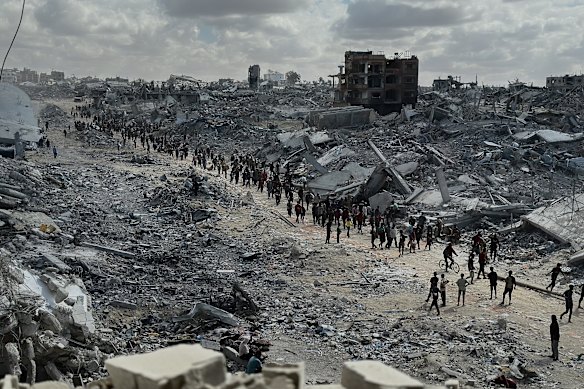
Palestinians return this week to the ruins of the southern Gazan city of Khan Younis.Credit: Doaa Albaz/Anadolu via Getty Images
For Jews, the trauma of October 7 will endure: Hamas’ live-streamed carnage and bloodlust, innocents slaughtered, hostages who felt like our own kin. Friends and strangers here who cheered, condoned or said nothing.
But if we are to protect our children from inheriting more pain, we must make space for another momentous task – a reckoning over the incalculable suffering inscribed in Gaza’s ruins.
The scale of destruction in Gaza will transcend politics. It will bypass ideology and strike the body directly, as a moral wound. Horror, anguish and confusion will flood in. For many, it has already proven too unbearable. Denial and blame, those oldest of defence mechanisms, have been employed as self-protection.
Intergenerational trauma is the transmission of unresolved pain across generations, carried in our waters, our bodies, our value systems. Decades of research show that what remains unspoken strains relationships and erodes our health. Every unprocessed grief seeks a vessel. If it’s not us, it will be our children. So let it be us.
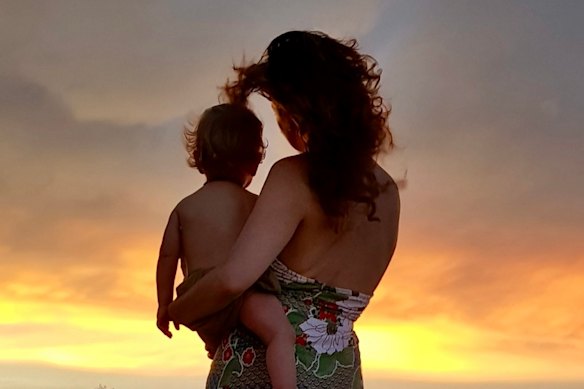
Ilana Laps. “This war not being my ‘fault’ will not spare me or my child from its shadow.”Credit: Mark Nussy
For three generations, Jews have been shaped by the legacy of the Holocaust; terror and erasure live in our nervous systems. In my DNA lives a 12-year-old girl, my grandmother, hunted through a Belarusian forest. Her mother, two months postpartum, runs out of breast milk; her newborn must not cry. Any sound could betray everyone they have left. That pain found its way to me, as these things do.
But we aren’t the only ones with inherited wounds. German journalist Sabine Bode coined the term kriegsenkel – war grandchildren – to describe those born into a legacy, not of complicity but of hidden grief and moral debt. In the American south, descendants of families who profited from slavery speak of guilt without memory. In post-apartheid South Africa, children of former regime supporters contend with a stained identity. In Australia, rage over Gaza is shaped, in part, by unprocessed guilt over Indigenous dispossession.
Loading
In my therapy practice, I sit with people generations removed from war who still carry its imprint. Inherited guilt can surface as relentless self-scrutiny, over-apologising or taking responsibility for harms never caused. Bodies brace for dangers long past, dreams reignite ancestral sorrow and an unconscious drive seeks atonement for what was broken before birth.
Silence, a protective response to unbearable suffering, is a precursor to intergenerational trauma. Taboo questions go unanswered, or are answered in ways that maintain emotional detachment. Over time, a troubled conscience settles into the body as trauma, distorting identity and limiting growth. Descendants carry unresolved histories, with no clear way to heal them.
I don’t want that for my child.
In this moment, our ability to metabolise vicarious trauma without retreating into denial or blame may be one of the most vital emotional tasks of our time.
But how do we find space to hold another people’s catastrophe in the midst of our own? Especially now, when Jews feel a real and growing existential threat across the diaspora; when my friends have been doxed, a workplace firebombed, and children I love harassed for their uniforms, their schools graffitied with hate? When I, myself, feel less safe than ever.
Loading
My answer: Years of listening to clients wrestle with moral dilemmas has taught me that healing begins when we allow painful truths to coexist. My heartbreak over October 7 and its aftermath of surging antisemitism cannot shield me from what lies buried in Gaza’s rubble. Horror over Hamas’ atrocities and the unspeakable two-year torment of hostages cannot justify mass starvation, nor the denial of aid or mercy. This war not being my “fault” will not spare me or my child from its shadow.
When the images pour in, and they soon will, the response will be primal. All we can do is wrest our legacy from the wreckage. No matter where we fall politically, in the face of Gaza’s unbearable reality it is not ideology that’s needed, but moral clarity. We cannot simply blame Hamas or Netanyahu. Our integrity will be expressed through our willingness to bear witness.
The story of October 7 matters profoundly, as does the Jewish story of thousands of years of persecution and exile. But ours can’t be the only story that matters, not after the devastation inflicted on the Palestinian people.
Without abandoning my own crisis, finding the resolve to hold Gaza’s cataclysm within my story hopefully helps my descendants stand steadier in theirs. Our children are not responsible for Gaza’s destruction, but as Carl Jung observed, what we resist persists. And what persists becomes our inheritance.
I will continue to reel from the agony of our newly released hostages. Very soon, I will also behold Gaza’s suffering in full. How I choose to face this will mark both my legacy and my child’s inner life.
Someone will shape how this moment lives on in the Jewish soul. In my family, let it be me.
Ilana Laps is a Melbourne-based psychotherapist and educator.
Most Viewed in World
Loading