3 months ago
20
3 months ago
20
Just over a year ago, girls’ private boarding school Frensham decided to ban smartphones in its junior high school, mandating the use of basic, old-school Nokia “brick” phones.
The switch was not without its teething problems as students, especially those in years 8 and 9, struggled for weeks to adjust to life without social media.
For year 8 student Lorelai Del Tufo, the biggest shift was losing daily access to Instagram messages and being unable to use FaceTime to call home. “Texting takes a lot longer on a Nokia. I also miss having that downtime of listening to music, or watching a movie on my phone.”
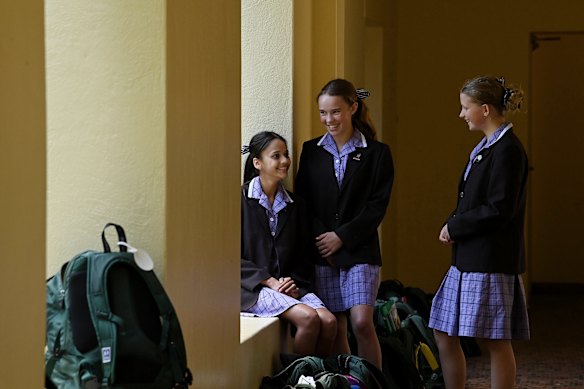
Frensham School boarding students (from left) Evi Gandhi, Hattie Snodgrass and Lorelai Del Tufo swapped their smartphones for Nokia bricks this year. Credit: Kate Geraghty
But the upside, she said, has been removing the temptation to sit alone after school, scrolling. Now she spends more time talking to friends instead.
In October last year, the Southern Highlands school told parents that it would ban smartphones for boarding students in years 7 to 9, allowing only so-called dumb phones with functions limited to calls and text. Phones are prohibited during the school day but can be used after school during set times, before being locked away overnight.
The decision came as debate was intensifying among the state’s boarding schools over how to manage students’ screen use, as the federal government unveiled plans to restrict social media for children under 16.
Loading
“We were seeing a deterioration in school community and the way girls were interacting,” said Frensham head Geoff Marsh.
“We were also dealing with the fallout from the mistreatment of each other because social media is fertile ground for bullying. The feedback from parents was we were letting them down by handing them free access to these apps.”
While most schools across NSW now have blanket bans on smartphones from bell to bell, boarding schools face the extra challenge of managing teenagers’ screen obsessions outside school hours. Last year, British boarding school Eton gave all year 9 students a basic brick phone, while St Edward’s School in Oxford added landlines in every boarding house for the first time in 15 years.
Marsh said that banning smartphones at Frensham led to better connection between students and expanded friendship groups.
“We haven’t had one online bullying issue in years 7 to 9 this year,” he said.
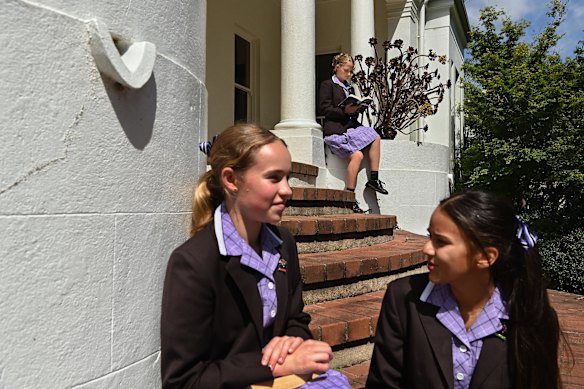
Year 7 to 9 boarding students at Frensham can no longer use a smartphone at school. Credit: Kate Geraghty
“They’re not rushing to get their phones after school so they can go on Snapchat or TikTok. They’re actually talking to their parents for 10 minutes, and then they’re off to do something else. Teachers also don’t have to struggle to get the phones off them.”
But the ban has come with frustrations, said Lorelai. “I think the year 9 girls found it harder because they had their phones and social media for longer.”
Her classmate, Evi Gandhi, said it was difficult to keep in touch with family overseas, who she used to chat with over WhatsApp. “There has been more homesickness, and I feel like I’ve lost contact with friends,” she said.
Another year 8 student, Hattie Snodgrass, said the ban came as a shock, though most students adjusted within the first weeks of term 4. Hattie misses “texting normally” and the “comfort of looking through photos” and FaceTime. “I think a lot of girls struggle without social media during the week,” she said, but less screen time means “the year has become more connected” and friendship circles have expanded.
Louise Boag, who has four children at the school, including a daughter in year 7, said the ban wasn’t as challenging as she had expected. “The whole year 7 group are doing it together and so that cuts out that fear-of-missing-out factor. It’s simplified life in a way,” she said.
With Australia’s social media ban taking effect on December 10, Boag said the phone ban at the school “makes it easier to support the bigger picture”.
Marsh said Frensham is now investigating giving students Nokia handsets or minimalist smartphones – similar to a Wisephone – with functions such as music and banking but no social media.
Loading
Students in years 10 to 12 are still allowed to have smartphones outside school hours, with limitations.
A Flinders University survey of 1500 students from five South Australian schools before and after phone bans found students reported more face-to-face social interaction and greater classroom engagement after the ban.
The study’s co-author, clinical psychologist Dr Marcela Radunz, said that post-ban, students were happier and reported a greater sense of belonging.
“It’s refreshing to see students picking up on these changes. They say things like, ‘Oh, my friends are actually talking to me now’,” she said, calling Australia’s ban a positive step, but noting “scepticism in terms of how it’s actually going to work and implementation”.
“Parents also tell me they want more education and resources on parenting kids in the digital age,” Radunz said. “You really need to allow kids to be bored, to play outside, to engage in imaginative play and to talk to each other.”
The Morning Edition newsletter is our guide to the day’s most important and interesting stories, analysis and insights. Sign up here.
Most Viewed in National
Loading