3 months ago
11
3 months ago
11
It’s not every day a story about a high school rugby game, played over a decade ago at Brisbane’s St Joseph’s Nudgee College, captures the attention of Hollywood stars Dwayne Johnson and Adam Sandler.
Then again, it was told by Jacob Elordi.
In a recent roundtable interview for The Hollywood Reporter, since viewed more than five million times, the Brisbane-born actor recalls the moment he broke his back playing rugby for the prestigious sporting school, cementing his path towards an acting career.
“The schools that I went to, and the environment that I was in, [was] sort of sports heavy, rugby oriented, you’re not really a person unless you play sport,” Elordi, now 28, explained.
“But then I broke my back when I was 16.”
Loading
A concerned Johnson, who made an early career out of hurtling his body across a professional wrestling ring, asks if it happened during a game. It did, but Elordi put the injury down to off-field antics.
He was lifting heavy weights “too early” and “squatting wrong”, he thinks. The pressure of his expanding body started fracturing the bones in his back. Unbeknownst to him, a routine tackle was all it took to break the bone entirely, shattering his football career.
Injuries are not uncommon among young rugby league and union players.
Data from the Australian Institute of Health and Welfare shows close to a quarter of a million Australians aged 15 and over played rugby in 2023–24.
Of an estimated 4,600 hospitalisations during that period, players aged 15-19 were most likely to be hurt. Across all ages, the most injured body parts were hip and lower limb; head and neck; and shoulder and upper limb, while overexertion accounted for about 335 cases.

Brisbane-born actor Jacob Elordi opened up about his experience breaking his back playing rugby, aged 16. Credit: Getty Images
Strength training was the actor’s eventual undoing, but when managed correctly and integrated in a holistic program, it can reduce the risk of injury. There is even evidence to suggest it can improve the bone health of adolescents.
But where is the line between sculpting a formidable young athlete and provoking injury?
Former rugby union player and sports scientist James Ambrosini has spent nearly 20 years scrutinising that question, shaping it into a program for young athletes.
Loading
Like Elordi, he spent his teenage years playing rugby in Brisbane. He had just made the Queensland under 15s team and was looking to move from St Laurence’s College to Nudgee when he broke his ankle at school camp.
“The camp instructor tackled me from behind after an intercept and broke the growth plate at my ankle,” he said. “I didn’t even know it was broken at the time.”
The injury healed and Ambrosini enjoyed a successful career, playing for the Brumbies Academy and making the Australian under 20s before moving overseas to play for Benetton Treviso and other international teams. But it was not the end of his run of injuries.
Between the ages of 17 and 20 he broke his hand four times, ruptured his left testicle, and dislocated his shoulder. The final straw was when he broke his thumb five days before the Junior World Cup teams were selected for Australia and Italy.
He puts some of it down to the bravado of youth: “Being a young boy, I wasn’t really fully mature enough to handle the stress mentally and physically.” But he also blamed a lack of support and close mentorship to help him understand how to train and treat his body.
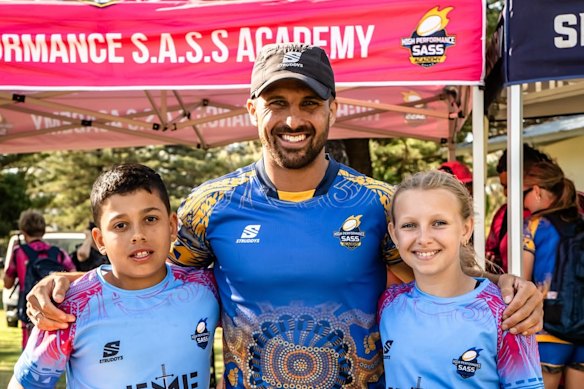
Former professional rugby union player James Ambrosini now runs an academy for up-and-coming athletes.Credit: @sass_academy_au
Ambrosini eventually applied his career learnings into founding High Performance SASS Academy, which helps young athletes hone their skills on and off the field. This includes strength training – but under a tight purview.
“The main focus with young athletes, before [they lift] too heavy too young, is to get the technique down pat before you put any sort of weight on your back or hold any sort of weight,” he said.
“First you’ve got to build a stable base, and that is through core and unilateral strength, learning to understand your body through mobility and flexibility for at least four to eight weeks. And then you move into building muscle mass.”
Loading
The temptation to add muscle to Elordi’s nearly two-metre tall frame would have been understandable.
Ambrosini remembers training hard in his younger years in a bid to expedite his professional career. Now he advocates patience as a necessary virtue.
“Lots of young athletes are very impatient, and they think what they see on Instagram, especially now, is what they should be doing, but their bodies are still developing. There’s a lot of physiological changes and hormonal changes,” he said.
“It all takes time, and it’s important that young athletes, especially rugby union players … [take] a different and more patient perspective.
“If I had started early doing the right structured training, I’m sure I would have been in a better position than where I ended up [with injuries].”
Start the day with a summary of the day’s most important and interesting stories, analysis and insights. Sign up for our Morning Edition newsletter.
Most Viewed in National
Loading