3 months ago
9
3 months ago
9
The sewing machines in the community room at the North Melbourne public housing tower on Melrose Street whir to life. Resident Amparo Collazos, a 78-year-old former public health worker originally from Colombia, is teaching her neighbour, retired architect Janis, how to make himself a strapping waistcoat.
It’s Thursday morning; the room smells of espresso and doughnuts, filled with gentle chatter between tenants and neighbours visiting to make clothes.
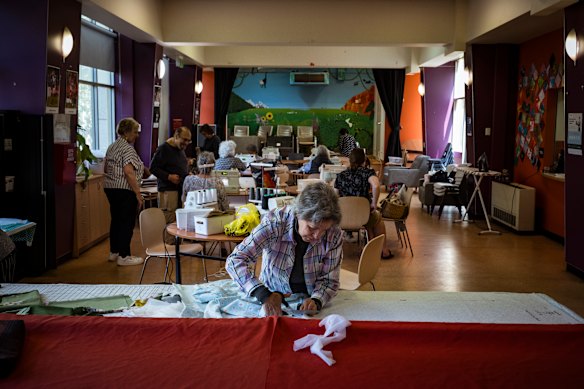
Amparo Collazos cutting fabric during the weekly sewing class she set up. It’s one of the many activities available to the tower’s elderly residents that provides them with a sense of community.Credit: Chris Hopkins
Collazos built this community. When the nearby community centre was demolished and the sewing group displaced, she applied for a grant, bought overlockers and sewing machines, and restarted the group inside the tower.
“We feel here [almost like] family ... there’s a sense of support,” she says. “Sometimes we say ‘she’s my sister’ ... because we feel worried about each other.”
On any given day, something is happening in this room for residents: a hot lunch, a singing group, bingo or mahjong games, or a late-afternoon film or TV screening (the residents are currently bingeing on historical-drama The Chosen).
This is the little-known reality of some of Melbourne’s high-rise public housing estates. Few people know that 30 per cent of the 44 towers slated for demolition – 13 of them across 12 suburbs – are dedicated to older tenants only.
They are part of the decades-old, state-funded Older Persons High Rise Program (OPHRP), designed as a “gold standard” model of care to help vulnerable older Victorians age in place.
Many more elderly residents live “invisibly” – scattered throughout the 31 general-needs, “family” towers or in other low-rise, 55-plus units across Melbourne, often without access to the tailored support the OPHRP provides.
Now, these residents and their advocates fear the state government’s demolition plan for every public high-rise across Melbourne will not just displace thousands of the city’s most vulnerable elderly people, but also lose this proven support system with no clear answers on what, if anything, will replace it.
“A lot of people are going to be quite bereft,” says St Kilda tower resident Royal Abbott, 73.
“I can think of a few neighbours that will be pushing up daisies quite soon after this because it’s going to be too much for them.”
‘Like winning the lottery’
For many residents of these towers, a unit was a lifeline.
Abbott describes getting his flat in 2016 as “like winning the lottery”. At 64, his life was spiralling. He had been made redundant, lost his rental, and was living in a friend’s bungalow. Then, his 32-year-old son, Max, died of a heroin overdose.
“I just buckled,” says the drug and alcohol community volunteer.
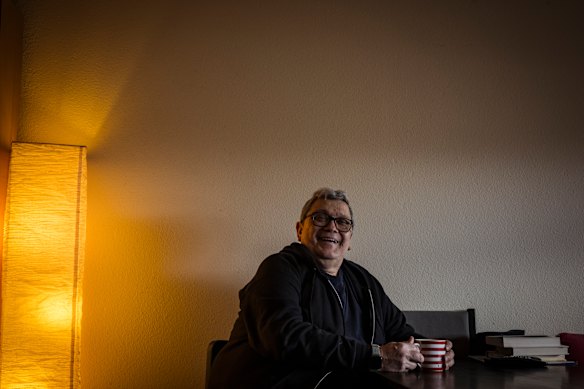
73 year-old Royal Abbott lives in the public housing towers at 150 Inkerman Street, St Kilda.Credit: Chris Hopkins
A housing worker at Port Phillip Council quickly helped him secure a one-bedroom flat at 150 Inkerman Street in St Kilda. He was safe, secure – a guaranteed lifetime rental with a rent (at the time) of less than $100 a week
On the other side of the city, Hank Ferguson, 60, found sanctuary in 2022 in a Northcote tower for older persons. It was his escape from homelessness after a breakup that left him shouldering a $250-a-week rent alone in an “atrocious” private rental.
He was surprised and appreciative of the quality unit offered by Darebin Council.
“I was like, ‘Wow, the windows aren’t rotting! It hasn’t got black mould!’,” the community radio broadcaster says. Like most of the towers, his flat has concrete walls. He plays his accordion late without disturbing neighbours.
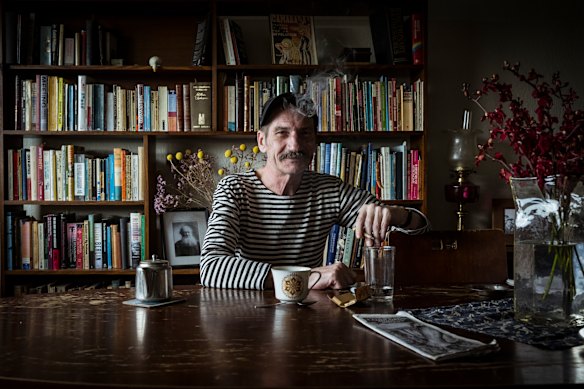
Ian ‘Hank’ Ferguson at his home in the Northcote public housing towers. Credit: Chris Hopkins
He rejoiced over the thought that he may never have to move again. “The insecurity of rentals is terrible,” he says.
Ferguson and Abbott were among dozens of older residents to make submissions to a parliamentary inquiry into the redevelopment plan earlier this year. A non-government-controlled upper house committee has been tasked with teasing apart the rationale for the controversial demolition plan, announced by former Premier Daniel Andrews in his final days in office.
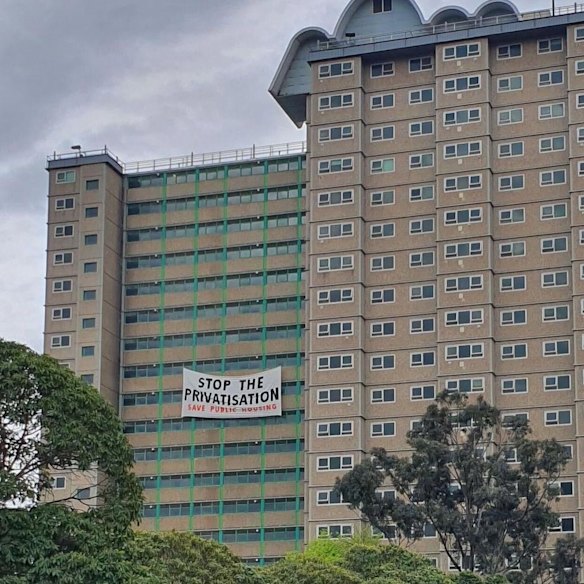
The sweeping plan involves progressively moving 10,000 residents, razing all 44 towers, and leasing the public land to private consortia for 40 years. The sites will be rebuilt with a mix of private rentals and “community housing” – properties owned and managed by not-for-profit organisations rather than the state.
So far, the only traditional public housing confirmed to be rebuilt is a pair of red-brick towers in Carlton, for which the federal government has committed separate funding.
Loading
A debate has raged for two years about whether it would be cheaper and less disruptive to build on the vacant land on the estates and refurbish the existing towers. The government continues to refuse to release its cost-benefit analysis, but is adamant that the towers aren’t worth salvaging and emptying the estates, razing them, and rebuilding with the private sector is the best path forward.
Shadow Housing Minister Richard Riordan, who has called the redevelopment program “a very expensive, slow and dubious plan,” said the Coalition would seek to “renovate, refurbish and repair the current housing stock … subject to having access to verifiable condition reports”.
The fears from residents and advocates about the plan are multifold: less secure tenure in community housing, increased utility costs, loss of dedicated aged care support, and most crucially, the enormous stress of upheaval and severing of connection from friends, medical facilities and routines in late life.
The inquiry heard that tenants of the older persons’ towers are most at risk, in what is generally considered a vulnerable cohort already in public housing.
In the two years since the plan was announced, there has not been one mention of the older persons’ towers by ministers or Homes Victoria. Asked by The Age this week, the state government gave no official indication it would keep the program.
Fiona York, from the Housing for the Aged Action Group, told the inquiry that many older tenants have no family support or assets. She fears many “will not survive the move”.
“It’s just unsafe policy to be talking to people about ... moving them out of their homes when they’re in their 80s and 90s, and they’ve lived there for 20, 30, 40 years,” York said.
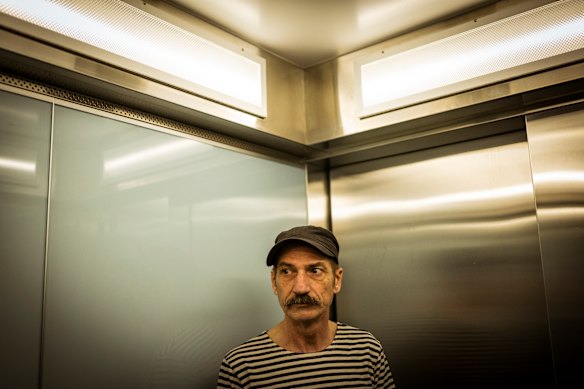
Hank Ferguson rides the lift at Holmes Court in Northcote.Credit: Chris Hopkins
One of the oldest tenants in the program is 91-year-old Me Hui Gong, who has lived in her North Melbourne flat for 20 years. She retired in China and came to Australia to be with her daughter and help care for her grandchildren. At first, she lived with her daughter, but later moved into this building.
Her one-bedroom flat – which, like most in the older persons towers, is a renovated bedsit where two flats became one – is the home she recovered in after refusing end-of-life care. Last year, she was diagnosed with cancer, and doctors at the Royal Melbourne Hospital told her she was too old for surgery.
“Gong insisted that she must have the surgery,” her Mandarin translator says. She survived it, but a severe allergic reaction to medication led to liver and kidney damage, and she was sent to the ICU.
She again refused to give up, asking her daughter to take her home. In her flat, unable to even open her eyes, she was determined to “live until 100 years old” and had her daughter play Chinese dance music to “keep her dancing... in her mind”.
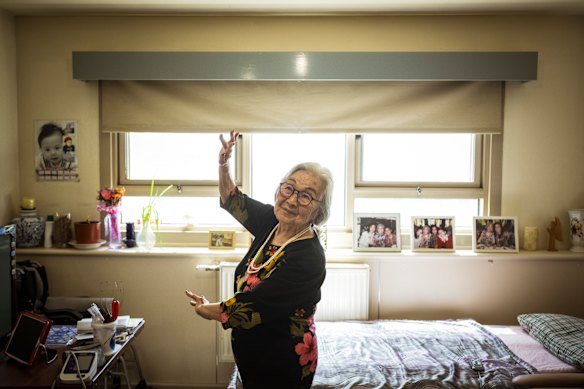
91-year-old Me Hui Gong, dances in her living room in her public housing unit, North Melbourne.Credit: Chris Hopkins
A year later, she does two to three hours of exercise every day, including “catwalks” in the hallway of 159 Melrose Street.
This recovery, she says, was only possible because the older persons’ program provides a unique, wrap-around support system.
The buildings are staffed by on-site workers from social service providers, such as the Salvation Army and Better Health Network.
“The support is very valuable,” Gong’s translator says. “They can ask the staff member to translate some letters, help with form filling and booking for GP appointments”.
Crucially, the towers are intended for elderly residents only.
“It’s much safer,” says Gong. She said she was “very concerned” about moving into a general-needs building, worrying that “teenagers... may bully the residents walking with a walking aid or trolley”.

Me Hui Gong recovered in her flat after she had surgery. Credit: Photograph by Chris Hopkins
‘Becoming toxic’
Those fears are already a reality for Bill McKenzie, a 17-year tenant of the Albert Park tower. He says it feels like life at his beachfront tower is going downhill.
McKenzie, 74, describes himself as a “burnt-out alcoholic wreck” when he moved in during 2007. The tower was a “caring, loving environment” with full-time caseworkers who helped stabilise his life.
But in recent years, he says the system has been “cut to ribbons”. Security patrols have been reduced, and security cameras in his building have not worked for 12 months, he says.
A Victorian government spokesperson – responding on behalf of Housing Minister Harriet Shing and Homes Victoria – flatly denied this, stating: “We take all resident concerns, incidents and safety matters extremely seriously. There has been no reduction in the level of security at any of the 44 high-rise towers.”
At the same time, McKenzie says, Homes Victoria has been placing younger residents with complex drug, alcohol, and mental health issues into the formerly tranquil older persons’ building.
In January this year, a younger man with severe mental health issues was placed in the building without adequate support, according to McKenzie.
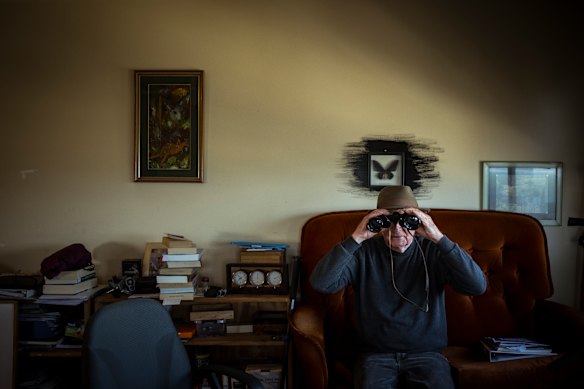
74 year-old Bill McKenzie watches for birds on Albert Park beach from the living room of his home in the public housing towers at 150 Victoria Avenue, Albert Park.Credit: Chris Hopkins
“At the start, that person was more of a danger to himself,” McKenzie explains. But recently, the resident tore a pipe off a bathroom fitting and chased someone down the street, threatening to kill them. Police have advised McKenzie and his elderly neighbours to take out intervention orders.
The state government spokesperson did not respond to questions about the case, nor the broken security cameras.
Former Port Phillip social worker Kate Incerti confirmed to the inquiry that funding for the older persons’ program had been reduced just when support was most needed.
“It’s becoming toxic,” McKenzie says. “It’s almost like ... they decided to drive everybody out.”
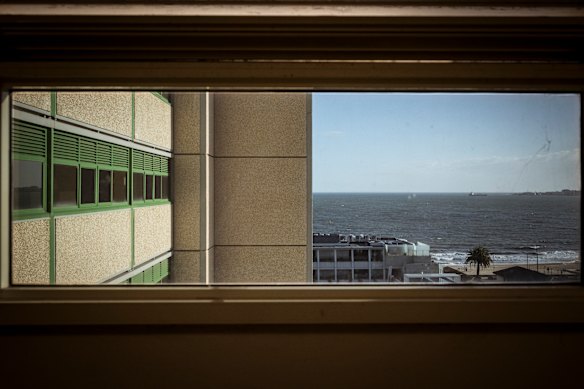
The beach views from the public housing towers at 150 Victoria Avenue, Albert Park.Credit: Chris Hopkins
The plan rolls on
While older residents wait, the wider demolition moves ahead. Two red-brick towers in Carlton are draped in black sheeting as cranes begin the brick-by-brick dismantling. Residents have begun being moved out of towers in Richmond and South Yarra.
Two towers in Flemington and one in North Melbourne (the next three towers to come down) are almost empty, with pressure ramping up on the handful of residents yet to accept a relocation offer. Final eviction notices are looming for the handful of holdout residents at 12 Holland Court in Flemington, specifically.
Those hold-out residents are pinning their hopes on a soon-to-be handed down judgment from the Court of Appeal, which will determine the fate of a long-running class action that argued the demolition decision was unlawful and breached human rights. The original class action was dismissed for the second time by the Supreme Court in April.
Down at the Flemington estate, a five-day-a-week picket line protest has formed to disrupt early works. It was here that Hank Ferguson was arrested in August after locking his foot to a drilling rig for four hours.
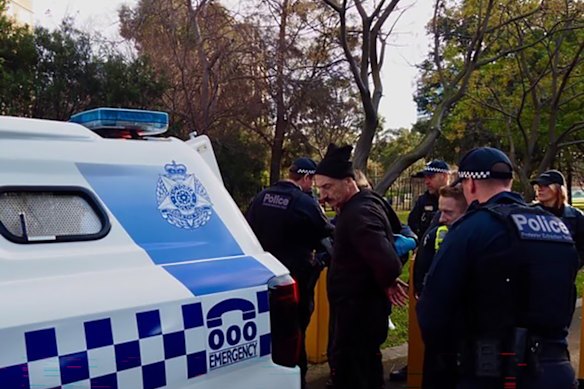
Hank Ferguson being arrested on August 4 after locking his foot to a drilling rig at the Flemington estate for four hours.
He believes that as a beneficiary of these towers—which were born from the slum clearance projects —he is morally bound to protect what they stand for.
“If it wasn’t for this kind of resistance, this building would not exist,” he says, referencing the anti-eviction struggles of the Great Depression.
The state government recently released tenders for the 30-year project, and planning is beginning for the third batch of towers, including Dorcas Street in South Melbourne. It is unclear when the older persons’ towers will be redeveloped. When asked by The Age, the government gave no timeline for the buildings.
Protest action at one of the first towers to be demolished, at 12 Holland Court on the Flemington estate, on October 31.
“Social housing residents deserve homes that they can be proud to call their own - homes that are modern, accessible, energy-efficient and well-connected to schools, healthcare and public transport,” the spokesperson said.
“The towers redevelopment will triple housing capacity across the sites, and the rights and rent settings of all relocating residents will remain the same - they will also have the right to return based on their ongoing eligibility and needs.”
Asked if the Coalition would retain the program, Riordan said, “credible and well-resourced ageing in place policies are better for residents and in the long run save government money”.
Greens housing spokesperson Gabrielle de Vietri says the government has “no respect” for this cohort’s vulnerability.
“Older people deserve peace and stability in their home, but Labor is uprooting them,” de Vietri says. “Labor doesn’t care about the harm they are causing ... They’re more concerned about cash for their property developer mates.”
For the thousands of elderly residents in the 13 towers, political fights over the rationale of the program are secondary to a terrifying reality.
Bill McKenzie says several residents have told him they would “possibly do themselves in” rather than move.
“They’ve come here from hard times ... and that’s being taken away,” he says. “And then you get the memories coming back to you ... the demons coming back to haunt you.”
Know more about this or another story?
Reach Rachael Dexter securely via ProtonMail (end-to-end encrypted) at [email protected] or message her on Signal at rachaeldexter.58.
Start the day with a summary of the day’s most important and interesting stories, analysis and insights. Sign up for our Morning Edition newsletter.