3 months ago
6
3 months ago
6
Opinion
November 17, 2025 — 7.30pm
November 17, 2025 — 7.30pm
This time, the contest isn’t just about who leads; it is a struggle over what the party stands for. And a new leader won’t fix a party that has forgotten what it stands for. The problem is the horse, not the jockey.
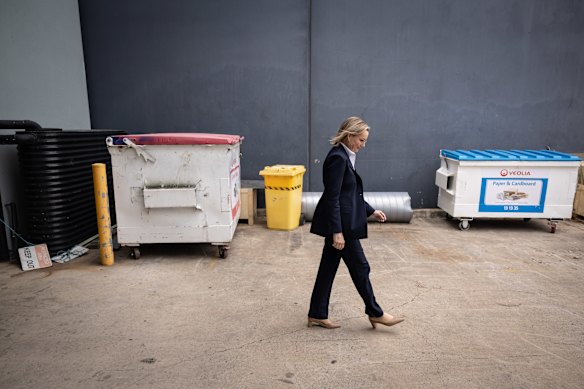
Opposition Leader Sussan Ley visits the Marley Flow Control manufacturing facility in Emu Plains.Credit: Wolter Peeters
Political parties do not collapse in an instant. They are eroded – slowly, then suddenly – when they stop reflecting the country they seek to lead. The United Australia Party learnt this lesson in the 1940s as its refusal to adapt hollowed it out from within. Robert Menzies tried to rescue it but ultimately concluded that renewal required starting again. He built the Liberal Party on the insight that a party must speak to modern Australia, not as a nostalgic projection of what it used to be. That is the choice confronting the Liberal Party today: renew or expire.
At its best, liberalism has always rested on confidence – confidence in people, in institutions, in enterprise and in the capacity of Australians to meet change with optimism rather than fear. This is the tradition that led Australia through post-war reconstruction, that championed free enterprise and individual dignity, and that placed women’s equality and migrant opportunity at the centre of national progress.
But liberalism, properly understood, is not self-perpetuating. It must be renewed with each generation. And here the party risks drifting away from the very principles that once made it a natural party of government. The country is moving towards industries that will define the next century, workplaces and public institutions shaped equally by women, an economy driven by innovation, skills and global competitiveness, a society enriched by migration and towards a conservatism that steadies rather than inflames. The question is whether the Liberal Party moves with it – or stands still and slowly shrinks around an ever-narrower core.
The path back is neither mysterious nor radical. It requires returning to the basic insight that a party must reflect the country it wishes to lead. If it does not, it will no longer be a party of government, only a protest movement. This is not a threat. It is a foreseeable political consequence.
Loading
First, the party must seek to govern for the economy we are moving into rather than pining for one that no longer exists. The clean-energy transition is not a cultural argument but an economic one. Global capital has already moved, and nations that seize this moment will become export superpowers; those that treat it as a culture war will be left behind. Believing in these facts is not left-wing – it is liberal.
This debate should not be a zero-sum game between energy affordability and net zero. Reducing power bills matters enormously to households and businesses, and Australians are right to demand scrutiny of how public funds are spent. But it is misleading to suggest net zero is driving up prices; the real pressures come from ageing coal plants, global fuel volatility and deferred investment.
The transition is the only durable pathway to lower prices because it replaces exposure to volatile fossil-fuel markets with increasingly cheaper domestic energy. A serious debate will ensure the transition is delivered efficiently, fairly and in the national interest.
Second, the party must embrace the opportunities inherent in the transition. If Australia wants to attract the next wave of technology, advanced manufacturing and energy-intensive industry, it must present a credible, durable policy framework. A party that vacillates or slides into populist obstructionism will find not only that it loses inner-city seats permanently but that regional Australia misses out on the industries that could secure its long-term prosperity.
Third, the party must respect women’s autonomy and equality. This is not optional. A party that signals ambiguity on women’s rights, safety or reproductive autonomy will lose the trust of women – and once lost, that trust is extraordinarily difficult to rebuild. Menzies understood that women were the backbone of social and economic life; modern Australia demands that recognition be backed by policy, not sentiment.
Loading
Fourth, the party must champion our institutions. Courts, universities, the public service and scientific agencies are not enemies to be subdued but pillars of a democratic society governed by law. When a party drifts into performative hostility towards its own institutions, it trades governing credibility for short-term applause.
Fifth, the party must affirmatively welcome migration. Migration has built Australia’s prosperity and deepened its social fabric. If the party signals ambivalence or hostility towards migrants, it fractures its coalition of voters and invites a new centre-right alternative to fill the vacuum.
Finally, the party must resist the lure of culture-war populism. Modern conservatism is steady, not reactionary; prudent, not paranoid; unifying, not exclusionary. A party consumed by culture wars loses the ability to speak to the mainstream and becomes captive to its angriest voices. That is the road the UAP travelled.
If the Liberal Party rejects this path, the consequences are not hypothetical. It will lose inner-city seats permanently. It will fracture its coalition of voters. It will alienate women and young professionals. It will become a regional grievance party rather than a national governing force. It will invite the emergence of a new centre-right party to occupy the space it once held.
But this trajectory is not inevitable. The crisis is real, but it is fixable – though not indefinitely. Renewal requires clarity and a return to the liberal temperament that built the party in the first place. It means choosing evidence over sentiment, opportunity over nostalgia, modern conservatism over populism, and national leadership over internal theatrics.
The country is not waiting. The question is whether the Liberal Party is willing to move with it.
Jane Buncle is a barrister, a member of the Administrative Committee of the NSW Liberal Party led by The Hon. Nick Greiner AC, and a member of the Future Reform Commission for the Liberal Party of Australia led by Senator James McGrath.
Most Viewed in National
Loading