
 4 months ago
76
4 months ago
76
10 minutes ago
Zoe KleinmanTechnology editor

 Reuters/Vicki Behringer
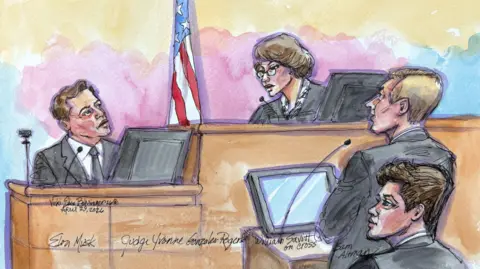
The colourful California trial put the men jostling for power at the top of the AI industry on full display.
Even though Elon Musk essentially lost on a technicality, there's a clear signal from the verdict that making lots of money from AI and competing fiercely with rivals is simply business.
The industry tries sometimes to display a united front, especially when it comes to safety, research and inclusivity.
But this case served as a powerful reminder that none of the AI giants are charities: and don't have to be, even if they once said otherwise.
Cracks in the façade of industry collaboration for the sake of humanity have been exposed before.
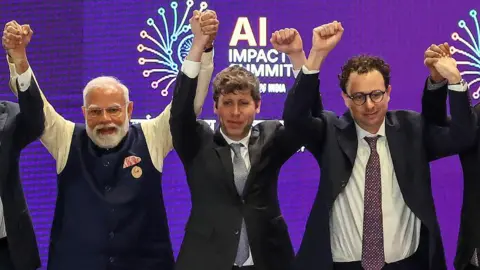
In February I was in India for a global AI Summit, where host Prime Minister Narendra Modi orchestrated the world's tech leaders to hold hands on-stage.
Sam Altman and Dario Amodei, once colleagues at OpenAI and now bitter rivals, found themselves side-by-side.
But this time, they pointedly clenched their fists into tight balls to avoid touching one another.
Similarly "petty" drama during the trial in Oakland, California these last weeks has helped lift the veil on the AI sector - and the huge egos of the men at the heart of it jostling for money and power.
Nobody came out of it looking particularly heroic.
Some also speculated that OpenAI could not afford to lose.
The company has burned through huge volumes of investor cash and recently hired a chief revenue officer, tasked with helping it to raise its own money.
Prior to the verdict, one economist predicted OpenAI had a 50% chance of going bust by 2027: not having to pay billions of dollars to Musk in damages may help lengthen those odds.
 AFP via Getty Images
AI bosses turning from friends to foes amid fierce AI rivalry - symbolised with Altman and Amodei's refusal to hold hands at the Delhi AI summit - has become a hallmark of the sector in recent years.
But he's also very loud and he does bear grudges: he will undoubtedly continue to swing punches at OpenAI and attempt to embarrass it from his social network X.
However while Musk and Altman have been focused on each trying to prove themselves the worthiest custodians of AI in court, their rivals have raced ahead.
Meanwhile Google, whose AI progress prompted Musk, Altman and others to launch rival OpenAI in the first place, is embedding AI across its popular services at-pace.
'Petty' execs and 'weird drama'
On the whole, this case showed there is still immense value in AI.
But it also exposed some of the immense egos driving its development.
"The trial served as a reminder of how much the future of AI still depends on a remarkably small group of powerful tech figures and their personal rivalries," said Sarah Kreps, director of the Tech Policy Institute at Cornell University.
She added its conclusion on a technicality "leaves a lot of questions and debates unresolved," such as how highly capable AI systems are governed and who reaps their economic benefits.
It also highlighted "not just a dispute between Musk and Altman, but a broader disconnect between the people building these systems and many of the people increasingly expected to live and work alongside them," Kreps said.
"Right now the brand of AI has just been trashed and this certainly doesn't help," she said - noting widespread mistrust of the tech, particularly among young people.
"When you look at these testimonies of people who are very petty, there's a lot of weird drama, obsession with money... someone having two babies with Elon Musk [and] didn't tell the board - the whole thing feels weird and dramatic."


















































