3 months ago
27
3 months ago
27
″The police called me and said: ‘Your husband’s been arrested’. Nothing can prepare you for that.”
When Alan Yazbek was photographed and arrested in late 2024 at a pro-Palestine rally in Sydney’s Hyde Park, brandishing a handmade sign featuring a swastika and the words “Stop Nazi Israel” in the colours of the Israeli flag, his wife, Rebecca Yazbek, had to make some very quick – and public – decisions.
The interior architect was suddenly running a multimillion-dollar group of restaurants, one of which had recently been awarded New Restaurant of the Year by the Age Good Food Guide. Just three weeks earlier, her head chef of 11 years, Jacqui Challinor, had given notice.

The timing could not have been worse. “I lost Jacqui and Al on the same day for completely different reasons. So it was really finding my voice very quickly,” says Rebecca, who had spent the past decade building the business with her husband. “Within the space of 24 hours, it was over.”
On Sunday, October 6, 2024, 10,000 people gathered at the protest. During that rally, Al was arrested and charged with knowingly displaying a Nazi symbol in public. It has been illegal to display the swastika in NSW since 2022. “He didn’t know that the symbol he used was illegal,” says Rebecca, who did not attend the rally.
The night before the rally, Rebecca was out to dinner with friends. She says she had no idea what symbol her husband was painting on the sign, which he had made while she wasn’t home. Had she known, she says, she would have stopped him from leaving the house with it.
“I had some very close Jewish friends send me the picture, saying: ‘Please tell me this isn’t Al’. So, that’s how I found out about it. And then the police called me and said: ‘Your husband’s been arrested’. There’s nothing that can prepare you for that.”
By the following Tuesday, Al, who has worked in hospitality for 30 years, was publicly out of the Nomad Group (he remains a shareholder), but the damage had been done. “For such a smart person, to not understand the consequences of your actions, I’ll never understand. But he thought he was a civilian with a right to free speech.”
After the incident and before sentencing, Al Yazbek flew to India to stay in an ashram, and Rebecca stayed in Australia to deal with the aftermath. G.H Mumm pulled their partnership with their Melbourne restaurant Reine & La Rue. Law firm Arnold Bloch Leibler also confirmed to this masthead that it would no longer book corporate or work events at the two-hatted restaurant. Investment bank Goldman Sachs cancelled a Melbourne event that was scheduled with the Nomad Group. Upon the news, the Good Food Guide took away the Nomad Group’s hats. “It was a shitshow,” says Rebecca.
On Tuesday December 10, Yazbek pleaded guilty to the charges and was granted conditional release for 12 months.
Yazbek, who had been silent until his plea, apologised.
“I apologise unequivocally for my actions at the demonstration on Sunday where I carried a sign that is deeply offensive to the Jewish community,” the then-director of Nomad group said in a statement.
“You can be sure that [I] will do all I can to regain the trust of my wonderful staff, our loyal customers and the broader community.”
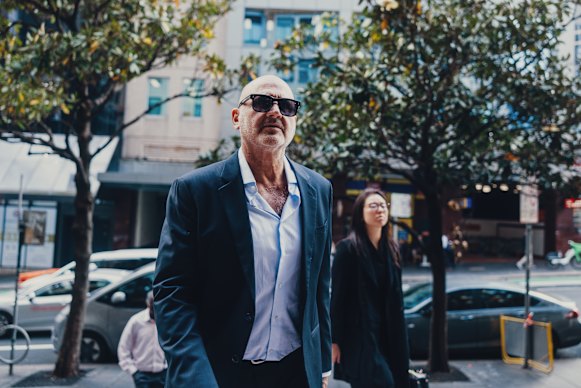
But Rebecca had to do what was best for the business – which, she says, was to remove Al.
“I was very thankful that the media didn’t chase my children or weren’t outside my house,” she says, adding she experienced feelings of PTSD off the back of it all.
“If I had accepted behaviour that didn’t meet respect and excellence, as a company director, I would have been failing my own values,” Rebecca says.
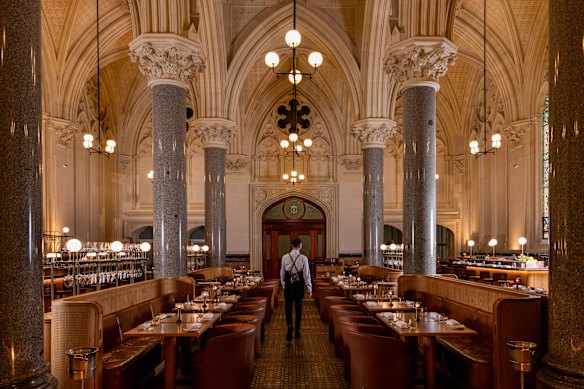
Opening Reine & La Rue (the Age Good Food Guide described the restaurant as “gorgeously grandiose”) forced the business to grow up. Until then, they had run the easygoing, Mediterranean-inspired Nomad restaurants – one in Surry Hills in Sydney, and one in the Melbourne CBD.
But taking a lease at a heritage site and going from 200 to 300 staff pushed the Yazbeks into different strata, offering headline-grabbing dishes in a grand old former stock exchange building. It was a cathedral of opulence, offering $240 seafood platters, rare sturgeon roe at $420 for 30 grams, and a one-kilogram David Blackmore wagyu rib-eye for $450.
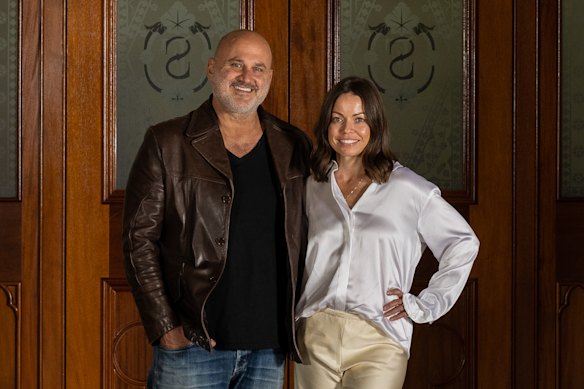
The one question that kept running through my mind through this interview was: how can a marriage survive something like that? When I asked Rebecca, she told me, without missing a beat or moving a facial muscle, that they remain happily married. “[Al] went through a really dark phase,” she says. “He’s not one to shy away from difficult conversations. But to put everything at risk like that ... he still can’t reconcile that he did that part.”
How that delineation between business and personal worked at first is another story. “Well, there was a lot of anger. To be honest, he was shocked at the backlash. [At the time] I said: ‘This is going to be horrific’. And he said: ‘No, no, I’m nobody’. But [Reine & La Rue] had just won [Age Good Food Guide] New Restaurant of the Year.”
To this day, Rebecca still receives missives from diners telling her they won’t be supporting the company. In the month following the arrest, Rebecca estimates a 10 per cent dip in revenue, which she said felt enormous at the time. For context, the average price of a meal at the 150-seat Reine & La Rue is about $300 for two. At Nomad Melbourne, which seats 100 at maximum capacity, it’s roughly $150.
“I don’t need everyone to come to my restaurants,” she says. “It is a business that relies on clientele and I dealt with it as gracefully as I knew how to.”
When asked whether diners have lost faith in the broader business, Rebecca says: “I think diners saw somebody that did the wrong thing, and apologised for it. They don’t have to accept that apology. They don’t need to agree with it.”
She says telling her staff was one of the hardest things she’s ever done, but believes the business is in a better spot now, with a clear decision-making process and a management hierarchy that essentially begins and ends with her.
Keen to change public perception of the Nomad Group post-trial, the company rebranded and renamed itself Edition, an empire backed financially by the Yazbeks. And with it, a set of non-negotiable rules of engagement.
“Respect, always. Excellence in everything. There’s a no-tolerance policy for sexual harassment. We have dry venues – no ‘staffies’. We’ve got a lot of family people. It’s ‘come to work, do the work as best you can. And then when you’re not at work, we leave you alone’. You have to protect everyone that is under your employ.”
A year down the track, Rebecca is more confident in her ability to run the business. “I have had a lot of time to reflect,” she says. “I think it was very easy for people to write me off, because I’m not a chef. I don’t have a background in hospitality. So it was very easy for me to not be seen as a strong figurehead.”
She describes her leadership style as inclusive and direct. She and her husband clashed early on because, she says, he wasn’t very good with people, favouring systems and operations over relationship management. Not having a hospitality background meant she could write her own rules.
This masthead asked Al Yazbek what he thought about how his wife has run the company since she took control over a year ago. He declined to comment.
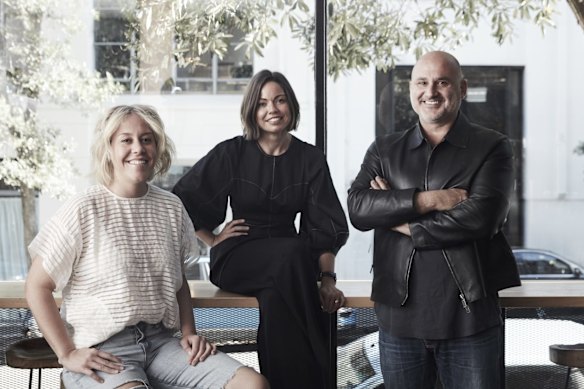
“I definitely manage differently,” says Rebecca. “I can’t compare because I haven’t worked in other hospitality businesses. But I remember even the differences between Al and I when we started. He’s male, he’s seasoned, he has never worked for anyone else … He doesn’t take no for an answer.
“I was like, ‘I don’t want to manage like that. I’m not a yeller. I need to
earn my respect here. I don’t get it just ’cause I own the place’. I was working my arse off and people could see that.
“And that’s completely flipped. [Now] we are people first,” she says. “I listen a lot. Excellence is something that I won’t compromise on. I expect people to respect the decisions that I’ve made because I am in the position I am. I think I would have asked for approval a lot more before.”
Rebecca grew up in Sydney’s Sutherland Shire. While she loved the natural beauty of the area, it was, at the same time, a poor cultural match for her. Keen to get out of the south as quickly as possible (“I did not fit in at all”), she boarded at Kincoppal in Rose Bay, studied abroad as part of an exchange in Italy at 15, and lived in India for six months after she finished an interior architecture degree at UNSW.
She was in Paris when news of the 2005 Cronulla riot broke out. “I was watching Cronulla on the news in French,” she says. “It was the most surreal experience. I was on the phone to my family who were locked in and couldn’t leave the house. At the time, it just cemented [something] for me. There were no mosques. No synagogues. It was just so ... monoculture down there. So I knew that I wanted out.”
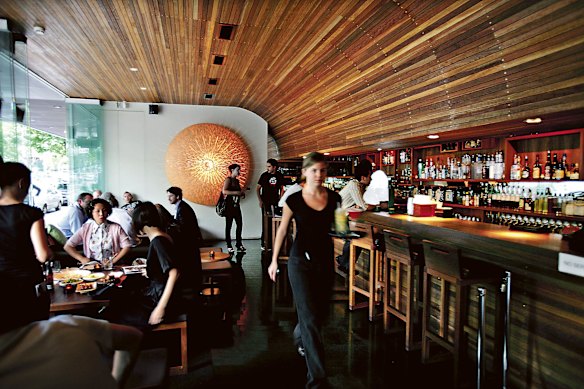
While she does not come from a hospitality background, Rebecca has always had a passion for restaurants. She was 22 when she met Al at Toko, the Surry Hills Japanese restaurant he owned and ran at the time with his brothers Matt and the late Daniel Yazbek.
Initially, she had no interest in entering the restaurant business. But she had always been interested in design and how people interacted with a space. “My favourite thing about restaurants is connecting with people. I like the tactility of spaces, how people interact when it’s all fluid, when all the pieces come together, it’s just like magic to me.”
Nomad Sydney, the group’s first restaurant, was inspired by intimate wine bars such as Sydney’s Love Tilly Devine and Melbourne’s Gertrude Street Enoteca. The original concept for the restaurant, which opened in 2013, was a cellar door in the city. The restaurant was designed and conceptualised by Rebecca but bankrolled by the couple. She signed the lease for it when she was 26.
“I think Nomad opened at the right place at the right time. Easy to take people to, good price point, good vibe,” she says. “The menu was interesting but not challenging. I had such a strong opinion on what worked and what didn’t. And I just was like, ‘no, this is gonna work’. And I’m just so grateful it landed really well with people from day one.”
In 2021, the Yazbeks launched Nomad Melbourne, followed by Reine & La Rue in 2023. “Melbourne, to me, was the centre of food in Australia,” says Rebecca. “I loved having a beautiful, busy, successful restaurant in Sydney, but I really wanted Melbourne.” The Yazbeks briefly owned a home in well-heeled Albert Park, but in August 2025, the Australian Financial Review reported the $12 million sale of that residence, Hambleton House. However, they still own their home in Woollahra, purchased in 2016 for $4 million.
It’s the heritage spaces that continue to attract Rebecca. Unlike Sydney’s obsession with new builds, Melbourne tends to treasure and preserve older sites. “Sydney loves to just destroy beautiful things,” she says. “Nomad Melbourne was supposed to be very different. We were looking at warehouses, and it was too much. I can’t be a Sydney restaurateur coming to Melbourne and recreating what we do in Sydney. I wanted to really reflect the city that we’re in with a concept that I really believed in.”
She sees Nomad Melbourne as a training ground for her young workers. “The staff are committed. They’re not seasoned professionals, so they’re all in it together. They’re so passionate about the product. So they’re really sort of cementing whether they want to be in hospitality or not there. When they feel like they can master that, then they’re ready for the bigger guys. So then they put their hand up for Reine – or now Florentino – or come up to Sydney.”
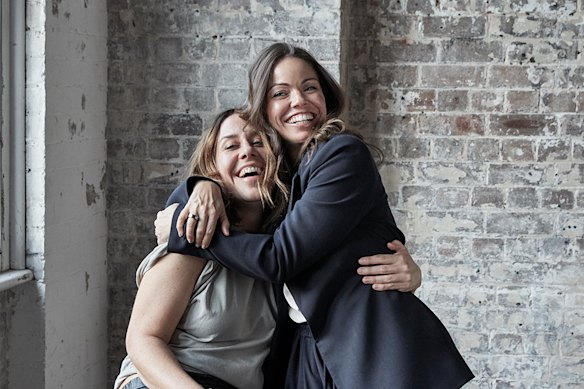
For Rebecca, staff retention is vital. “You’ve gotta have thick skin in this game. It is so up and down from one week to the next. The challenges, they can hit you from all sides without any warning,” she says. “I invest a lot into my guys and if they’re gonna stay with me, I need to have career progression for them. There’s always people with more money, bigger, newer things.”
In late 2024, group head chef Jacqui Challinor moved on from the business after 11 years with the Yazbeks. In late 2025, she took a position with Andrew McConnell’s restaurant group, Trader House (Cutler; Cumulus Inc; Marion; Supernormal; Gimlet; Morning Market; Meatsmith; Builders Arms Hotel; Apollo Inn, plus Bar Miette and Supernormal in Brisbane). “Jac and I had a great working relationship, [but after 11 years] she was done,” says Rebecca. “She was tired, and I absolutely get it. We had a beautiful friendship and a great working relationship. Tumultuous at times, challenging at times, but look what we did together.”
When asked for a comment for the circumstances around her exit from the then-Nomad ground, Challinor declined to comment.
Rebecca believes part of Challinor’s reason for resigning was the chef putting undue pressure on herself.
“Because I’m not a chef,” Rebecca says, “I leaned on her a lot in terms of the food vision and my overarching vision for the spaces. Chefs wanted to work for Jac. They wanted to learn from her. So it was very much like a partnership until it wasn’t. It was just time.”
The commute between Sydney and Melbourne hasn’t been easy, especially with three children aged nine, seven and five years old. “If I’m not working, I’m spending as much time as possible with my kids … our work is so all-consuming, you’ve got to be able to switch off and that’s challenging.”
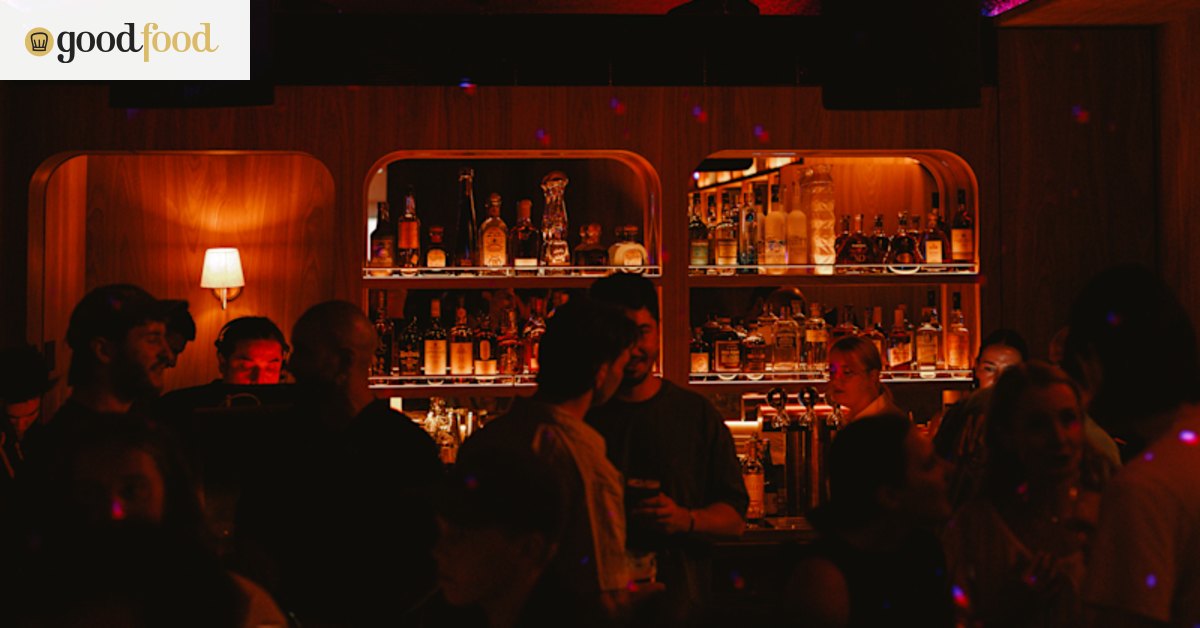
Now, her sights are set on Florentino – the business the Grossi family ran for 26 years before handing it over to the Edition Group in late 2025, eight months after a series of allegations of sexual harassment were levelled at chef and figurehead Guy Grossi.
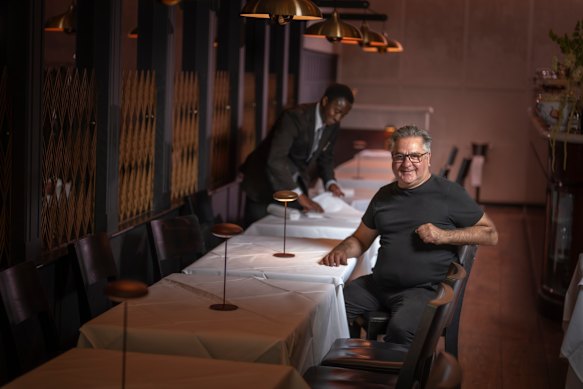
Rebecca will be rolling her sleeves up when it comes to addressing the existing culture within the Florentino business, which includes the historic upstairs Dining Room, downstairs Cellar Bar, The Grill, Ombra wine bar, and Arlechin cocktail bar. “There are some systems that weren’t present in how the Florentino was being run, that we’re just bringing in to make it appropriate for 2026.
“Florentino is 97 years old. The upstairs dining room should be – and always will be – the time capsule of what the Florentino represents. The rest of it needs an overhaul. It needs love and attention and care. And that’s not to say the Grossis didn’t because 26 years, my golly, that’s a good run in any business.”
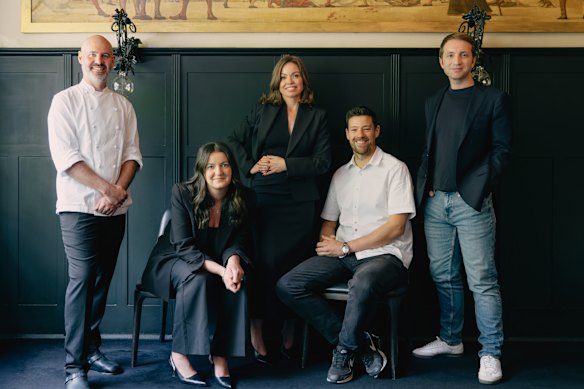
Much like the Grossis before her, the restaurateur sees herself as a guardian of the space. “I don’t own that restaurant. I hope that’s a restaurant that’s there forever and I’m a custodian until I’m not. I want to be part of the solution for making great restaurants that are value for money.”
When it comes to her plans for the Edition group, Rebecca says she has a site in Sydney she’s interested in, but won’t comment further at present. “I live in Sydney, I love this town,” she says. “I think if we could cement that here, then the bit of expansion we do with Reine & La Rue and making Florentino a go-to destination again would get us to a level where the people we attract are the best of the business. I’ll be happy with all that for a while.”
As for the long term, she says: “I want to be the best. And I think I’m attracting people that support the vision.”
Start the day with a summary of the day’s most important and interesting stories, analysis and insights. Sign up for our Morning Edition newsletter.