3 months ago
30
3 months ago
30
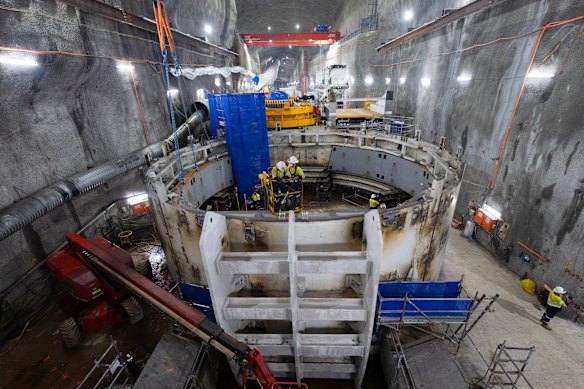
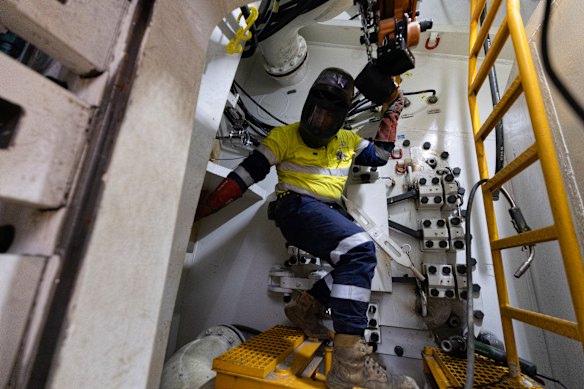
It is difficult to imagine the scale of what is happening beneath inner Sydney until you trek deep underground to two large caverns dug for a mega-assembly. Three months ago, one of the two 120-metre-long caverns under Birchgrove was largely empty. Now it is filling fast, leaving only a 1.5-metre gap for workers to pass between cavern walls and enormous pieces of equipment.
Workers are craning into place about 167 major pieces that will form the first of two giant boring machines. Once assembled like giant Meccano sets, they will worm their way under Sydney Harbour in coming months from Birchgrove to Waverton, leaving in their wake twin three-lane tunnels which will form the last part of the $7.4 billion Western Harbour Tunnel motorway.
Illustrating the scale of the undertaking, the project is being touted as the “world’s largest” assembly underground of tunnel boring machines. “It’s like Tetris and Solitaire challenges put together,” Transport for NSW project director Simon Cooper said. “It’s big pieces of plant moving heavy machinery around, but in a very confined space.”
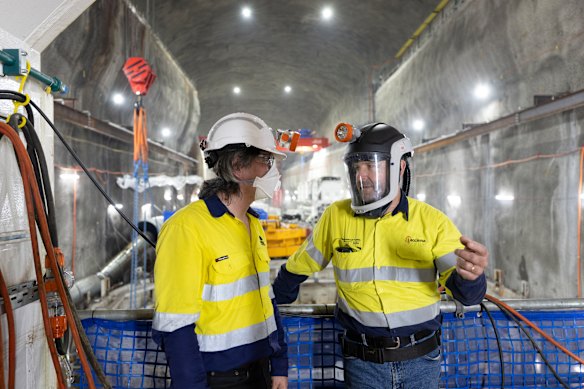
Cooper admits some people might say there is a “big risk” in what contractors are assembling underground, but he adds that it is mitigated by technology, suppliers and the skill of those working on the project.
Contractors cannot afford to get the sequence wrong as they piece together the two boring machines. The team at Spanish contractor Acciona has spent up to a year figuring out the sequence of the assembly, deciding the order in which equipment needs to be transported underground and when and how it will be fitted together.
“It’s a very difficult challenge to unpick if we get it wrong,” Cooper said. “You’ve got no space, and you’re building and lifting big blocks with big Tonka toys, and you’ve got to get it right. If you are playing chess, you have to think 50 moves ahead. In essence, that is what we are doing.”
Over the past 10 weeks, equipment has been hauled from Glebe Island though tunnels to the caverns. Many of the giant pieces are carried by specialised transporters in the dead of night, crossing part of the City West Link. “It’s like a factory carpark,” Cooper said, pointing at utes and other vehicles lined up inside the tunnels through which pieces for the machines are carted.
In a major step towards piecing together the first machine, a 462-tonne cutter head was lifted 90 degrees from a horizontal position to be hitched to the front of the boring machine overnight last Thursday.
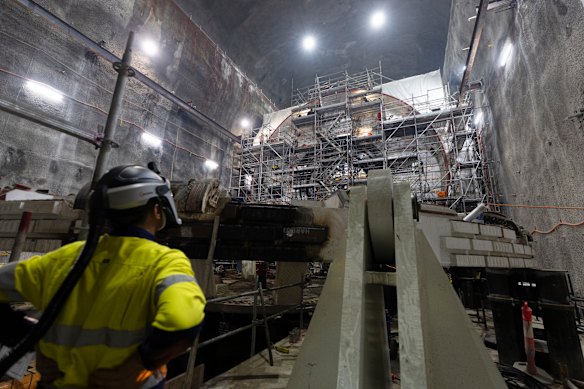
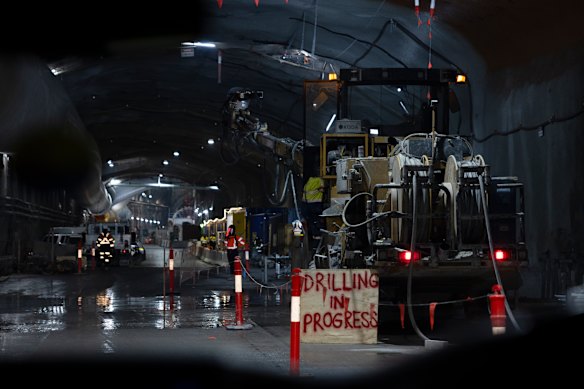
Like a giant grinding disc, the cutter head is split into three pieces, and the middle one resembles a bow tie and is the largest piece, while the main motor drive is the heaviest. All up, some 97 disc cutters, each weighing about 300 kilograms, are fitted to the cutter head. It is 15.7 metres in width – more than double that of the boring machines used to tunnel Sydney’s metro rail lines.
“This thing is a beast. The power on it is just exceptional in terms of push and torque in being able to turn that big cutter head,” said Cooper, who worked in the UK on schemes such as the second stage of the Channel Tunnel rail link.
The first boring machine – named Patyegarang after an Aboriginal language tutor – is almost half complete, and should be fully assembled by March or April before it begins carving through rock and sediment by the middle of the year.
The second machine, called Barangaroo, is about a fifth of the way through its underground assembly. Once complete, they will each be 137 metres long and weigh about 4400 tonnes.
NSW Roads Minister Jenny Aitchison said lifting the first cutter head into position on the boring machine was a major milestone for one of the country’s most complex infrastructure projects. “These machines are almost ready to disappear underground and do some of the hardest work on this mammoth project, carving a new harbour crossing that will serve Sydney for generations,” she said.
Acciona mechanical superintendent Martin Bell said the sheer weight of the equipment explained why the parts had to be craned in. “It’s all about size. You need to be a contortionist to work on these machines,” he said, pointing at the difficult places workers have to reach as they work on assembling the machines. “We are not wasting any space.”
Once it starts tunnelling, the boring machine will each have about 20 people working on them at any one time. The machines will tunnel 24 hours a day, which will be especially crucial when they reach a section of alluvial fill – a mixture of clay, silt and sand – beneath the harbour. They will reach depths of up to 47 metres below the harbour surface.
The grinding discs on their cutter heads will wear out as they scrap away rock. To ensure they do not do so in a place where the teeth cannot be changed underground, each of the machines will be fitted with a robot arm to replace the cutter discs. And once they near the end of their journey, the mega-machines will need to be able to push off hard rock to propel themselves up a steep rise towards Waverton.
The use of boring machines represents a major U-turn on earlier plans. The previous NSW Coalition government decided to dig deeper tunnels for the main section of the motorway between Birchgrove and Waverton, ditching plans to lay large tubes in a trench on the harbour floor.
Travelling at up to 55 metres a week, the machines are expected to take nine to 12 months to tunnel 1.5 kilometres under the harbour to Waverton. Spanning a total of 6.5 kilometres, the Western Harbour Tunnel is due to be completed in 2028, linking the Warringah Freeway on the north shore to WestConnex in the south and providing a bypass to the western side of the Sydney CBD.
Start the day with a summary of the day’s most important and interesting stories, analysis and insights. Sign up for our Morning Edition newsletter.