3 months ago
40
3 months ago
40
Opinion
January 17, 2026 — 5.01am
January 17, 2026 — 5.01am
There’s new data out this week on retirement confidence in Australia, and it makes for uncomfortable reading. Only 41 per cent of women say they feel financially confident about retirement. For men, it’s 59 per cent. That gap – of nearly 20 per cent – should stop us in our tracks.
Dig a little deeper and the worry is everywhere. Nearly three-quarters of women are concerned about having enough super for retirement, compared with just over half of men. Seven in ten fear they won’t be able to afford the lifestyle they want later in life. More than half are already holding back on everyday spending because they’re worried about running out of money in retirement.

Women typically have lower super balances than men as they are more likely to take time off work to raise children.Credit: Simon Letch
This isn’t a single data point or a momentary wobble in confidence. Women report higher levels of worry across every measure. It would be easy to describe this as anxiety and brush it off, but that would be a mistake.
These findings come from AMP’s Retirement Confidence Pulse, an important piece of research that tracks how Australians feel about their financial futures. As Melinda Howes, AMP’s Group Executive for Superannuation and Investments, put it: “We cannot accept a future where Australian women remain more worried than men about their financial futures.”
What the data really shows is not anxiety, but smart realism. Women are responding rationally to the reality of their financial lives, in a retirement system that has never fully accounted for the fact that women have more fractured working lives than men, even today.
They still earn less. They still take on more caring roles. And they still live longer than their partners if they have one. All of that collides in retirement.
This can’t be about asking women to work harder or sacrifice more. It needs to be about helping women have a voice.
So when women say they’re worried, it’s not because they haven’t thought about retirement enough. It’s because they have. They can see the social and financial realities facing single women later in life, and they understand how exposed retirement can be if things don’t go to plan.
What often gets overlooked is that women are not disengaged from the future. In fact, many think about it more deeply than their male counterparts. Two-thirds say leaving a financial legacy matters to them, a higher proportion than men.
The issue is not a lack of care. It is, in my view, a lack of space to prioritise themselves financially. And gaps in the way the system works to incentivise fixing women’s super balances early.
Loading
When the household budget is tight and the tax benefit of contributing to the husband’s super is higher, the woman takes the hit. When someone needs to go part-time, take a career break or say no to a promotion, it is rarely the higher-earning partner.
When the consequences show up decades later, they are treated as unfortunate rather than predictable. And there’s no tax incentives to change this. In fact, the tax incentives are geared in favour of the higher earners, often leaving the women on the sidelines of extra contributions.
And when women don’t, or can’t, prioritise themselves earlier in life, they miss out on a valuable opportunity to save small, incremental amounts into the low-tax environment of superannuation and let that money work hard through compounding over time. That puts them at a compounding disadvantage.
This is not inevitable. It is something policy can help fix, if we are willing to put pressure on politicians. Targeted tax incentives that encourage and reward women’s super contributions, particularly earlier in life or after career gaps, would make a meaningful difference.
The knowledge gap matters too, and it did not appear by accident. According to the survey, only a third of women understood the power of compounding before the age of 40, compared with more than 60 per cent of men.
Nearly a third do not know who their super is with or do not engage with their fund. Fewer than one in three have ever sought retirement advice of any kind. That gap reflects decades where household finances were often managed elsewhere, and where women’s super was treated as secondary income rather than essential infrastructure.
But with better education, we could nudge this in a different direction. Think about it – a national focus on financial literacy seems like a powerful and valuable move for all (especially women), particularly given the complexity and importance of our superannuation system. Expecting people to navigate it confidently without proper education and tooling has always been unrealistic.
There is also an important message that women and their partners need to hear much earlier. When women contribute more to super earlier in life, the gap in both confidence and wealth at retirement narrows sharply. Research consistently shows that when women can contribute closer to 15 per cent of income across their working lives, retirement outcomes start to look far more equal.
But reaching 15 per cent contribution rates can only happen when households make a conscious decision to prioritise her super, not just his, even when she is on maternity leave or taking time out to care for a parent.
This can’t be about asking women to work harder or sacrifice more. It needs to be about helping women have a voice at the dinner table, and guiding couples and single women on how to design their finances in a way that doesn’t leave so many gaps later.
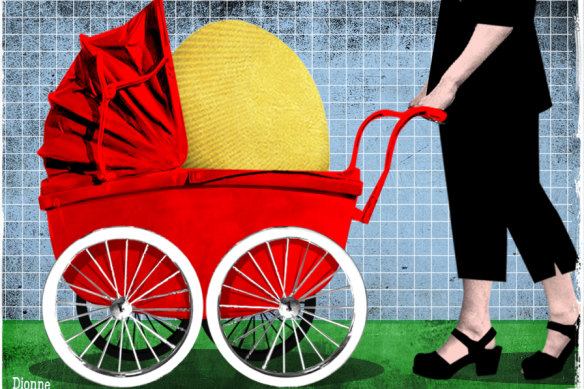
Women shouldn’t be forced to choose between a secure retirement or having kids.Credit: Dionne Gain
There are four lessons I wish all women, partners of women, and anyone who cares about their future, would take seriously.
First, women’s super has to be treated as non-negotiable. Whether partnered or single, super is not a side account or a nice-to-have. It is the backbone of financial independence later in life. Too many women only turn their attention to contributing extra once everything else has been paid for. By then, time and compounding are things you cannot buy back.
Second, career breaks need an active recovery plan. Time out of the workforce for caring does lasting damage to super balances if it is left unattended. When paid work resumes, contributions need to lift with it, even temporarily, to help close the gap.
For single women, this matters even more. There is no second balance to lean on later. Ideally a sensible government would come to the party with tax incentives to support this one day.
Third, learn about and use every lever available. Spouse contributions and contribution splitting matter for couples, but single women still have options that are routinely underused. Consider salary sacrificing a little more into your super salary sacrificing when income allows, co-contributions, Low-Income Superannuation Tax Offsets and other supports all exist for a reason.
These are not marginal ways of getting money in that should be ignored. They are real contributions that can compound quietly while life is busy, and build security over time.
Finally, women, and the partners of women, need to plan for the reality of longevity. Women live longer and are more likely to spend their later years alone. That makes financial resilience critical.
Retirement planning for women cannot assume they’ll have shared living costs forever, or someone else stepping in if money runs short. It cannot rely on inheritance arriving later in life when they lose their partner.
Loading
It has to assume women need to fund their own retirement from start to finish. That is simply reality in a world where divorce, AI and workplace change are coming at us, and we don’t know what the future holds.
This is not fearmongering. It is an issue worth talking about because when we talk about it, the conversation spills onto kitchen tables. People start to act, and financial plans get made. Women think twice about ignoring the gaps, and work on the ways they stop becoming the statistics in the articles. That’s what it’s all about.
So ladies, and gentlemen, it’s time to step up.
For partners, that means actively supporting a woman’s path to equal super. Retirement in a partnership should be treated as a shared responsibility, not something that automatically defaults to the higher earner.
For single women, it means recognising super for what it is: self-protection.
And for government, it means coming to the party with tax settings that genuinely support women to save, especially in those years when, on paper, it may have looked smarter to direct contributions to their partner’s super instead.
Women’s retirements deserve to be planned deliberately, not left to chance.
Bec Wilson is author of the bestseller How to Have an Epic Retirement and the newly released Prime Time: 27 Lessons for the New Midlife. She writes a weekly newsletter at epicretirement.net and hosts the Prime Time podcast.
- Advice given in this article is general in nature and is not intended to influence readers’ decisions about investing or financial products. They should always seek their own professional advice that considers their own personal circumstances before making financial decisions.
Expert tips on how to save, invest and make the most of your money delivered to your inbox every Sunday. Sign up for our Real Money newsletter.
Most Viewed in Money
Loading