3 months ago
27
3 months ago
27
A decade ago the Herald examined what Sydney would look like and how it would function in 2026. Here is what did get done - and what needs to be done next.
See all 7 stories.Sydney, the nation’s economic engine room, has always had a beating heart: the CBD. But by 2036, one of the most noticeable shifts might not be the types of jobs, but where they are located, according to KPMG economist Terry Rawnsley.
The cause? The opening of Sydney’s south-west and west metro rail lines.
“That big transport infrastructure over the next 10 years is going to really reshape how Sydney functions as an economic entity,” Rawnsley says, predicting concentration of the labour market in a singular business district will be dispersed over several centres of economic activity.
“We’re still going to have those big clusters of finance, insurance, professional services – those classic white-collar jobs. Where they are located in the city might shift a bit over the next 10 years, so the metro will open access into North Sydney, Chatswood, out to Macquarie Park.”
Ten years ago, Rawnsley predicted Sydney’s banking and finance sector would account for one in every five dollars generated by the city’s economy. Largely, those prognostications have turned out to be correct, he says, with the notable exception of the impact of the pandemic on retail and hospitality jobs.
A KPMG analysis of Transport for NSW employment projections revealed that the big rises in the next 10 years are expected to be in health care, the professional and scientific sector, logistics and construction.
City of Sydney, on the other hand, is bullish that the CBD will continue to thrive. The council is planning for an additional 200,000 jobs – a near 40 per cent rise – within the local government area, which spans 26 square kilometres from the Opera House through to Roseberry, by 2036.
In 2016, the creation of several “knowledge hubs” was forecast by the Committee for Sydney’s then-chief executive, Tim Williams, who argued a high-speed rail connection between Parramatta and the CBD was overdue. The line, which has a price tag of up to $29 billion, is set to open in 2032, albeit with a 20-minute travel time – double the 10 minutes Williams hoped for.
Loading
University of Sydney professor Chris Wright agrees with Rawnsley’s prediction the expanded metro network could be transformative for the city’s economic landscape.
The shift away from the CBD will be compounded by structural changes to the post-pandemic economy, including working from home becoming less partisan, Wright predicts. Parramatta, Liverpool and Bankstown all had the attributes needed to benefit from a decentralised Sydney labour market, Wright says.
Another big job creator is due to open this year 44 kilometres west of the CBD: the long-awaited Western Sydney International Airport will offer round-the-clock domestic, international and cargo flights. Rawnsley said it would create logistics jobs, along with roles the airport was reliant upon.
Sydney’s only 24/7 international airport with no curfew, the new airport will help fuel an additional 43,000 logistics jobs projected to be created over the next decade, Jobs and Skills Australia (JSA) modelling forecasts.
One person who is expecting to experience Sydney’s evolving economic terrain is Chriso Chindilas, a recent graduate of the University of Sydney.
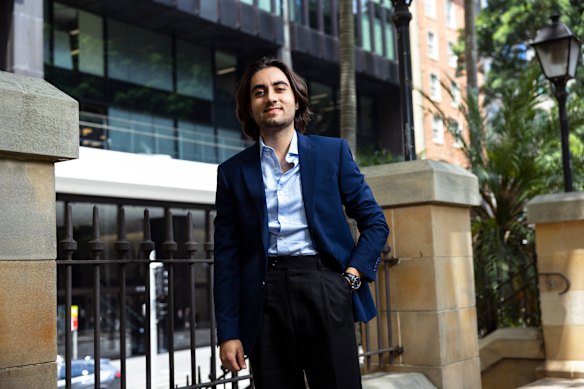
Chriso Chindilas is a finance student preparing to enter the workforce.Credit: Dominic Lorrimer
The 23-year-old completed an “eclectic” mix of internships throughout his bachelor of commerce and law, from a private equity firm to venture capital work. Now he’s looking forward to a role in financial services.
He’s excited to work with cutting-edge technology and employ his passion for financial strategy. But the 23-year-old doesn’t want to stay there forever.
AI: fewer jobs … or different?
The X factor of the next decade will be artificial intelligence, says Deloitte economist Stephen Smith.
A report released by the NSW Productivity Commission in 2022 argues the next technological revolution will cause significant changes in the types of jobs, but also the types of skills demanded.
By 2036, AI was more likely to be augmenting rather than replacing jobs, Smith believes. But the transformative technology will probably cause displacement. Sales assistants, bank workers and truck drivers were all vulnerable to automation, the Productivity Commission found.
“Ten years could be quite transformational in terms of how AI might disrupt things quite significantly in professional and financial services,” Smith adds.
However, broad adoption of AI brought considerable economic opportunities too. Modelling by the NSW Productivity Commission found there would be “more jobs overall” due to emerging technologies.
While forecasting a reduction in lower-income jobs (between $40,000 and $80,000), those roles would be entirely offset by the creation of positions earning more than $80,000.
These technologies will change the nature of work, accelerating demand for skills from physical to cognitive, the NSW Intergenerational Report, released in June 2021, found. Complex problem-solving, mental processes, social skills and cognitive skills were all predicted to be more desirable to employers.
Overall, the Productivity Commission found widespread adoption of AI could boost the NSW economy by 11.8 per cent by 2035, creating new jobs, and generating $4.5 billion in government revenue, despite demographic challenges.
Ageing population
The primary demographic challenge over the next decade will be the state’s ageing population, says Dr Luke Hartigan, an economics lecturer at University of Sydney.
“From a demographic perspective, there will be a lot less young people here,” he says.
In response, health care jobs are forecast to increase by nearly 19 per cent across NSW, adding 74,000 over the next decade, the most of any industry, KPMG Analysis of Transport for NSW employment projections found.
By 2035, the health care and social assistance, and professional, scientific and technical services sectors were projected to account for almost 30 per cent of the state’s total jobs, according to the NSW Intergenerational Report.
By 2035, the state’s ageing population will reduce the participation rate from 65 per cent to 63 per cent, the report found.
Sydney becomes more like New York
Ten years ago, Williams warned if unaddressed, soaring Sydney house prices would exacerbate existing demographic issues.
“The question is, will we still be a city for young people?” Williams asked.
This was eight years before Productivity Commissioner Peter Achterstraat warned Sydney risked becoming a “city without grandchildren”.
Those pressures have deepened in a way not many in 2016 could imagine. Smith warns with house prices predicted to continue rising steeply, the crisis will almost certainly worsen by 2036, risking not only the economy but also Sydney’s social fabric.
Loading
The city’s lack of affordable housing will have several deleterious consequences, argues Ed Cavanough, chief executive of the McKell Institute, a progressive think tank.
First, the high house prices discourage young people from moving to Sydney and encourage them to move elsewhere. Second, the challenges of an increasingly unaffordable city will limit young people’s ability to take risks on establishing their own businesses. Last, Cavanough says, restricting access to the property market could exacerbate Sydney’s income inequality.
“Everyone loves New York. Everyone loves London. But you do see the harsh sort of consequences of inequality in those cities … we risk seeing that type of stratified society emerging in Sydney, if we’re not careful,” Cavanough warns.
In 2024, the NSW government committed to building 378,000 homes by July 2029, an average of 75,000 each year, to deal with the acute aspect of Sydney’s housing shortage. However, only 45,000 were built in 2024 and an estimated 42,000 built last year, respectively.
Cavanough, who left Sydney with his wife and returned to Adelaide when they were about 30 years old, now asks a simple question: Why would any 25-year-old essential worker, unless they grew up here, choose Sydney over anywhere else?
Start the day with a summary of the day’s most important and interesting stories, analysis and insights. Sign up for our Morning Edition newsletter.