2 months ago
18
2 months ago
18
It is not unusual for renowned architects such as Andrew Andersons, the two-time winner of the Sulman award for public architecture, to update or extend a landmark project over their lifetimes.
What was very unusual, said Andersons on Monday, is when the architect (him!) wanted to cut an enormous void in the floor of the original architect’s 1988 work (him again!). This is what he did for the redesign of the State Library of NSW’s Macquarie Street wing.
The library will today unveil a $15 million glow-up by Andersons with Cullen Feng Architects. It was completed in seven months, in time for the library’s 200th birthday next year.
Visiting the site where NSW parliament’s tennis courts once stood, the 83-year-old architect said he was happy with the outcome.
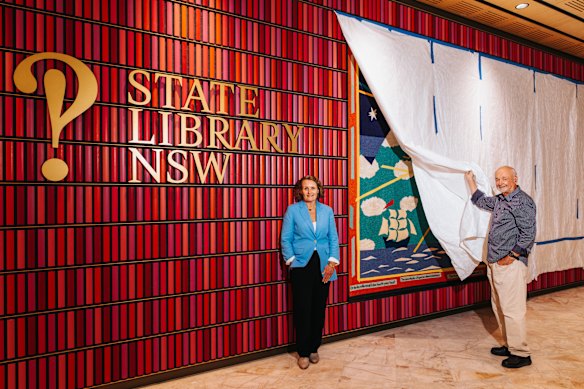
State Librarian Caroline Butler-Bowdon and award-winning architect Andrew Andersons take a sneak look at the Martin Sharp tapestry that has restored to its rightful place after a $15 million redesign.Credit: James Brickwood
“The main reading room is a miracle of daylighting,” he said, thanks to the new 55 square metre void that brings light to the lowest floor of Marie Bashir Reading Rooms, which are underground.
Nearly every major art gallery and library, including the Art Gallery of NSW, the State Library of NSW and the National Library and the National Gallery of Australia, has benefited from Andersons’ light touch – the introduction of daylight and views, some curves and other playful touches.
State Librarian Caroline Butler-Bowdon said the upgraded reading rooms now matched the rest of the library in quality.
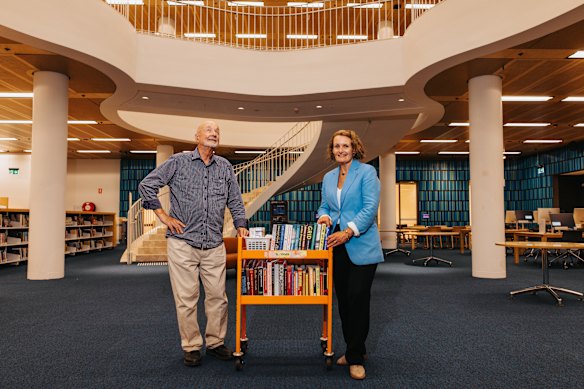
Into the void they looked. Andrew Andersons and State Librarian Caroline Butler-Bowdon in the newly updated bottom floor of the Marie Bashir reading rooms. It now a huge void letting light into the underground space. Credit: James Brickwood
Andersons replied: “You are not the poor cousin of the Australian Museum any more or the Art Gallery of NSW. I think you are ahead now, though, I shouldn’t say that.”
Standing next to a time capsule from 1988 that commemorated the wing’s opening by Queen Elizabeth, Andersons said it was not unusual for him to go back to do additional work on a project over time.
This time, though, he had to justify his proposal to create the large void – shaped a bit like the library’s comma logo – to let light into the lowest floor of the reading rooms that he originally designed.
“You see, I had to do the heritage impact statement on what this work does to a building I designed 40 years ago. Now that’s really quite funny.
“I had no trouble justifying it, of course.”
Being the original architect had given him the confidence to take “greater risks to achieve stronger visual impact than others may have been prepared to do”.
Loading
The newly updated entrance will restore Martin Sharp’s Oz tapestry (commissioned for the 1988 building) to the main foyer.
The update brought light to the reading rooms and colour to the walls, now decorated in brightly coloured timber slats that resemble the spines of books.
Butler-Bowdon said seating in the reading room had increased 37 per cent to 659, and there were more study rooms, up from six to 21. Much of the original furniture had been retained, but updated.
“Our reading rooms are the absolute core of this institution,” she said.
Unlike an art gallery, which the public may visit sparingly, Butler-Bowdon said the library had many visitors who came daily or three times a week. “It was a place to be alone but together.”
A large study space was named in honour of Neville Halse, whose bequest announced earlier this year will support readers for generations.
The newly expanded cafe will serve 220, and retractable windows and awnings extend the space into the adjoining courtyards, and the bookshop has tripled in size.
Andersons said he had been coming to the library for nearly 70 years, starting as a student in 1959, colouring the working drawings of an extension to the Mitchell wing.
When he was studying architecture at Sydney University, he used to come to the State Library because the university’s Fisher Library had nowhere to sit and read. “You had sit on the floor in the stacks.”
Start the day with a summary of the day’s most important and interesting stories, analysis and insights. Sign up for our Morning Edition newsletter.