3 months ago
25
3 months ago
25
In May last year, Sydney’s public transport network experienced massive delays when a high-voltage wire collapsed near Strathfield station.
Completely unaware of the problem, and wondering why every bus passing her stop was full, was law student Lucy Long.
While most Sydneysiders would check their Opal app or a news site for a traffic update, that isn’t possible on Long’s flip phone, which is bright pink and stamped with a Barbie logo.
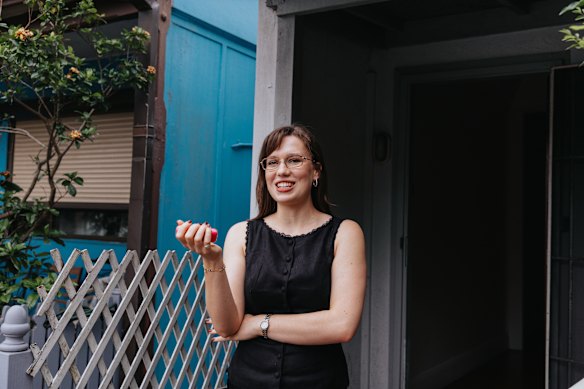
Fifth-year law student and paralegal Lucy Long uses a Barbie flip phone. Credit: James Brickwood
Unable to order an Uber and with no cabs passing by, she had one choice: walking 3½ hours home. Despite this major inconvenience, Long defends her decision to ditch her smartphone.
“I genuinely have never had a real problem,” she says. “I have always been able to call someone, ask for directions, or, like, talk to literally a stranger on the street.”
The popularity of so-called “dumb phones” is climbing. Google Trends data shows searches for the devices have increased significantly since 2020. Nokia has launched new and improved versions of its iconic flip phones, and Reddit forum r/dumbphones has 179,000 weekly visitors.
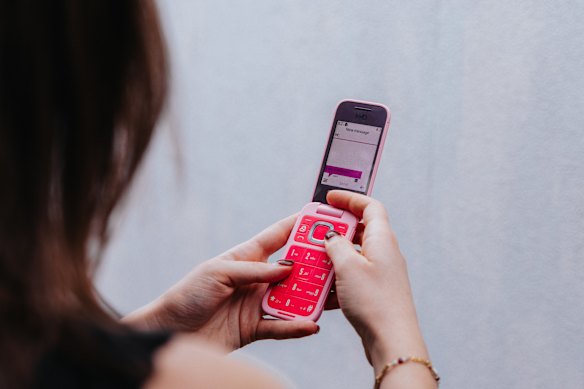
Google Trends data shows searches for “dumb phones” have increased significantly since 2020.Credit: James Brickwood
Technology and culture researcher Dr Omar Fares, an assistant professor of marketing at the University of New Brunswick, has researched the flip phones trend. He says it stems from a love of nostalgia, but also reflects a rebellion against smartphones and how they operate.
“We’ve lost connectedness to one another,” he says. “Maybe people are thinking of saying, let’s actually disconnect from social, and let’s disconnect from digital as a way to reconnect.”
Long ditched her iPhone earlier this year because she felt she was wasting her life on a phone addiction.
“I’d established that really the only reason that we have phones is to talk to people.
“And I was like, well, what is something that I could replace with this, you know, slightly devilish piece of technology that still fulfils that function?”
Long is proud of her quirky phone, bringing it to her work as a paralegal.
She gets some questions, of course, but says most people envy her self-restraint.
University of Sydney PhD student Isaac Gill decided to ditch his smartphone for a black Nokia after years of sometimes deleting his social media apps, or turning his notifications off.
Loading
“Then eventually I read this book that really pushed me to do the switch,” he says, urging others to also approach the change slowly.
“It takes, I think, years to comfortably do it.”
For his first week with a flip phone, Gill also carried his iPhone to fill in any unexpected gaps, such as two-factor authentication.
While both Gill and Long recommend dumb phones, they are realistic. Both have taken their smartphones on international holidays.
Online, Generation Z’s love of dumb phones has been criticised as “performative” and attention-seeking.
Fares thinks these critics are missing the point.
“In all of these trends, there is consistently a performative element, and that is fine,” he says. “As long, though, as the push is towards something healthy.”
Start the day with a summary of the day’s most important and interesting stories, analysis and insights. Sign up for our Morning Edition newsletter.
Most Viewed in National
Loading