
 4 months ago
87
4 months ago
87

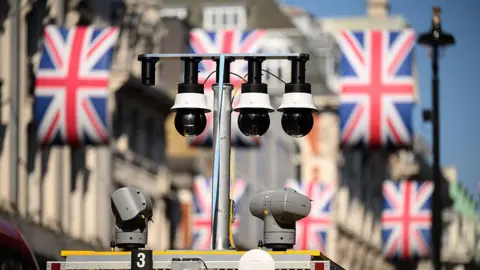 Getty Images
A facial recognition system deployed by the Met at Oxford Circus last summer
Privacy campaigners have lost a High Court challenge aimed at limiting the Metropolitan Police's use of live facial recognition technology.
Youth worker Shaun Thompson, and Silkie Carlo, director of campaign group Big Brother Watch, brought the claim over concerns that facial recognition could be used arbitrarily or in a discriminatory way.
Scotland Yard defended the challenge, telling the court that the policy was lawful.
The Met Police will continue to use the technology, with commissioner Sir Mark Rowley calling the ruling an "important victory for public safety".
One of the claimants, Thompson, was misidentified by live facial recognition technology (LFR).
Lawyers argued the plans to mount permanent installations in the capital would make it "impossible" for Londoners to travel without their biometric data being taken and processed.
Lord Justice Holgate and Mrs Justice Farbey said in their judgment that "in the context of promoting law and order in a large metropolis, the policy provides the claimants with an adequate indication of the circumstances in which LFR will be used and enables them to foresee, to a degree that is reasonable in the circumstances, the consequences of travelling in an area of London where LFR is in use".
The 74-page ruling added that the "risk and potential scope for discrimination on grounds of race was no more than faintly asserted".
The judges also said that Thompson and Carlo's human rights had not been breached.
Plans set out by the Home Office in January will increase the number of vans from 10 to 50 and make them available to all forces across the two nations.
Met Police commissioner, Sir Mark Rowley, said the High Court ruling was a "significant and important victory for public safety".
He added: "The courts have confirmed our approach is lawful. The public supports its use. It works. And it helps us keep Londoners safe.
"The question is no longer whether we should use live facial recognition, it's why we would choose not to."
In response to the ruling, Thompson said: "No one should be treated like a criminal due to a computer error.
"I was compliant with the police but my bank cards and passport weren't enough to convince the police the facial recognition tech was wrong.
"It's like stop and search on steroids. It's clear the more widely this is used, the more innocent people like me risk being criminalised."

















































