
 2 months ago
69
2 months ago
69
It was a cold and wet June weekend in 1981 when 10-year-old Christopher Nolan sat down in a local cinema in Evanston, Illinois to watch Clash of the Titans, the mythological fantasy directed by Desmond Davis, with iconic stop-motion special effects by Ray Harryhausen. Though Nolan and his brothers – Matthew, two years older, and Jonathan, six years younger – were raised in north London, they spent their summers in their mother’s American hometown.
That particular summer seemed rich with movies that would flood the cultural zeitgeist: Raiders of the Lost Ark opened the same weekend, and Superman II was just a week away. Clash of the Titans was the one, though, that possessed a specific resonance for the young Christopher. Harryhausen’s visual effects captivated him and set him on a career-defining path that would, 45 years later, bring him to the release of his own $US250 million (about $355 million) mythological blockbuster epic, The Odyssey.
“There was a wonderful correspondence between the technique of stop-motion animation and the promise of mythology, the idea or the type of images that are suggested by those stories and that world,” Nolan says. “I thought it was a marvellous thing. It had a real sense of cinema to it.”
Four-and-a-half decades later, on a trajectory that brings him almost full circle from the tales of those titans, gods and demigods Perseus, Andromeda, Zeus, Thetis, Poseidon and Athena, the now-legendary Hollywood filmmaker is sitting down with Good Weekend in the quiet stucco courtyard of his temporary office on the Warner Bros lot in Los Angeles.
Down the corridor, Nolan has spent the day working on the final sound mix of The Odyssey, arguably the most significant film in an already significant career, which aspires to bring to the screen one of the foundational pieces of human literature; an epic poem traditionally attributed to the ancient Greek poet Homer about Odysseus, king of Ithaca, returning home after the Trojan War.
The Odyssey is also Nolan’s most ambitious film and his most expensive, no small feat in a Hollywood economy where few studios are interested in writing ever bigger cheques. It stars an extraordinary cast: Matt Damon as Odysseus, Anne Hathaway as his wife Penelope, Tom Holland as their son Telemachus, Robert Pattinson as the ambitious Antinous, Lupita Nyong’o as Helen of Troy, Zendaya as Athena, the goddess of war and wisdom, and Charlize Theron as the nymph Calypso.
For Nolan, the journey to this moment is the story of one of cinema’s greatest auteurs, a master storyteller who specialises in complex, paradigm-shifting stories: the reverse-timeline neo-noir Memento (2000), the gritty and philosophical superhero origin story The Dark Knight (2008), the mind-bending heist thriller Inception (2010), the World War II epic Dunkirk (2017) and, of course, his extraordinary biopic about the “father” of the atomic bomb, Oppenheimer (2023).
That he began his cinematic career obsessed with gods and monsters is perhaps unsurprising given a childhood immersed in masterworks such as 2001: A Space Odyssey (1968), Star Wars (1977), Alien (1979), and Harryhausen’s low-budget classics Jason and the Argonauts (1963) and The Golden Voyage of Sinbad (1973).
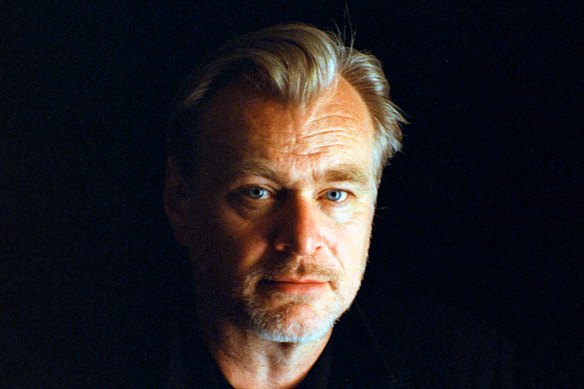
“It’s hard to point to a crystallising moment in terms of my relationship with capturing images and wanting to put them together in a particular order; that was a sort of developing thing from when I was about seven or eight years old,” Nolan says, reflecting on his early life.
“In Blade Runner and Alien [I realised I was] looking at completely different stories, completely different genres, yes, bounded by science fiction – one is of horror, one is a sort of noir-detective – different actors, everything’s different, but there’s something, there’s a commonality, there’s the same mind behind it.”
One mind, perhaps, but many hands – evident in the formation of a company of artists which has slowly grown around Nolan, including cinematographer Hoyte van Hoytema, composer Ludwig Goransson and actors such as Damon, Hathaway, Cillian Murphy, Michael Caine and actor/director Kenneth Branagh.
In the world of Christopher Nolan, however, nobody sits more centrally than Emma Thomas, the 54-year-old London-born producer who has steered all of Nolan’s film work. They met on their first day at university, married four years after they graduated and have four children: Flora, Oliver, Rory and Magnus.
When I walk into the cavernous sound mixing stage at Warner Bros to watch the final edit of The Odyssey, it is Thomas who greets me warmly and sits down with me on a sofa on the edge of the space.
In its centre, Nolan is busy. On the cinema screen, we watch scenes from the Trojan War unfold as Nolan directs the final mix of the sound. It’s a tweak here and a tighten there. But with each replay, the sequence becomes tighter and tighter.
The interactions are calm and precise. Fractions of seconds of action are replayed and changes are made: some small and subtle, some which reshape the impact of specific shots. Nolan is famous for a relatively calm filming style. Even here, in the trenches, the mood is pretty low-key.
In the heart of Hollywood, on one of the city’s most storied studio film lots, we are a long way from University College London (UCL), in the early 1990s. Nolan was there to study English literature. Thomas, the daughter of a diplomat, was studying ancient history. It was a fortuitous meeting or, as Nolan told UCL graduates in 2017, “Pay a lot of attention to who you meet on your first night at your halls of residence.”
Thomas reflects on their first meeting with a wry smile. “It’s funny because I think it was such a pivotal moment in our lives, really, but at the time it didn’t seem that way,” she says. “[Chris was] the only person not wearing jeans, and he stood out for that reason. He never looked like the rest of us. He was always more mature, I guess.”
As young filmmakers – the student Nolan became president of the university’s Film & TV Society, and Thomas took a producing role on their projects – two shorts, Larceny (1996) and Doodlebug (1997), were followed by Nolan’s first feature, Following (1998), which had a budget of just £3000.
In a proper Hollywood marriage, they not only keep house but also run a successful production business, Syncopy Inc., which boasts 14 feature films and a total box office of $US6.8 billion ($9.7 billion). In 2024, Nolan and Thomas were recognised with a knighthood and damehood for their services to film. Nolan describes Thomas as “a close collaborator who has absolutely no compunction or fear about telling me exactly what [she thinks, with] no agenda whatsoever. For a filmmaker, that’s an incredible asset.”
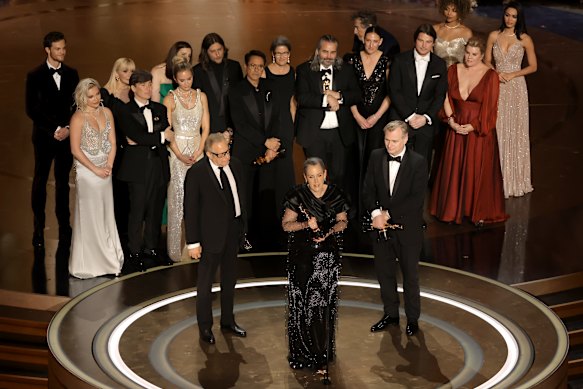
The round-the-clock nature of the parallel enterprises does not faze them, Thomas adds. “There’s a level of trust and also a sense of pulling in the same direction that I don’t know we would have if we were not also life partners. That’s not to say that we don’t challenge each other. That’s an advantage as married people, because we’re able to challenge each other in a way that I think you might not if you didn’t have that basis of strength and a deep foundation.”
The mash-up of a working and home life in Los Angeles with four children also means that “movie night” has, over the years, become entrenched as an important family tradition. “We watch everything,” Thomas says, when I ask if there is any film snobbery in a household headed by Oscar-winning parents. “There’s literally not a genre, I think, that we don’t watch. Maybe I have a bit more trouble getting them to watch romcoms because three of them are boys and they love John Wick, Fast and the Furious, those movies,” she says. “But I do insist every year [at Christmas] that we watch Love, Actually.”
Nolan’s first professional work after graduation was as a script reader, camera operator and director of corporate films. Thomas, meanwhile, took a job at Working Title during what would prove to be its halcyon days: Four Weddings and a Funeral (1994), Dead Man Walking (1995) and Fargo (1996).
The couple’s breakthrough came in 2000 with Memento, a psychological thriller starring Guy Pearce as a man with anterograde amnesia; that is, unable to form long-term memories. The film was notable for its non-linear structure and powerful exploration of perception, grief and self-deception. Its tonal notes have endured in Nolan’s cinematic canon.
Memento’s success transformed the trajectory of Nolan’s and Thomas’s careers. The film was followed by Insomnia (2002) and then a triptych of iconic comic-book adaptations: the origin story Batman Begins (2005), The Dark Knight (2008) and The Dark Knight Rises (2012), starring British actor Christian Bale as Batman.
For Michael Caine, one film with Christopher Nolan became a working relationship that spanned eight films – the three Dark Knight films, in which Caine played Batman’s alter-ego Bruce Wayne’s loyal butler, Alfred Pennyworth, and The Prestige (2006), Inception, Interstellar, Dunkirk and Tenet (2020).
“I’ve often said he was my good-luck charm, though I like to think I might have been his as well,” Caine tells Good Weekend, describing Nolan “even as a young man, [as someone who] carried himself with remarkable professionalism. There was always a calm about him, a quiet authority that put everyone at ease. People did their best work around Chris because they trusted him.”
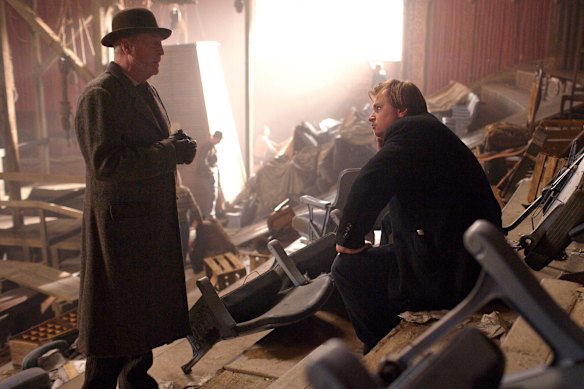
Caine also acknowledged Nolan’s sartorial elegance. “He was, without doubt, the best-dressed director I have ever worked with. You would find him on set in a suit, completely composed, knowing exactly what he wanted. He is, without question, one of the finest directors I’ve ever had the pleasure to work with.”
Anne Hathaway’s career trajectory has taken her from America’s sweetheart in The Princess Diaries films (2001, 2004) to a gig at the fictitious Runway magazine working for the infamous Miranda Priestly (Meryl Streep) in The Devil Wears Prada (2006) and, most recently, its 2026 sequel. Along the way, as Lureen Newsome in Brokeback Mountain (2005), Hathaway revealed layers of dramatic complexity.
Nolan cast her as extremely physical Selina Kyle, alias Catwoman, Batman’s feline nemesis. And it was the foundation of a collaboration that would see her return for Interstellar and now as Penelope, the deeply devoted wife of Odysseus (Matt Damon) and the politically shrewd queen of Ithaca in The Odyssey.
“When I think of Selina Kyle, I thought Chris did a brilliant job adapting a comic-book character who lives in the grey. Is she a villain? Is she a hero?” Hathaway tells Good Weekend. “The thing I always feel with Chris’s writing is … I just feel like he gets to the soul of the character and that’s always what I connect to.”
In The Odyssey, Hathaway was presented with something almost unprecedented in Nolan’s filmmaking: a dramatically upscaled world captured on IMAX’s super-framed cameras but wholly dependent on small, intimate character notes that propel the story.
“There was a monitor [on the set], and I tried not to look at it because I just wanted to have the physical present that I was in, so I wouldn’t be tempted to play to the grandeur of the lens – but one day I slipped and looked down while they were setting up a shot. When I saw the space, what it was going to look like on camera, I got very, very emotional,” Hathaway adds.
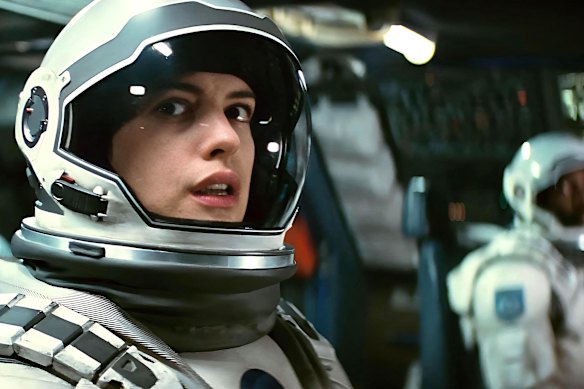
“At that point I’d been on that set for about three weeks and I thought I knew every inch of it, and then when I saw it through the lens, I saw things that my eye hadn’t been able to comprehend, just the way things lined up, the intelligence of it, the taste of it. Oh my goodness, it was so incredible. I kind of had to go away for a second and gather myself.”
Interstellar is one of Nolan’s benchmark films – his second film with Hathaway, his first with Matt Damon and his first with cinematographer Hoyte van Hoytema, who would return to shoot Dunkirk, Tenet, Oppenheimer and The Odyssey.
The biggest misconception about Nolan, van Hoytema says, is that people assume he is scientifically minded; he’s not. Even as I describe Nolan’s scriptwriting to van Hoytema as “methodical and mathematical”, he stops me. “It took me literally one film working with him to understand that the opposite is true,” van Hoytema says. “He’s one of the most intuitive and most empathetic people I know.”
Van Hoytema describes Nolan’s scriptwriting as economical. “His writing is not extremely descriptive in a very elaborate sense,” the 54-year-old says. “His script has fewer words, if you will. But I think they are very much written with the understanding that the people that are close to him read in between those lines.
“They are not instructional manuals for strangers, but there are things that are written for people that know Chris and that know his mind,” van Hoytema adds. “When I read his scripts, I always feel a lot of warmth and I feel a lot of humanity.”
‘He’s one of the most intuitive and most empathetic people I know.’
Cinematographer Hoyte van HoytemaInterstellar was also the first piece in the mosaic of Nolan’s collaboration (and friendship) with Matt Damon. An A-list actor at the time, Damon agreed to take a small role – Dr Mann, a NASA astronaut – behind topliners Hathaway, Matthew McConaughey and Jessica Chastain. When the script was delivered to him, Damon was in the Harz, the highlands in northern Germany, filming The Monuments Men, a war film directed by his friend George Clooney and starring them both. “I vividly remember reading that screenplay because I was so moved by it; it was kind of a cameo role, but I was thrilled with it,” Damon tells Good Weekend. “It was a great little part and a chance to work with him.
“What he was willing to do to get every shot and to never, ever lose momentum; that momentum is the thing that defines him. Steven Spielberg is really similar in that they don’t ever seem to run out of energy and they really drive everybody. It’s true leadership, the way they move from one shot to the next, because time is the most important commodity and they will never sacrifice a moment.”
Damon understands the significance of Nolan’s decision to take on The Odyssey. “I knew that he had, since early in his career, wanted to do The Odyssey and The Iliad, and I knew that he had a longstanding relationship with this material. While we were making it, the weight of it was less about what it personally meant to him and more about the ambition of what he was trying to do with this.”
Damon says Nolan is a filmmaker who works in the trenches. “He was just as cold and wet as we all were. This movie really felt like an expedition. We were all out on the boats, out at sea. There was no comfortable room that anybody got to go sit down and rest, there wasn’t that for anybody.
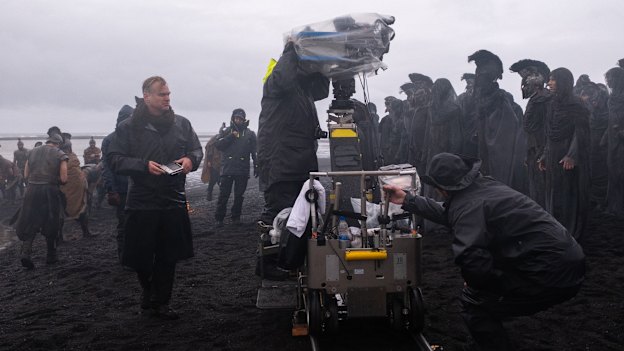
“Getting to that last night, I still remember the feeling – it was celebratory. Every day, you’d get to the end of the day and go, ‘Wow, we made our day.’ Then you’d get to Friday, you’d look around and say, ‘Oh my god, we made the week.’ And as each week would pass, we started to realise, ‘We’re really doing this, we might be able to actually do this.’ ”
In seeking insight into Nolan, Damon’s perspective and context is perhaps unique: aside from Nolan, the 55-year-old’s body of work is populated by a literal who’s who of cinema: Spielberg (Saving Private Ryan), Martin Scorsese (The Departed), Ridley Scott (The Martian) and Steven Soderbergh (Ocean’s Eleven et al.) to Clint Eastwood (Invictus) and Francis Ford Coppola (The Rainmaker).
“[Directing] is the most difficult [job], it comes with the most pressure and responsibility and everybody does it differently because you can’t hide your personality,” Damon says. “It really reveals who you are because of the sheer number of decisions you have to make every single day over this long period of time. And the final product is a function of those decisions and every decision ultimately rests with you.
A common factor among Hollywood’s top-tier directors is that they are truly open to the ideas of everybody around them, he says. “They have the confidence that they’re the ultimate arbiter of what is in the movie and what is not, but no idea threatens them because they are truly available to a better idea at all times. They are always listening, they’re always attuned to what’s better.
“The best description of directing I ever heard [came from] Steven Soderbergh, who said it is like making a mosaic [the size of] a city block from an inch-and-a-half away,” he adds. “It requires this incredible attention to detail. The ability to collaborate and evolve and get the best out of every person that you’ve hired and incorporate that into the mosaic without losing the mosaic itself.”
‘Getting to that last night, I still remember the feeling – it was celebratory. Every day, you’d get to the end of the day and go, “Wow, we made our day”.’
Matt Damon on filming The OdysseyThree years after Interstellar, Nolan would deliver Dunkirk, a 2017 film about the Dunkirk evacuation of World War II in which Kenneth Branagh played the fictional Commander Bolton, based on a composite of several officers who played a heroic role in the operation.
But their creative relationship – at least, from Branagh’s point of view – began when the 65-year-old Belfast-born filmmaker first saw Memento almost two decades earlier. After watching the film, he says, he sat down with his friends, trying to unpack what they had experienced.
They did not meet until 2015, when Nolan decided to approach Branagh with a view to casting him in Dunkirk. Nolan, the atypical Hollywood producer, eschewed the traditional office meeting and instead flew to London to watch Branagh’s theatre company performing William Shakespeare’s The Winter’s Tale, the opening production of his year-long residency at London’s Garrick Theatre. The following morning, they sat down to talk.
“Chris spoke with passion, emotion and depth about the concept and its attendant casualties in the story,” Branagh tells Good Weekend. “Forty minutes later, he had forensically investigated grief, jealousy, betrayal and joy. At the end of it, he asked me if I would like to be in Dunkirk. I said yes before the end of the title’s first syllable.”
Branagh, an accomplished director (Much Ado About Nothing, Murder on the Orient Express) himself, believes that time – “the infinite concept”, he says – sits at the centre of what drives Nolan.
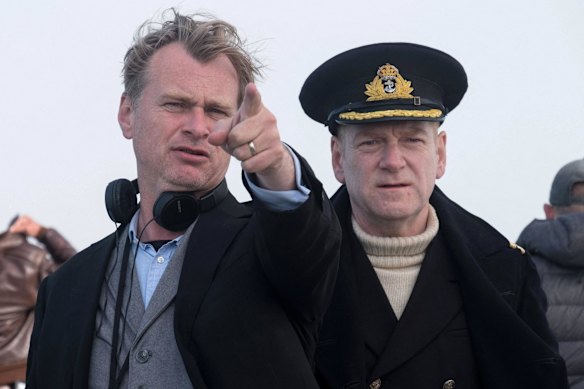
When I put that point to Nolan, he acknowledges that the manifold strands of time wrap around and through his films. For good reason, he says. “Because I’ve always lived in it. We all do. And age at different times, different rates in our lives, when we have children who are growing up too fast. The elasticity of time, the effect of memory on time, and time on memory … it’s so much part of our lives.”
This manifests in both intangible and practical ways on set, Branagh says. “Chris knows how to manage it, dare I say control it, in a wizardly way. His sets are massive, the numbers are huge, but when the scene begins there is no sense of rush, ever. All that noise was for this focused work. Then a hush descends. The master is at work. One of the greats, in front of his canvas and making art. A beautiful thing to witness, and a wonder to participate in.”
The seriousness of Nolan’s work, and his contribution to cinema, is beyond dispute, Branagh says. “His greatest gift [is] the confidence to respect his audience’s intelligence, whatever the material. [And that] has released in him a freedom to explore and experiment in form and in theme to a degree that is astonishing.”
At the same time, Branagh says, Nolan does have a lighter side. “[I love] his enthusiasm about other people’s work, when he talks about it, [it is] with unbridled and generous delight,” he says. “I’ve heard him talk equally eloquently and touchingly about his family. I even heard him deftly riff once on the exquisite pleasure of ice-cream. Mind you, we had just had a gelato of rare delight and that, too, in Italy, so maybe that explains itself.”
As our conversation dances across Nolan’s three-decade-plus career, all roads lead inevitably to The Odyssey, which bears an enduring mystery: the identity of Homer himself. Historians still debate whether he was a single individual, an editor of other writers’ work or simply a name given to the collective epic poems of the time.
Homer, the ancient Greek equivalent of pseudonym-penned Mills & Boon romances and Hardy Boys novels? Say it isn’t so.
“Even to the point of not knowing where the name comes from, I have no sense of Homer and I think the mystery of Homer, whoever he, she, they was, that’s a wonderful mystery at the heart of these great epics,” Nolan says of his most recent and perhaps most elusive collaborator.
“Unless there’s some truly miraculous archaeological discovery, it seems very unlikely that we’ll ever know the answer to the mystery of who or what Homer was. That’s one of the things that both attracts me to the material and also makes me feel free to reinterpret it. It’s not like Shakespeare. Shakespeare is fairly mysterious as well, but not as mysterious as Homer.”
To that end, Nolan sought to walk a few miles in Homer’s shoes. Or, at the very least, sail a few miles, on Odysseus’s ship, by taking the film’s production to the same Greek waters that Odysseus sailed some 3000 years earlier. What that final piece of the journey does is infuse Nolan’s cinematic odyssey with an intangible sense of mystery that relies on its setting.
At least cinematically, Nolan was under no obligation to keep things real. Hollywood could have easily recreated ancient Greece using special effects. But Nolan, a fan of physical effects, wanted to bring a realistic grit to The Odyssey.
Parts of the film were shot in Italy, Morocco, Iceland, Malta and Scotland, and several key sequences were filmed in Greece, notably at the medieval fort Methoni Castle, the sprawling acropolis ruins at Acrocorinth, and Voidokilia Beach and Nestor’s Cave, where, writ large in the pages of Greek mythology, Hermes was said to have hidden Apollo’s stolen cattle. Just below it sits the more-than-3000-year-old Mycenaean vaulted tomb of Thrasymedes.
“It is really about the eternal,” Nolan says, of where place meets story and artistry. “As a species, we’ve stepped on the moon, you’ve seen photographs of all of it [and] you look up at the moon with more of an understanding. But it still carries so much of the same mystery and resonance as it did for ancient people, but for them, all of these things were truly mysterious.”
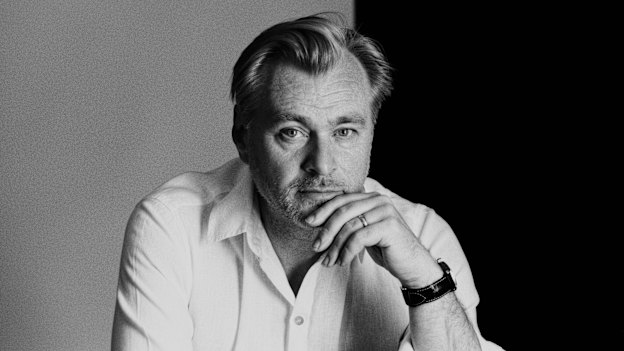
The intangible power, however, is the manner in which events – fictional, fantastical, or for the crew shooting The Odyssey, practical – are connected across the chasm of history.
“[At the filming location] you’re really experiencing something that people thousands of years ago would have experienced, hearing it the way they would hear it, feeling it the way they feel it,” Nolan says. “Then we’d have to put the [boat’s] engine on, destroy the illusion. But for a lot of time, we were able to really experience the beauty of that, the freedom of it, but also the fear of it.
“You were completely at the mercy of Poseidon. You’re bouncing around all these waves, doing the best you can to call the favour of the gods. And that’s what it is. Certainly, it’s getting closer to a sense of a connection between ancient times and now to be able to have the privilege to be able to do things like that. That was pretty magical.”
And what that waterlogged reality delivers in true grit is felt in every frame. The sounds of water, boots in the dirt and swords clashing may be fine-tuned in the sound mixing studio, but there is an earthly truth to Nolan’s art that makes it compelling to watch and to experience acoustically. It’s impactful, and it boldly challenges the instant coffee-style era of AI and deepfake filmmaking.
Whatever the AI revolution means – however it lands and what form it ultimately takes – it is clearly the herald of looming changes on the artistic horizon. Even the ground we’re standing on for Nolan’s interview with Good Weekend – the Warner Bros lot, owned by Warner Bros Discovery – is a 25-hectare dream factory, which is part of a gigantic $US110 billion (about $156 billion) acquisition offer from Paramount Skydance, currently pending approval by US and European regulators.
Nolan, who is president of the Directors Guild of America, is less worried about the technology than the people using it.
“What we’re always in danger of losing is our empathy and our humanity, whatever the new technology is,” he says. “AI is the same as so many technologies that came before, where, if it’s all pursued for pure profit by corporations who aren’t accountable for their human instincts, or there’s no human accountability, everything’s removed.
“So [if] everything is just what Wall Street says, we’ll pay the most money to shareholders, whatever; then we lose our community, we lose our humanity. That’s always the danger, but I’m very much an optimist in those terms. I think we are all hardwired to protect those things. Yes, there’s a point at which they become challenged, and then you have to push back, and that pendulum carries on swinging.”
Nolan views the rise of the tech titans as the latest iteration of the ascendance of a wealthy class and the tensions it creates between enriching particular individuals and then what benefits wider society as not unlike the rise of the railroad barons some 200 years ago.
“It’s exactly the same,” he adds. “At risk is always humanity and mutual respect and the things that bind us together as human beings. That’s a constant struggle, and I don’t believe it will ever be lost, but it’s not ever going to be won either. That’s the problem. To bring it back to Homer, when you look at The Odyssey, when you look at The Iliad, these are the things you find, these eternal struggles.”
And the 10-year-old boy who sat in a darkened cinema watching Clash of the Titans, with its imperfect effects brought to vivid life by a beam of light shot through a strip of plastic negative film coated in an emulsion of silver halide crystals – perhaps a process as close to alchemy as any modern technology might get? That boy is perhaps his most important collaborator.
“You try to keep him in the room,” says Nolan, his voice underlined with sentiment. “The memories of your experiences of watching movies, particularly in a movie theatre when you’re young, they’re very special, and the screen had real depth and the sound had real depth and the possibilities were truly infinite. I think you have to absolutely carry that with you into your filmmaking. You don’t ever want to lose that.”
The Odyssey is released on July 16.
Read more from Good Weekend:
- How a family secret shaped a cinema icon’s career
- Rachel Ward and Kathy Lette on botox, menopause and sexism
- How Luke Bateman became Australia’s most unlikely book influencer
- Never in her wildest dreams did Ita Buttrose think her career would go the way it did
Get the best of Good Weekend delivered to your inbox every Saturday morning. Sign up for our newsletter.

















































