3 months ago
43
3 months ago
43
Archie MitchellBusiness reporter

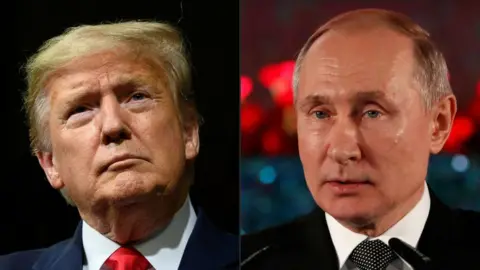 Getty Images
The Trump administration's decision to ease sanctions on countries buying Russian oil has been welcomed by the Kremlin and has sparked deep concern among pro-Ukraine campaigners.
The US waiver, active for one month, will let countries buy up Russian oil which, under current sanctions, has been floating at sea, unable to be sold.
Treasury Secretary Scott Bessent said the "tailored, short-term" policy move would reduce the economic impact of the US-Israel war with Iran.
But Bill Browder, a sanctions campaigner and leading critic of Putin's regime, told the BBC the move was "a terrible decision that will enrich Vladimir Putin and prolong the war in Ukraine".
The waiver applies to oil which was loaded onto vessels before Wednesday.
Until now US sanctions have prevented countries from purchasing the oil. In August Washington imposed a 50% tariff on imports from India over allegations the country was helping to finance Putin's war in Ukraine by buying Russian oil.
Much of the sanctioned oil was left on tankers off the coast of India and other Asian countries, with traders searching for buyers willing to take it.
Putin's economic envoy, Kirill Dmitriev, said the move showed Russia was integral to the stability of the global energy market and that the further loosening of sanctions was "inevitable".
Bessent has insisted that Russia will only see a limited financial boost from the sale of the oil, while the move addressed the "instability posed by the terrorist Iranian regime".
But the BBC has heard from experts who warn that Russia would in fact see huge financial gains with even a marginal easing of the limitations.
Benjamin Hilgenstock, head of macroeconomic research and strategy at the Kyiv School of Economics, said the move was "a serious bailout" for Putin's regime.
He estimated the move could see monthly Russian oil exports boosted by around $10bn (£7.5bn), with half of this being paid in tax straight into the government's coffers.
If the crisis in Iran were to last only a month or two, the pressure on Russia would be reduced, but if it lasted much longer it would put Russia "back in quite a comfortable situation".
Will it take the pressure of the oil price?
Meanwhile, the move would help global energy markets only "on the margins" said Hilgenstock.
Warren Patterson, head of commodities strategy at Dutch bank ING, agreed, suggesting the US move would "only scratch the surface" of the supply disruption in the Persian Gulf.
"There is only one solution for the oil market and that is getting oil flowing through the Strait of Hormuz," he added.
Patterson said the countries most likely to buy up the newly-available Russian oil would be India and other Asian countries who have been most affected by the closure of the strait.
Around a fifth of oil traded globally passes through the Strait of Hormuz in normal times. That trade has hit a virtual standstill, reducing the supply of oil on the global market, raising fears that disruption may go on for some time, and pushing the price up sharply.
In turn that has worried politicians who see a renewed threat to inflation through higher energy costs.
While the overall impact from the US move may not prove significant, pro-Ukraine campaigners have said it marks a symbolic shift in the Western consensus away from applying maximum pressure on Russia.
Alexander Kirk, sanctions campaigner at human rights group Urgewald, said the message to the Kremlin is "wait long enough and the West will blink".
"Russia has already made billions from fossil fuel exports since the strikes on Iran began.
"Allowing more Russian oil onto the market now only helps refill the Kremlin's war chest," he added.
Amid fears other countries would follow the US in easing sanctions on Russia, Britain's energy minister Michael Shanks insisted the UK would not.
"What we absolutely can't have is Putin sitting in the Kremlin seeing this as a chance to invest in the war machine," he told the BBC.
Regardless, the Centre for Research on Energy and Clean Air (CREA), said Putin would take the opportunity to clear the tankers it has at sea and once again boost Russia's oil production.
CREA Russian energy analyst Isaac Levi said the country had been forced to slow its production due to storage constraints, and will now be able to reverse this.
Hilgenstock said the crisis in the Strait of Hormuz was, from the perspective of Russia policy, akin to an "act of God" that had pushed the West's anti-Russian sanctions regime beyond its limits.
Sanctions against Russia relied on the global oil market being able to work around the hit to overall oil supplies, he said.
"The challenge in the Strait of Hormuz is so massive, that ability is gone for now."
"There is not much that we can do until it is over."