
 2 months ago
53
2 months ago
53
2 hours ago
Paul SeddonPolitical reporter

 Reuters
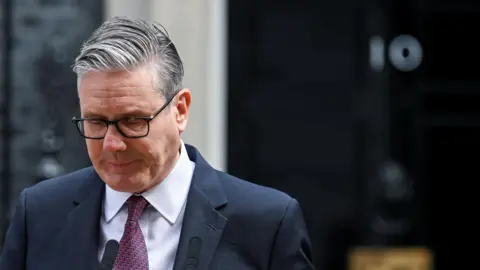
Sir Keir Starmer has announced his resignation as Labour leader, heralding the end of his time in 10 Downing Street.
He has said he will stay on as UK prime minister until his successor is in place.
Pressure on the Labour leader had been building for a while, amid dire poll ratings and a series of damaging revelations over his decision to appoint Peter Mandelson as his US ambassador last year.
Elections to the Welsh and Scottish parliaments, as well as local councils in parts of England, in May had long been billed by gloomy Labour MPs as a last chance for him to prove he could turn things around.
In the end, the results were devastating, prompting Wes Streeting to resign as health secretary, as well as a clutch of more junior ministers.
An ally of Andy Burnham quit as MP for Makerfield, clearing a path for the then Greater Manchester mayor to fulfil his ambition of returning to Westminster to challenge for the Labour crown.
Sir Keir had previously been able to block Burnham from standing in a by-election in February. But with scores of MPs demanding his resignation in the wake of the election results, he did not have the authority to repeat the move.
His standing ebbed further when a long-simmering row behind the scenes over defence spending prompted Labour stalwart John Healey to resign as defence secretary earlier this month.
Burnham's decisive victory in Makerfield last week, where he increased Labour's majority over Reform UK, further strengthened his appeal to many MPs.
Sir Keir initially insisted he would contest a challenge to his leadership, despite several of his cabinet ministers privately urging him to quit.
But after mulling it over this weekend, he ultimately concluded he did not have enough support among Labour MPs to make a make such a move viable.
When might a new leader be selected?
An official party timetable is yet to be announced, but in his resignation speech Sir Keir said contenders to replace him would have between 9 and 16 July to garner the necessary support to stand.
The party's rulebook says candidates need to be nominated by 81 Labour MPs, as well as either 32 of Labour's 634 local branches, or three organisations affiliated to the party (including two trade unions).
If more than one MP clears this threshold, there would then be a vote among party members and affiliated trade union supporters to pick a winner before Parliament returns from its summer recess on 1 September.
But there are already signs that this may not be required.
Burnham has confirmed he will be putting himself forward and is widely regarded as having more than enough support among Labour MPs to get on the ballot.
But as yet no other Labour MP has said they will stand, whilst potential leadership rival Wes Streeting ruled himself out and threw his weight behind Burnham within hours of Sir Keir's resignation.
Does this mean a coronation?
If Burnham is nominated without another candidate throwing their hat in the ring, he would automatically become Labour leader without a contest.
It raises the prospect that he could then be propelled into Downing Street as early as mid-July, less than month after taking up his seat in Parliament.
The possibility of such a curtailed contest has already led to some calls from Labour MPs for Burnham, who has been out of Westminster for nearly a decade, to set out further details of his blueprint for office.
It has also raised questions over how Sir Keir would achieve his stated desire to ensure an "orderly handover of power".
The outgoing prime minister is due to attend a Nato leaders' summit on 7 July, by which point he had promised to finally unveil the military spending plan that led to Healey's resignation as defence secretary.
But it remains to be seen whether that can now go ahead, given the cash to fund it was due to be found by re-writing the budgets of government departments.
And in the wake of Sir Keir's announcement, a scheduled UK-EU summit Sir Keir had been planning to attend on 22 July has been postponed.
Will there be a general election?
Whoever won a Labour leadership election would automatically become the prime minister, without the need for a general election.
This is ultimately due to the fact that British prime ministers derive power from commanding the confidence of the House of Commons, where Labour enjoys a massive majority.
Labour's current leadership rulebook is meant to ensure leaders have a mandate from the party's members and trade unions, as well as its MPs.
But the party has never run a full contest under these rules whilst in power, with all the uncertainty and disruption it entails.
Unlike Sir Keir, who entered office after fighting the 2024 election on a 136-page manifesto, Burnham has only offered glimpses of his possible policies during the month-long Makerfield campaign.
Unsurprisingly, there have already been calls, including from Reform UK, for the former mayor to call a snap election if he is effectively crowned leader.
But there is nothing that would force him to do so, with the next UK general election not legally required to be held until 2029.


















































