3 months ago
17
3 months ago
17
Opinion
December 8, 2025 — 7.30pm
December 8, 2025 — 7.30pm
The Albanese government describes Australia’s social media age restrictions as world-leading, and it is right. Denmark, Norway, France, Italy, Spain, Malaysia and New Zealand are all considering similar laws. Last week, the European Parliament approved a proposal by large majority calling for a ban on social media for people under 16. EU President Ursula von der Leyen and French President Emmanuel Macron have both voiced strong support.
The policy has equally vocal critics. In October 2024, 140 academics, child rights advocates and civil society organisations signed an open letter opposing the measure as undermining the digital rights of young people. The Digital Freedom Project has backed a constitutional challenge that is heading to Australia’s High Court, while Senator Ralph Babet proposed a repeal bill co-signed by senators including Pauline Hanson, Matt Canavan and Alex Antic.

The social media ban for under 16s begins in Australia on Wednesday, December 10.Credit: Getty Images
These eclectic coalitions for and against reveal competing visions of the internet itself. Some see it as US Justice Stewart Dalzell (later to sit on the Supreme Court) described in 1996: “the most participatory form of mass speech yet developed” that “deserves the highest protection from governmental intrusion”. Others argue that open internet has been superseded by a handful of global platforms dominated by the world’s largest corporations, engaged in algorithmic manipulation to maximise attention and advertising revenue.
Much has been made of the technical complexity of implementing age restrictions and how platforms can accurately verify whether users are under 16. There has been lengthy debate about which platforms are subject to the law and what constitutes “social media”.
But we need to be careful not to assume that because regulation is technically difficult, governments should therefore do nothing. Complexity is not an excuse.
Loading
Global finance is a multibillion-dollar industry in which money moves around the world rapidly and where actors clearly seek to evade oversight. We would never say that given the complexity and global nature of finance, national governments should simply not regulate financial systems. Public interest criteria and economic stability concerns have long shaped financial regulation. As the internet increasingly constitutes our collective information infrastructure, governments have legitimate grounds to harness corporate power and direct it towards addressing citizens’ concerns.
One reason for such interest in Australia’s initiative is the abject failure of industry self-regulation regarding both content moderation and protection of minors. For decades, social media companies have required users to be aged 13 or over, yet such requirements were consistently ignored by users and rarely enforced by platforms.
Much of the resulting social media mess and associated online harms may have been avoidable if measures had been taken earlier to age-gate digital content so that children did not simply step directly into the adult internet. Only government action has belatedly forced tech companies to address these issues, such as Instagram’s Teen Accounts feature. Waiting for the tech industry to prioritise safety as a social obligation has failed, and whistleblowers such as Frances Haugen and Sarah Wynn-Williams have spoken of the low regard given to such concerns in Silicon Valley.
US won’t lead, so world must
Australia finds itself at the crossroads of two divergent paths for internet governance. Since Donald Trump’s re-election as US president in 2024, it has become readily apparent that he has the strong support of the world’s largest tech company leaders, who want no restrictions on digital technologies and AI development at home. They routinely lobby Trump to declare such regulations in other countries as both attacks on internet freedom and unfair impositions upon US tech companies.
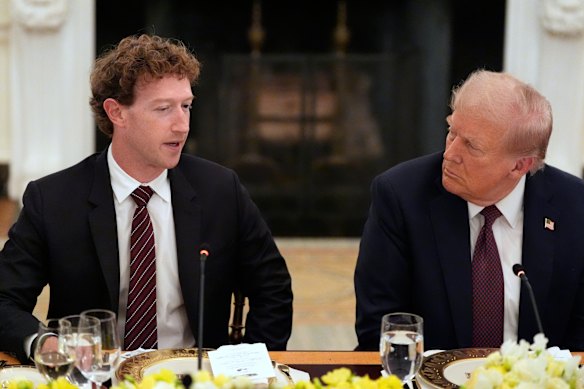
Facebook CEO Mark Zuckerberg attends a dinner with President Donald Trump on September 4.Credit: AP
America will not follow Australia’s lead. Constitutional barriers around free speech make similar restrictions there virtually impossible. This means the rest of the democratic world must chart its own course if it wants to regulate big tech in the public interest.
Australia has, perhaps surprisingly, found itself at the forefront of a different approach to the internet and social media by which the benefits of digital innovation are balanced by public interest regulations to maximise the social dividend of tech advancement. This will not come from the current US government or from appealing to tech companies’ social responsibility.
With the News Media Bargaining Code, the decision not to allow text and data-mining exemptions for AI companies under the Copyright Act, national content quotas for overseas streaming giants, and now the Online Safety Act amendments, Australia has become a major example of a small country seeking to regulate digital tech giants.
None of these measures are perfect. All have implementation challenges, and they will not magically solve every problem with what critics call surveillance capitalism and a predatory online environment. But collectively, they demonstrate that an activist government can address legitimate public concerns about the digital world rather than simply shrugging and declaring everything to be too hard.
Loading
For too long, it has been left to parents, teachers, carers and other busy individuals to navigate the digital world in their children’s best interests. They have typically received little help from global tech giants, who more often see young people as target demographics rather than emerging digital citizens. When people feel powerless in the face of change, they look to governments to address their concerns. Social media age restrictions are one way that cry is being heard – not as a failure of parenting, but as a demand for corporate accountability.
Terry Flew is the professor of digital communication and culture at the University of Sydney and co-director of the Centre for AI, Trust and Governance. He is an Australian Research Council laureate fellow, researching the changing nature of trust in a digital world.
Most Viewed in National
Loading