3 months ago
30
3 months ago
30
In a courtroom drama, the moment the hero lawyer stands to begin their cross-examination, the room falls silent with expectation.
Fixing their opponent with a steely gaze, they quietly set about dismembering the testimony, character and credibility of someone whose evidence just minutes earlier seemed unassailable. In a flourish, the case is turned on its head.
Actual trials, I hate to report, are less dramatic and rarely as satisfying. But the mechanism is true to life.
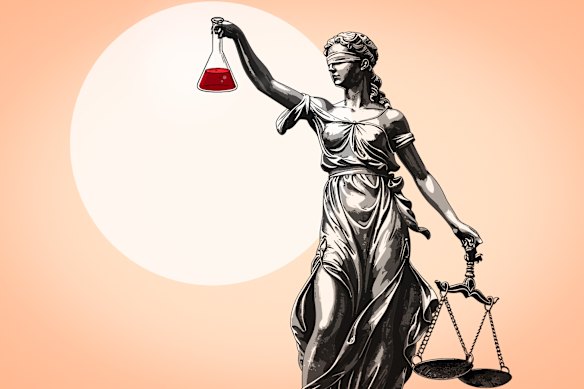
Justice and science are a difficult mix.Credit: Matt Absalom-Wong
Cross-examination is said in legal circles to be “the greatest legal engine ever invented for the discovery of truth”. In contested cases, courts rely heavily on a barrister’s ability to test character, tease out facts and unveil falsehoods.
Ken Crispin was just such a barrister, then a director of public prosecutions, then a judge in the ACT. And as a judge, in 2001, he wrote an extraordinary, prescient judgment in a trial over shaken baby syndrome which eviscerated the prosecution evidence. The scientific “proof” of the syndrome, Crispin wrote, was based largely on anecdote, theory and unreliable confessions.
I interviewed him for a forthcoming bonus episode of my podcast, Diagnosing Murder, and our conversation turned to how difficult it was even for a whip-smart practitioner such as himself to properly cross-examine scientists.
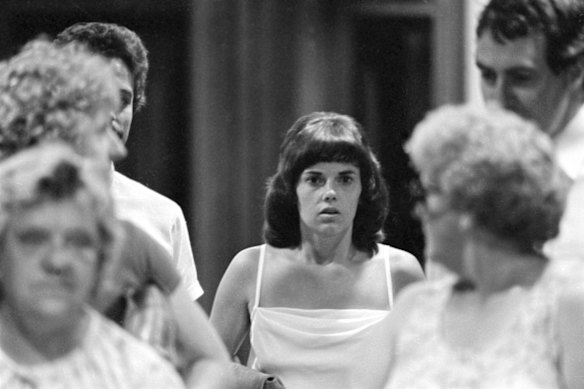
Lindy Chamberlain was convicted over the death of her baby, Azaria, on the basis of seven pieces of scientific evidence. Six of them were wrong.Credit: Michael Raynor
As a barrister, Crispin appeared in the 1986 royal commission investigating the wrongful conviction of Lindy Chamberlain. He wrote a book about it and decades later is still outraged at the forensic chicanery involved in her prosecution. There were major errors in six out of seven pieces of scientific evidence used against her. Proving it, though, wasn’t easy.
“We subpoenaed one bundle of documents from one witness and the first page consisted of a series of statements in point form and the points consisted in part of English words and in part of symbols,” he tells me.
“It took me 12 hours with a professor of immunochemistry to work my way through the document and understand exactly what the witness was saying and what might be wrong with it.”
“[After that], in almost any case in which expert evidence was to be given, I would try to persuade my instructing solicitors to engage an independent expert who could advise me, not just the court, so that I’d know what questions to ask,” Crispin says.
That costs money, which many defendants can’t afford. But even if they can, the challenge remains to convey that information to a judge and jury.

This is a small amount of what you need to hire an expert to explain to your lawyer the scientific evidence being used to put you behind bars.Credit: Louie Douvis
“Judges usually know very little about the case at all until it starts,” says Crispin. “Traditionally, they derive all of their evidence from the witnesses in the case … so if there are any problems in the evidence, the courts are almost entirely dependent upon the cross-examination of the counsel … to bring out those errors.”
How good are barristers at doing this?
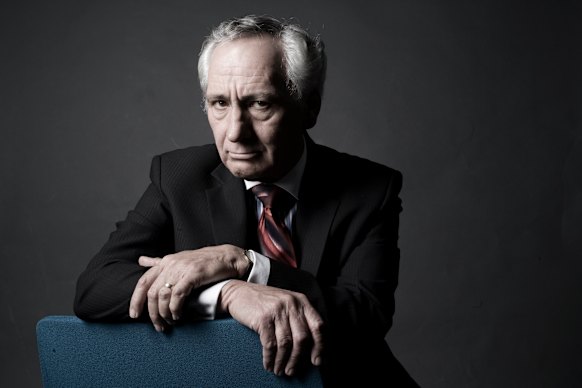
Former Supreme Court judge Ken Crispin says judges are responding to what happens in court – not to the deeper issue of whther the scientific evidence presented has no proper basis.Credit: Louie Douvis
“Barristers vary from pretty hopeless to absolutely brilliant, with most of them more or less in the middle, being honest tradespeople trying their best,” Crispin says.
If all this sounds dispiriting, it gets worse. Pretty much every scientific technique you saw on CSI to identify a “perp” – bite-mark evidence, blood-spray patterns, hair microscopy, voice spectrometry, lie-detector tests – are junk science. None of these was ever widely used in Australia, but it took a systematic review of forensic science in the United States to discredit them entirely.
Even fingerprint matching – which does work, and has been used in Australia since the early 1900s – is prone to user error.
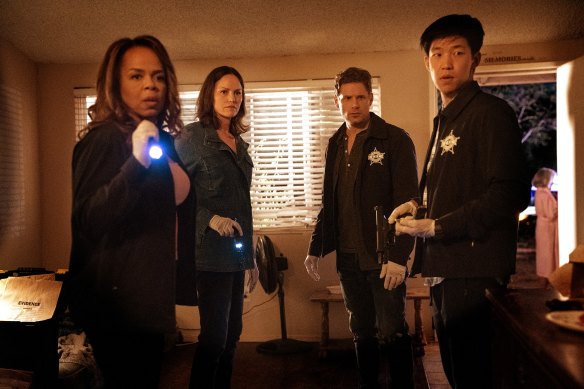
CSI: Don’t believe a word of it. It wallows in junk science.Credit: Paramount+
Professor Gary Edmond, the director of the program in expertise, evidence and law at the University of NSW, tells me about an experiment in which researchers asked fingerprint experts to judge whether two sets of prints matched.
But there was a catch.
The same experts had previously matched the same prints in earlier court cases. To test the consistency of these findings, the researchers dropped subtle suggestions to their experts that the prints would likely not match. The result? “Most of the fingerprint examiners in that cohort reversed their opinion,” Edmond says.

Think fingerprints are foolproof? Think again.
What it shows is that, even on an objective test, experts are as susceptible to the power of suggestion as the rest of us. It’s an effect that happens “at levels that you’re not aware of, and you can’t train your way out of it”, Edmond says.
Science makes experiments “double-blind” to eliminate these biases. But in courts, says Edmond, biasing information is built in – from where the defendant sits to who hires the expert. Many scientists, including police traffic reconstruction experts and forensic doctors, actually work for the state and appear exclusively for the prosecution. The expectation on them is pretty clear.
And to juries, their evidence carries great weight. They are presented as having special knowledge, and are the only witnesses permitted to offer an opinion. A cross-examiner needs to be at the top of their game to successfully challenge this expertise. Even if they do, the jury must be focused enough “to comprehend the significance of the questioning and the significance of the answers”, Edmond says.
Almost a decade ago, all this led to one of our most eminent judges, Chris Maxwell, to a revelation.
“It is simply chilling to read of the hundreds of exonerations (through subsequent DNA testing) of individuals wrongfully convicted in US courts, and imprisoned, on the basis of ‘junk’ science,” Maxwell said in a speech to a law reform conference in 2017.
The problem, he thought, was “the scientific illiteracy of the participants in the trial”. As for judges, he echoed Crispin’s point: They “tend to be insulated from, and practically incapable of, engaging with scientific knowledge and the best scientific advice”.
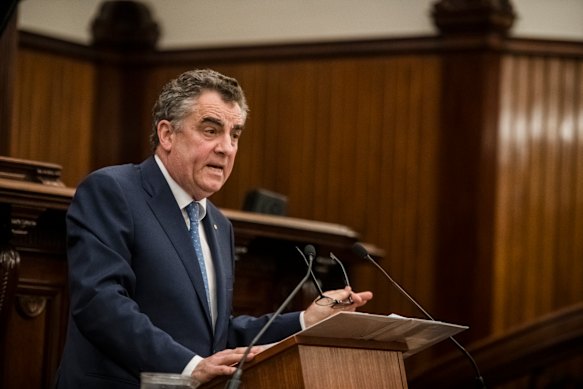
Jurist Chris Maxwell says “the scientific illiteracy of the participants in the trial” all too often gives rise to miscarriages of justice.
Two cases prompted Maxwell’s revelation. One was R v Klamo – a shaken baby case. The expert witness in that case made it clear that the evidence presented could not establish beyond reasonable doubt that the child’s death had been caused deliberately. But the jury either misunderstood or ignored his evidence and found the man guilty anyway.
Klamo spent a year in jail until the Court of Appeal, with Maxwell writing the key judgment, set him free.
The misunderstood expert was Professor Stephen Cordner – the former long-time head of the Victorian Institute of Forensic Medicine. Cordner told the Diagnosing Murder podcast that when he read Maxwell’s judgment, “I thought, ‘Thank God. Somebody … understood what I said’.”
He added: “That is the type of involvement that sears the soul. This is such serious stuff. People go to jail … So there’s nothing quite like that to focus the attention.”
That case prompted Cordner to take a harder look at shaken baby cases. He now wants an inquiry into the scientific basis for the diagnosis because convictions rely too heavily on the views of the state’s small group of forensic doctors. And they (for largely admirable reasons) have an immovable view of what globally is highly contested science.

Emiturus Professor Stephen Cordner, an expert in forensic medicine, wants a public review into shaken baby syndrome.Credit: Jason South
As for Maxwell, he was worried enough to write a new Supreme Court practice note instructing all lawyers on how to deal with expert evidence.
In June 2025, that note got a significant update. The judge behind the update was Justice Kristen Walker – who has her own experience of a major shaken baby case.
Walker was the dissenting judge in a Victorian appeal in 2021 that hammered out the scientific arguments around shaken baby syndrome. Walker thought the appellant, Jesse Vinaccia, should be released immediately because his conviction was unsound. But she was outvoted. Her two fellow judges preferred the forensic doctor’s assurances, Vinaccia stayed in prison, and a precedent was set.
Walker’s updated note on expert evidence now demands that where scientific, medical or technical evidence is led, the prosecution or defence should ensure it is “repeatable, reproducible and accurate”. Good science, in other words.
A recent judgment of the New Jersey Supreme Court, also in a baby-shaking case, found this kind of scientific proof was a “bedrock” of the legal system because “only evidence that is sufficiently reliable … may be presented to the jurors”. Their inquiry into that case found shaken baby syndrome was “conjecture”.
Australia, though – as the Australian Academy of Science has repeatedly pointed out – has no such “reliability” standard. So does the Victorian Supreme Court’s new practice note establish one?
Not really.
A defence lawyer working in the field, Holly Boylan – who had a client acquitted of child homicide in a shaken baby case last year – says the practice note, while admirable, is unenforceable.
“It’s a statement of expectations, but doesn’t dictate what happens if those expectations are not met,” Boylan says.
The blockage is a High Court case which, in 1998, said questions of the reliability of any evidence, including scientific evidence, was up to juries to decide. In practice, it means judges are rarely permitted to stop juries hearing expert evidence – even if it’s based on dodgy science.
That’s the law. And, as Boylan says, “the law trumps a rule”.
So we’re back where we began – relying on the knowledge, competence and eloquence of barristers and the intelligence and receptiveness of juries.
Our system is good. It gets it right most of the time – 90 per cent of the time, indeed probably more. But all of us should find it disturbing that, when we get it wrong, people who’ve done nothing wrong end up serving time in prison.
In Maxwell’s words, that’s “chilling”. It should, as Cordner said, “sear the soul”.
Surely, the least we should demand of courts is that our juries are not being fed on junk.
In need of some good news? The Greater Good newsletter delivers stories to your inbox to brighten your outlook. Sign up here.
Most Viewed in National
Loading