2 months ago
6
2 months ago
6
When Emily walked into maths class at uni, there were only three women. Then something changed
When Associate Professor Zsuzsanna Dancso walked into her first advanced mathematics lecture at the University of Sydney in 2020, the numbers hit her instantly: 30 male students and just three women.
The seasoned mathematician didn’t need an equation to know the ratio was off.
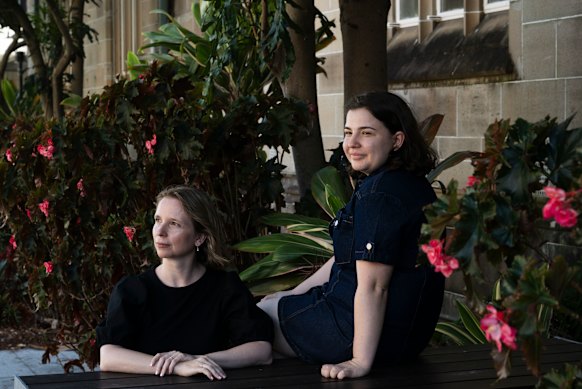
Maths associate professor Zsuzsanna Dancso (left) with one of her former students, Emily Cooper, at the University of Sydney. Credit: Janie Barrett
“I had been in maths for a decade and a bit but that ratio was stark, even for me,” she said.
Dancso was determined to figure out what was going on – and stop the “nosedive”.
“Enrolments from female and gender diverse students in the advanced version of our maths curriculum the highest level of maths in our university were falling, becoming lower and lower,” she said.
She found that although 35 per cent high school leavers who complete maths at the highest level were female, only 22 per cent of women went on to do the highest level of maths at Sydney University.
She had a theory: “Maybe these women who are coming in don’t think they are qualified to take this course.”
She set out to create a community for women in maths, forming a mentorship program for young female and gender diverse students.
Before the start of semester, professors compared first year enrolments with students’ higher school certificates and majors. Students who enrolled at a lower level than their background would suggest were sent personalised emails encouraging them to switch to the advanced level.
“Anyone who is taking an advanced maths course and self-identifies as female or gender diverse can sign up. Usually, this means 50 to 80 students a year.”
Loading
Each student was placed into a mentorship group with a senior student and an academic. “There are discussions of maths topics, study parties, there’s also discussions of how to adjust to university and study effectively,” she said.
It worked – this year female enrolments in advanced first year maths were back up to 30 per cent – nearly equal to the high school levels and a record high since that infamous lecture, five years ago.
Emily Cooper was one of the three women sitting in the lecture hall the day Dancso presented her first lecture. She described it as “a shock”, and wondered if she was in the right place.
“I went from an all-girls high school where we all wore pink,” she said. “It was a very female-driven school. And then coming into uni was a bit of a shock. You are wired to look for what you know. It was a bit of an ‘am I in the right place?’ situation.”
Cooper was invited to join the mentorship program. It made all the difference. “[When] bringing any person into a new environment, is helps a lot to know that that thing is possible,” she said.
She went on to become a mentor herself, helping younger students.
“If it was a perfect utopia, you wouldn’t need programs like this, but we are still at the stage where there is a very stark discrepancy that we are moving towards correcting,” she said.
Dancso agrees. “When self-doubt is a part of the issue, you can’t solve the problem with general messaging,” she said. “It is so important to have personal relationships and mentorship and community.”
Most Viewed in Politics
Loading