3 months ago
19
3 months ago
19
The image was confronting: Venezuela’s President, Nicolás Maduro, handcuffed aboard a United States warship, the USS Iwo Jima. It was a moment that made clear 2026 will be no calmer than the year before. From Australia, this may appear a distant drama in the Americas, tied to Washington’s long-running efforts to counter narcotics trafficking. But that framing misses the point.
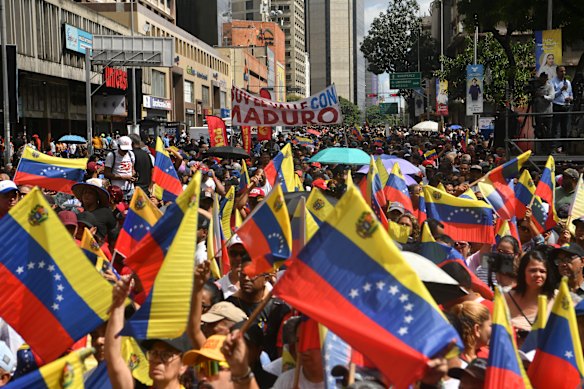
Pro-government supporters attend a rally a day after the capture of Nicolás Maduro.Credit: Getty Images
What unfolded in Venezuela exposes a growing tension at the heart of today’s global order. On one hand sits a faltering system of international law, anchored in the UN Charter, designed to restrain the use of force. On the other sits deterrence aimed at preventing use of force, increasingly tested in a world where adversaries question the willingness of major powers to act. The US response signals a decision to privilege deterrence over legal restraint. The consequences may be stark, but the reality of geopolitics is rarely clean. Recognising that reality is not the same as endorsing it.
This shift matters well beyond Latin America, particularly in the Indo-Pacific. It suggests a United States prepared to act decisively, and unilaterally, when it judges its interests to be at stake. These actions are controversial and ethically fraught in international law terms. That judgement should not be confused with sympathy for Maduro, an authoritarian leader whose rule has been marked by widely criticised elections and documented human rights violations. They also reinforce American deterrence at a time when its credibility is being tested. For Australia, the implication is unavoidable. Our security depends on a major ally willing to back its words with force, even as the rules governing that force come under strain.
That tension between law and deterrence did not emerge overnight. Since the end of World War II, the use of force has been governed by the UN Charter, which permits military action only with Security Council authorisation or in self-defence. With the Council paralysed, states are increasingly willing to use force to pursue foreign policy objectives, a trend reflected in the seizure of Maduro.
The past few years have seen a steady return to the use of force as a tool of statecraft. Russia’s illegal invasion of Ukraine continued, conflict escalated across the Middle East, and tensions flared elsewhere in Asia. The taboo on the use of force has weakened, not because the rules no longer exist, but because the institutions meant to enforce them are failing and states see advantage in using force.
Loading
The implication is stark. States can no longer rely on a broadly peaceful international environment, or on international law alone, to prevent the use of force. They must actively discourage it. This is where deterrence comes in.
While US action in Venezuela illustrates the erosion of legal restraint on the use of force, it also sends a different signal. It demonstrates US seriousness about deterrence. Generalisations on deterrence should be avoided, but at its most basic it rests on capability, credibility and communication.
The US action in Venezuela may yet produce ill-fated consequences. But the willingness to act, particularly after explicitly signalling that it would, mirrors earlier US strikes against Iran in June 2025. Together, these actions suggest a Trump administration that is not isolationist and is prepared to use force.
For deterrence, that willingness matters. Credibility is built not on statements, but on follow-through. And for Australia, whose security depends heavily on the credibility of its principal ally, that reality may be uncomfortable, but it may also make Australia safer in an increasingly dangerous world.
Loading
But Australia cannot outsource its security to its ally. It is not the United States’ responsibility to defend Australia. That burden rests with us. In a world where the use of force is again a tool of statecraft, Australia must adapt to strategic reality rather than nostalgia. That means reassessing the effectiveness of our own deterrence strategy, particularly its credibility and capability.
The 2026 National Defence Strategy and Integrated Investment Program provide an opportunity to do so. But strategy without investment is illusion. Credible deterrence requires sustained commitment, resolve and money. The lesson from US actions this week, ethics aside, is clear. Deterrence depends on capability and the demonstrated willingness to use it. An island nation with a small, ageing navy and limited missile defence cannot afford complacency.
Australia must pay attention to Venezuela, to Europe, to the Middle East and to China’s actions around Taiwan and the South China Sea. These are not disconnected crises. They are signals of a world that has changed, and of hard choices Australia can no longer afford to avoid.
Jennifer Parker is an expert associate at the National Security College, Australian National University and non-resident fellow with the Lowy Institute.
Get a weekly wrap of views that will challenge, champion and inform your own. Sign up for our Opinion newsletter.
Most Viewed in World
Loading