
Behind the counter of a bodega in Brooklyn, a cashier casually rang up a tiny vial of a peptide the store advertised as retatrutide — an experimental weight-loss drug whose sale is generally prohibited by federal law.
"PEPTIDES SOLD HERE" reads a large sign displayed on the storefront of Mr. Green, a small shop on a busy stretch of Bedford Avenue sandwiched between a poke restaurant and a funeral home. The poster promotes retatrutide for "weight management," though it also says in small type that the peptides on offer are "not for human consumption" — a disclaimer that doesn't appear to be hurting business.
An employee manning the counter on Tuesday afternoon initially wasn't sure if he had any retatrutide left.
"This sh** has been selling," the employee said, before locating a vial and selling it to a CBS News reporter for $95. No age verification, no medical questionnaire, no prescription needed.
The sale of what is billed as retatrutide in multiple New York bodegas shows how the craze for an experimental drug — which has not been approved as safe and effective by the Food and Drug Administration — has migrated from shadowy online vendors into brick-and-mortar retail settings where it is sold alongside sodas and snack food.
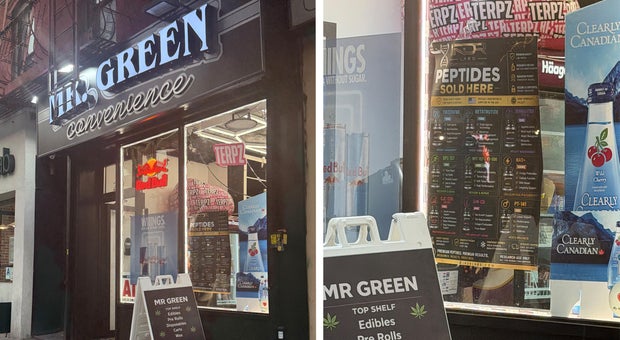 At the Mr. Green convenience store in Brooklyn, a sign in the window, seen in the closeup on the right, advertises peptides from Indr Labs, including retatrutide, an experimental weight-loss drug that has not been approved by the FDA.
CBS News
At the Mr. Green convenience store in Brooklyn, a sign in the window, seen in the closeup on the right, advertises peptides from Indr Labs, including retatrutide, an experimental weight-loss drug that has not been approved by the FDA.
CBS News
Last month, CBS News documented how, without regulatory approval, retatrutide has gone viral online and was being widely prescribed by licensed medical professionals. But the brazen advertising and sale of an unproven, research-grade version of retatrutide — over the counter — shocked some medical experts.
"I was surprised that there would be a company so openly selling a product that's not approved by the FDA," said Jonathan Darrow, an expert in drug regulation who previously taught at Harvard Medical School. "What argument could they possibly be putting forth to justify this?"
The vial purchased by CBS News bears the label of a peptide vendor called Indr Labs. A QR code links to the company's website, which says its products are "for research use only" — language that doesn't appear on the vial itself. Federal law allows experimental drugs to be used in clinical trials or animal research in limited circumstances, but it prohibits their commercial sale to the public.
On its site, Indr Labs promotes various peptides, claiming that they are tested by a third-party lab for their makeup and purity. Known as certificates of analysis, these lab reports are widely relied on by people who purchase unregulated, research-grade products. But in Indr Labs' case, there are irregularities.
For instance, the certificate for retatrutide shows a graph that appears to identify the sample as a different weight-loss drug, tirzepatide.
In addition, the report indicates the analysis was performed by Vanguard Laboratory. But Tori Johnson, the lab's operations manager, said it is fake — along with the lab reports for other peptides on Indr Labs' website that claim to be by Vanguard, she said.
"We did not issue these [certificates], we do not have a client called INDR Labs," Johnson said by email.
Indr Labs did not respond to emailed questions. It subsequently changed its website to require a password to access the lab reports.
Efforts to reach the owner of Mr. Green were unsuccessful. The FDA didn't respond to a request for comment, but it has warned consumers against buying retatrutide that is labeled for research use, saying such products "are of unknown quality and may be harmful to their health."
A spokesperson for Eli Lilly, which is developing retatrutide to treat obesity and type 2 diabetes, called on regulators and law enforcement to "help dismantle the illicit networks selling these black-market drugs."
In clinical trials, retatrutide has shown that it could be more effective than the most potent weight-loss drugs that have been approved by the FDA. That has ignited buzz on social media and kindled a vast market for the drug well before Eli Lilly even seeks approval from the FDA.
The agency, whose job is to determine whether a drug is safe and effective, has so far struggled to crack down on the sale of retatrutide. When it has taken enforcement action, the agency has singled out companies that claim retatrutide is for research but advertise its purported health benefits.
Indr Labs' website says its peptides have at least "98% purity" and promotes "discreet packaging," but it steers clear of medical claims and requires online purchasers to acknowledge it is only for research use. The advertisement in Mr. Green's storefront, however, lists human-sounding benefits such as "cardiometabolic health" and "weight management" for retatrutide.
And it is not unique.
Barely two blocks away, Classy Bite Deli 2 had the same Indr Labs poster on its window and also offered retatrutide for sale. Efforts to reach its owner were unsuccessful.
Jeff Cohen, a lawyer and co-founder of the American Peptide Association, said advertising research-grade retatrutide in a retail store was "incredibly aggressive."
"It's probably the most aggressive form of product placement" he's seen for retatrutide, Cohen said. Selling research-use peptides is like driving on an interstate, he added: "Every interstate has a speed limit, but nobody abides by it," he said. "People who get pulled over are the outliers from the pack."
While many individuals and some medical professionals say they've seen great results from retatrutide, there are also reports of concerning side effects. America's Poison Centers has tracked a sharp rise in reports of toxicities attributed to the drug, and more claims of adverse events — though unverified — are arriving at the FDA.
On the same day last month that CBS News ran an investigation on the widespread availability of retatrutide, a 72-year-old woman contacted the FDA to report "sever [sic] skin irritation and still seeing doctors" after being prescribed the drug. The woman added, "learned today on CBS news that it is not FDA approved."
In:

















































