3 months ago
18
3 months ago
18
The leaders of extremist religious sect the Plymouth Brethren Christian Church this week tightened their grip over every aspect of their members’ lives and finances, while rejecting the prime minister’s accusation that they’re a cult.
Leaked audio from the church’s annual conference, Strive 26, held on Monday and obtained by this masthead, features Dean and Charles Hales – two of the ultra-wealthy sons of the “Man of God”, Bruce Hales – pressuring the Brethren “saints” to give more money and to hand over more financial information to centrally controlled companies.
The church is facing an ongoing Australian Taxation Office investigation, scrutiny from a parliamentary committee over its widespread support for Peter Dutton at the last election, and a number of audits of its publicly funded school system.
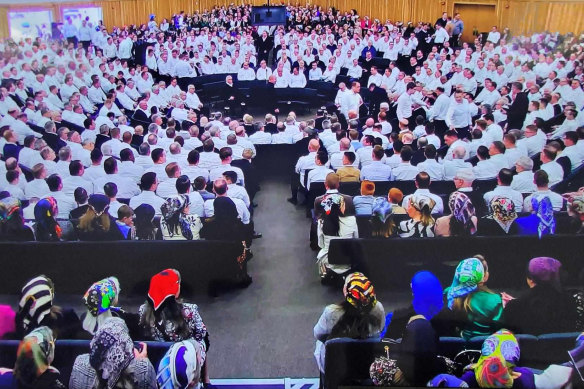
A recent service of the Plymouth Brethren Christian Church.
The sect, formerly known as the Exclusive Brethren, is a closed organisation which preaches a “hatred” for people outside the church. Its followers, known to each other as “saints”, are taught Hales is “so close to the Lord Jesus that he can feel his heartbeat”.
The Strive 26 conference, conducted over Zoom, and at which all Brethren households globally were expected to be present, is designed to shore up the church’s vast “ecosystem”.
The ecosystem is a multi-billion dollar network of entities, overseen by a Global Advisory Panel of senior Brethren members, including the church itself and its charities and investment vehicles, as well as Brethren members’ individual businesses, schools, church properties and its public-facing charity, the Rapid Relief Team.
Individual Brethren businesses were heavily encouraged to divulge all their financial affairs to a central business run by church elders, and to invite Brethren “board advisers” to help their companies prosper.
The Hales brothers celebrated at the conference that properties housing all “gospel halls” globally had recently been pulled under the control of trustees operating out of the PBCC headquarters in Sydney. The PBCC says this is to standardise their operation, to give access to “world-class advice” and to reduce costs.
Families were also told that all school children should have proprietary Brethren spyware called Streamline 3 on their phones for their “protection”.
A spokesman denied these moves were an attempt to centralise control or influence over individuals, private businesses or church properties.
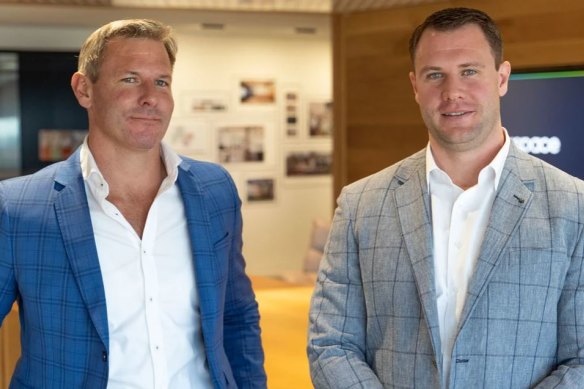
Gareth Hales (left) with Charles Hales, sons of Plymouth Brethren Christian Church head Bruce Hales. Credit: Nine
A key purpose of the Strive 26 meeting was to tap church members for a single, “rolled up” donation to fund its various enterprises, which the church leaders call “one number”.
“I believe the whole ecosystem costs about $430 million per annum to run and the school makes up $370 [million] of that,” Charles Hales told the global meeting of Brethren members.
“This year’s global one number need is $261 million Australian dollars,” another speaker announced – the equivalent of $5000 for every man, woman and child member of the church globally. Separate church documents say its purpose is “elevating circumstances and accelerating prosperity”.
According to a church insider, speaking anonymously for fear of the consequences of being identified: “They say, ‘Give what you can – give until it hurts’.”
We’re not a cult
The church’s leaders spent considerable time saying it was not a cult – a sore point after Prime Minister Anthony Albanese’s campaign-trail accusation spurred by its deployment of thousands of members to campaign for Dutton.
“PBCC is a system of care, compassion and teaching to help us move forward in every area of our lives,” one Australian speaker told the flock. “We’re a Christian church, not a cult. We’re not controlling business, we’re not political influencers.”
Dean Hales, who is widely regarded as his father’s possible successor as “Elect Vessel” of the church, likewise said: “We have guidelines, we have direction, we have ministry, we have the Holy Bible and the scriptures that we seek to lead and abide our lives by. But there’s no ultimate control.”
His brother, Charles, another potential leader, said there was further proof in how often children attended church.
“It’s not even an hour a night. In some instances, it might only be half an hour. So to call the PBCC a group that brainwashes the oncoming generation could not be further from the truth,” he said.
Still, they said adults and children should spend time every day reading “ministry” – the transcribed words of Bruce Hales, who’s also known as the “Minister of the Lord in the Recovery of the Truth”.
“It’s all those daily disciplines of righteousness that sets you up for prosperity … We have to keep at it day in, day out,” Dean Hales told the meeting.
The identities of all speakers were not always clear to this masthead, but one said: “We couldn’t be further from a cult. These men [Bruce Hales, his father and other former Brethren leaders] – they’ve led us, they’ve taught us, they’ve fathered us, they’ve shepherded us. There’s nothing more they could have done for us … That’s every step of our lives we have been shown the way.”
A church spokesman accused this masthead of repeating the “lie to the point that it was even echoed by the prime minister”. It had resulted in personal attacks on members and was “upsetting, hurtful and untrue”.
US sociologist and cultic studies expert Dr Janja Lalich says a cult is characterised by “zealous and unquestioning commitment to its leader”, and that cult adherents regard the leader’s belief system, ideology, and practices “as the truth, as law”.
Peer pressure is used to influence members’ behaviour and the cult discourages questioning, doubt and dissent. Cults also claim a special, exalted status for themselves, their leaders and members, she says.
The Brethren describe themselves as “the saints”; they revere the words of “Mr Bruce”, which are printed and passed to every Brethren household globally. They claim to have “special light” and they have a raft of strict and inflexible rules.
If members leave the church, or are “withdrawn from” (excommunicated) they stand to lose their businesses and livelihoods, access to their families and their entire social circle.
The ATO investigation
In March last year, the Australian Taxation Office mounted an unannounced raid on the global headquarters of the Brethren ecosystem’s “parent company”, the charity Universal Business Team, or UBT. Weeks later, its linked accounting firm shut down.
The Brethren described it at the time as “a regular audit”, but the ATO confirmed it was an “access without prior notice” raid, which happened “only in exceptional circumstances including suspected tax evasion, fraud, secrecy or concealment”.
In one of Bruce Hales’ transcribed ministries from September this year, also obtained by this masthead, he reveals he told his “saints” that: “The Australian Taxation Office have given up their investigation of us. I thought that was a ray of comfort … Amen. Amen and Amen. It’s a mercy”.
But referring to the investigation in this week’s conference, the chief of UBT, New Zealand Brethren businessman Caleb Hall, said the organisation had “made significant progress with the ATO and continue to work with them”.
A UBT spokesman told this masthead that the tax office had finalised actions against two entities that had made voluntary disclosures while other parts of the ecosystem remained under review.
“We are continuing to work with the ATO in a co-operative and transparent fashion,” they said.
The ATO said it was unable to comment due to its obligations under taxpayer confidentiality laws.
In this week’s comments, Hall again described the raid and investigation as an “ATO audit” and said the ATO had “commented that they have a better understanding of who we are and what we do and there has been a movement forward following ongoing transparency and cooperation”.
Charles Hales admitted some shortcomings, telling the Strive 26 meeting: “Whilst we acknowledge that there are things that we could have done better and should have done better, I think honestly, as a team, we would say we’re actually glad that it did happen.
“It’s given us an opportunity to sit back and look at our ecosystem, see how we can design it to be stronger and better fit or a better fit for the future.”
The Universal Business Team
According to the Hales brothers and other Brethren leaders, the church’s response to the ATO investigation would be to “restructure and rebuild”.
Their central entity, which provides advice to Brethren businesses, would be “UBT 2.0”, and it aimed to double the net profit of Brethren businesses by 2030 so that “all of our 56,000 members prosper globally”.
To do this, Dean Hales said, UBT aimed to know the details of every Brethren business’s finances to give them “the best quality advice that we can”.
“It’s about having accurate and timely financial reporting and … you can’t advise anybody until you get accurate reports. If you got an accurate report, it’s like a doctor.
“Accurate financial reporting [of companies’ to UBT] is a non-negotiable.”
Asked if access to those financial details suggested a cult-like level of control, a UBT spokesman said it only requested “financial data from clients when we need it” and it was bound by “normal contracts and non-disclosure agreements”.
Loading
The church ecosystem’s top governing body, known as the Global Advisory Panel, was now “focusing on building strong boards, strong ecosystem entities”.
Dean said Brethren businesses should appoint UBT “board advisers” to go through the details of every business. If individual businesses could not afford to pay, then other businesses could sponsor them.
“They’re unemotional, they’re there to look objectively at your business and can help you dissect where your challenges are … don’t be emotional when you need to cut to the concrete,” Hales said.
Sacked staff could find a job with another Brethren business, he said.
Individual householders were also encouraged to disclose their financial details to the church – including an accounting of their debt, expenditure and savings – through a program called PPP.
Speakers at Strive 26 said divulging this information could put Brethren members “in control of your situation and make better moral, financial and personal decisions in life”.
As for the schools, known as “OneSchool Global” – which Australian governments provide with $37 million in funding – speakers at Strive 26 said recent “non-routine audits and increased scrutiny by the regulators have made it clear we must invest in strengthening our governance”.
“We need to do this to preserve our charitable status and to protect the significant amount of government funding contribution.”
A OneSchool spokesman said it ran “a great school” which was always striving for improvement and, in Australia, complied with all laws.
“As part of this commitment, audits have been conducted across [OneSchool Global] NSW schools and properties. No significant issues were identified,” the spokesperson said.
Be the first to know when major news happens. Sign up for breaking news alerts on email or turn on notifications in the app.