3 months ago
9
3 months ago
9
To pay for those tax cuts, the government needed money. And, like previous governments, it went after tobacco.
It decided to change the point at which importers paid excise on cigarettes.
It was described as a much-needed step against illicit tobacco. But it came with the added bonus of an extra $3.3 billion in tobacco excise in the 2019-20 budget year.
A promised budget surplus, which Morrison said was due to good economic management, would really be built on higher taxes on ciggies.
The crackdown on tobacco across the nation’s wharves (plus higher excise rates) would swell expected cigarette excise to a record $17 billion in 2019-20.
So gung-ho were our tax collectors that just a few months later they upgraded expected excise collections by another $400 million in 2019-20 and by $3.2 billion over the following three years.
But it quickly became apparent that the tobacco cash cow was in trouble.
Instead of collecting $17.4 billion in 2019-20, the government raised $16.3 billion.
Coupled with the increases in excise (from 80¢ a stick in 2018 to $1.40 today), the change in when tobacco was taxed was the financial incentive needed for organised crime to flood Australia with dodgy cigarettes.
This was the starting point for the huge tobacco-excise hole in the current budget.
By March 2022-23, for which Frydenberg had forecast tobacco excise of almost $17 billion, the actual amount collected was $12.6 billion.
That same budget, Frydenberg forecast excise would raise $13.6 billion in 2025-26. Chalmers last month revealed it will be closer to $5.5 billion this financial year.
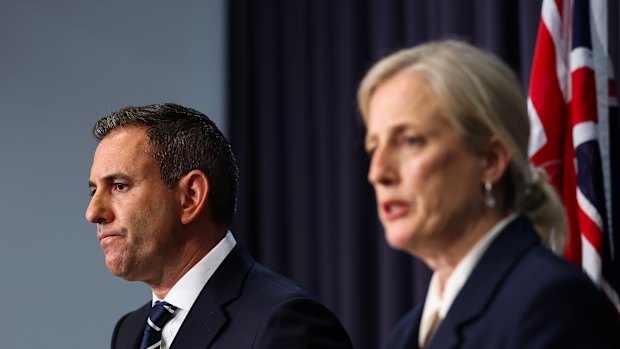
Treasurer Jim Chalmers and Finance Minister Katy Gallagher revealed in the mid-year budget update in December another increase in the cost of the GST deal.Credit: Alex Ellinghausen
The gap between what the government was expecting in tobacco excise back in 2018-19 and what it is forecasting to receive by 2029-30 is now an eye-watering $67 billion.
To be clear, what happened with the tobacco revenue collapse is not Morrison’s fault. The experts who backed the change in taxing arrangements did not foresee the reaction of criminals and law-abiding smokers.
Loading
But seven years on, with governments throwing more money at policing dodgy tobacco outlets and a war among criminal gangs playing out on the nation’s streets, no one can deny the problem that was created.
Six months after the tobacco decision, Frydenberg delivered his first mid-year update, which contained the government’s solution to a huge political problem – the amount of GST flowing to Western Australia.
Both sides of politics knew they had to cobble together something, otherwise WA (which had been in a recession for almost two years) would end up not getting a dollar of GST.
The government decided to top up the GST pool to give WA more cash. Added to that was a promise to make sure no other state or territory was left worse off.
At the heart of the fix was an assumption that iron ore prices would fall. Lower iron ore prices would, under the complex way GST is shared among the states and territories, mean WA’s share would increase naturally. On this assumption, the federal government locked in the amount of GST that WA would receive. The federal government – and its taxpayers – would “only” be on the hook for $2.3 billion.
But iron ore prices did not fall.
Iron ore prices were forecast in 2018-19 to drop to $US55 a tonne. They have never dropped that low. During the pandemic, they almost reached $US220, while they ended 2025 at almost $US110.
So, rather than $2.3 billion over four years, this bipartisan policy is now on track to cost more than $50 billion by the end of the decade.
Oops.
Unlike the tobacco change, there were warnings the GST deal could go pear-shaped.
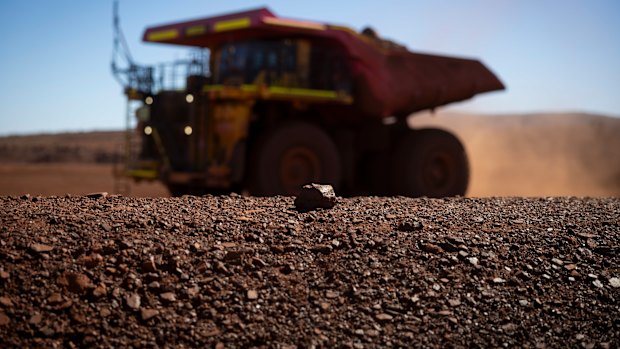
Iron ore prices were expected to fall in 2018-19. They’ve been higher ever since.Credit: Matt Jelonek/Rio Tinto
This correspondent noted at the time that if iron ore prices stayed at their current level or increased, then the cost would jump. That’s exactly what has transpired.
This year alone, the federal government will spend at least $5.1 billion on the GST fix.
There are deep-seated problems with the budget.
Loading
It’s too dependent on tax paid by ordinary workers. There’s too much spending. There are too many loopholes and concessions that enable the well-heeled to effectively choose their own tax rate.
Despite collecting record amounts of tax, the government is expecting a deficit of $37 billion this year.
Both sides of politics – who, by the way, have failed to offer solutions to deal with the tobacco and GST fiascos – are more interested in fighting each other than dealing with the budget problems created by both of them.
Chalmers, promising this year’s budget will deal with the nation’s long-standing productivity shortcomings, also has to address the fiscal fallout from those calamities created in 2018.
I’ve seen many bad budget decisions over the years; Peter Costello’s changes to superannuation (and capital gains tax), Wayne Swan’s mining tax, Joe Hockey’s first budget.
But nothing holds a candle to 2018-19.
Shane Wright is a senior economics correspondent for The Age and The Sydney Morning Herald.
The Opinion newsletter is a weekly wrap of views that will challenge, champion and inform your own. Sign up here.