
 4 months ago
59
4 months ago
59
1 hour ago
Faisal Islam,Economics editor, James Landale,Diplomatic correspondentand Mitchell Labiak,Business reporter

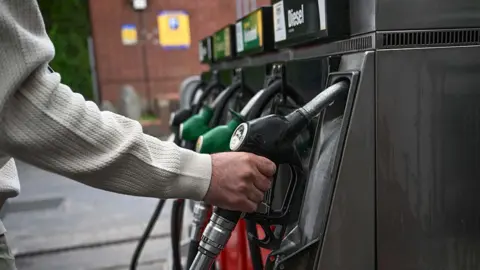 Getty Images
The UK government has loosened strict sanctions on Russian oil refined into diesel and jet fuel in third countries as prices rise.
The waiver begins on Wednesday and reflects growing supply concerns over certain fuels due to the effective blockade of the key Strait of Hormuz waterway since the start of the US-Israel war with Iran.
Some sanctions on the transport of Russian liquefied natural gas (LNG) were also lifted.
The government said that overall sanctions had got tougher but extra flexibilities were required. A similar move by the US was widely criticised.
European jet fuel prices more than doubled after the war started but are now around half higher while UK pump prices continue to rise.
Several airlines operating in the UK and around the world have cancelled flights and raised prices in response to sky-high jet fuel prices.
For years the UK led international efforts to put economic pressure on Russia for its war on Ukraine.
Only on Tuesday it signed a G7 statement reaffirming its "unwavering commitment" to impose "severe costs" on Russia.
Since October the UK had banned the import of diesel and jet fuel refined from Russian crude oil in third countries.
Easing sanctions now will effectively allow imports of jet fuel from India, which was previously a key supplier to UK and Europe. A lot of Russian crude is also refined in Turkey.
The new rules for sanctioned processed oil products will be of "indefinite duration", though they will be reviewed periodically and may be amended or revoked, the government said.
The UK also issued a time-limited licence covering the maritime transportation of LNG and related services under Russia sanctions rules, running until 1 January.
Earlier this week, the US extended a similar waiver, first introduced in March, which loosened sanctions preventing other countries buying Russian oil and petroleum already loaded on vessels at sea.
US Treasury Secretary Scott Bessent said in March the "short-term measure" was aimed at promoting "stability in global energy markets".
The policy has been criticised by many US and UK allies who say it helps the government of Russian President Vladimir Putin and his full-scale invasion of Ukraine, which has been ongoing since 2022.
However, UK Foreign Secretary Yvette Cooper refrained from criticising the US decision in March, describing it as a "specific, targeted issue".
A UK government spokesperson said on Tuesday it had "introduced a range of new prohibitions under the Russia sanctions regime".
"This includes further export and import bans against Russia, including restrictions on the sale of refined oil products derived from Russian crude oil and the import, supply and delivery to third countries of Russian uranium," they added.
"These sanctions also include a maritime services ban on Russian LNG. This will gradually restrict Russia's access to the UK's world-leading shipping and insurance services, disrupting their ability to transport Russian LNG.
"We are committed to strengthening our sanctions on Russia to degrade its ability to wage war in Ukraine, whilst protecting critical supply chains and maintaining market stability."

















































