3 months ago
7
3 months ago
7
Sunday marks the 20-year anniversary of a moment that changed the face of Australian sport.
On November 16, 2005, the Socceroos beat Uruguay in a penalty shootout to qualify for the World Cup, ending a 32-year drought for Australia on football’s biggest stage.
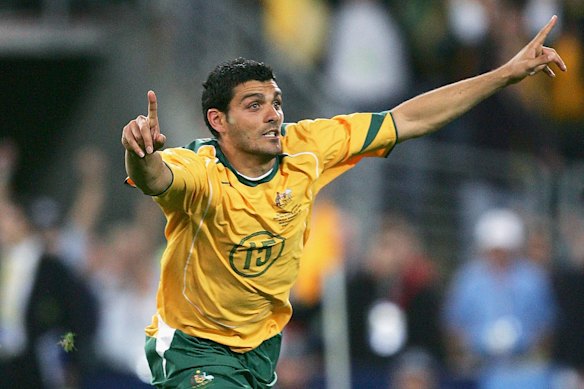
John Aloisi gets the party started on one of Australian sport’s greatest nights.Credit: Getty
There have been multiple documentaries and a book made about it, so by now you should know it all by heart: Mark Schwarzer’s two saves, Mark Viduka’s miss, John Aloisi’s match-winning spot-kick, and the beautiful carry-on from Craig Foster, the colour commentator for SBS whose euphoric, guttural screams said more about what it all meant than any words could.
But there’s an overlooked aspect to that famous night at Stadium Australia. In the years since, our national teams have built a quiet reputation for thriving when the pressure peaks, producing a string of dramatic penalty shootout wins in tournaments and qualifiers alike.
Sure, the Socceroos lost to Japan on penalties in the quarter-finals of the 2007 Asian Cup. And, yes, the Matildas also fell to Norway in the 2019 World Cup’s round of 16 … and to Brazil in the quarter-finals of the 2016 Olympic Games, and to China in the 2008 Asian Cup final. So as a football nation, we’ve had more than our fair share of heartbreak.
For the purposes of this exercise, though, we’re pushing those losses aside to focus on five landmark shootout wins that, in their own way, reshaped the game, to ask a slightly more unsettling question: what if we’d lost?
Let’s take a walk down memory lane, in reverse chronological order.
Young Socceroos vs Saudi Arabia: U-20 AFC Asian Cup final, 2025
This was just the third major trophy for Australia in the Asian Football Confederation, and a just reward for Trevor Morgan’s sensational Young Socceroos side, who knocked off arch-rivals Japan in the semis, and then squeezed past the other regional powerhouse, Saudi Arabia, after scores were locked at 1-1 after extra time. Steven Hall, a goalkeeper on the books of Brighton and Hove Albion, was lauded for his Schwarzer-esque performance with a one-handed save with the final penalty to win it.
... but what if they’d lost?
This is the least consequential of the five, in that not too many casual followers would have even known that this happened. But that’s not to say it wouldn’t have hurt had Australia gone down. Scratch the surface, and the game isn’t in a healthy state. So a defeat here would have been a serious gut-punch, replacing a much-needed positive headline with the (false) narrative that Australia doesn’t produce good players and is being outstripped by rivals in Asia. The idea that the Socceroos are on the cusp of a new golden generation (true) would have been that much harder to sell without the silverware.
Matildas vs France: FIFA Women’s World Cup quarter-final, 2023
The best penalty shootout … ever? Maybe? Everyone knows where they were. Neither side could score through 120 truly intense minutes, despite Sam Kerr’s return from that calf injury. Australia won the shootout 7-6, but that barely tells one per cent of the story: France’s attempted ‘Redmayne’ manoeuvre (we’ll get to that next), Mackenzie Arnold’s save, and then her chance to win it, which came off the woodwork, then her double save against Kenza Dali, who had to retake her penalty because Arnold had come off her line ... and then Cortnee Vine, who became the unlikely hero.
... but what if they’d lost?
‘Matildas fever’ wears off, and the nation snaps out of its trance. The World Cup is still remembered as a massive success, but Arnold doesn’t become Australia’s ‘minister of defence’, Vine doesn’t rocket to instant national fame, Kerr doesn’t get her ‘Cathy Freeman moment’ with her goal against England in the semis, and the Matildas’ quarter-final hoodoo at major tournaments is further entrenched. And having failed to steer them to the final four, coach Tony Gustavsson is axed – meaning Joe Montemurro is appointed as his replacement much earlier than he was, and his reboot of the team gets underway immediately, leading to a better performance at Paris 2024 and a smoother road to the 2026 Women’s Asian Cup in Australia.
Socceroos vs Peru: FIFA World Cup qualification AFC-CONMEBOL play-off, 2022
Having missed out on direct qualification for Qatar 2022, it all came down to this. Under-fire coach Graham Arnold’s bold gambit of replacing skipper Maty Ryan with the unheralded Andrew Redmayne before the shoot-out paid off deluxe, with the ‘Grey Wiggle’ making the match-winning save, becoming an international viral sensation in the process. In Qatar, Australia would record their best performance at a World Cup, winning two group matches before a last-16 exit at the hands of champions Argentina.
... but what if they’d lost?
Huuuuge dramas. The Socceroos miss the World Cup for the first time in four cycles, and Arnold is sacked immediately. Instead of an instant cult hero, Redmayne becomes a pariah, and Arnold’s decision to sub out Ryan turns into a national flashpoint. Football Australia misses out on the $15 million-plus in prizemoney for qualifying, plunging the federation into a financial crisis, while newly-installed chief football officer Ernie Merrick receives a firm mandate to make seismic changes to Australia’s player development systems. Kevin Muscat is forced into an agonising choice: stay with Yokohama F. Marinos and win the 2022 Japanese title or answer the call from the Socceroos to replace Arnold. Maybe, in that case, the rejuvenation of the team currently being overseen by Tony Popovic is now a little further along.
Matildas vs North Korea: AFC Women’s Asian Cup final, 2010
The first and only piece of major silverware won by Australia’s women, at the tournament where a 16-year-old Sam Kerr announced herself to the world. Kerr scored the opening goal in the final, which ended 1-1 after extra time; all five Matildas players converted their spot kicks, but North Korea’s Yun Song-mi missed their second, and that proved the difference in a tight affair.
... but what if they’d lost?
Instead of putting them on the map, this becomes just another disappointing chapter in the history of the Matildas, another “nearly” moment for a team of plucky outsiders. Women’s football goes back to being an afterthought for FFA, at a time when resources were tight and the A-League was experiencing growing pains. This being Australia’s first trophy in Asia, across both genders and all age groups, broader validation for the move from Oceania would have been lost – and though Kerr, Lisa De Vanna, Clare Polkinghorne, Emily van Egmond, Steph Catley and the rest would have still emerged as the team’s defining stars of that era, they do so without the collective confidence in their ability to win things. Put simply: it’s hard to imagine the Matildas becoming what they are today.
Socceroos vs Uruguay: FIFA World Cup qualification OFC-CONMEBOL play-off, 2005
We don’t need to go over what happened again, do we?
... but what if they’d lost?
Loading
Is this the biggest sliding-doors moment in Australian sporting history? Quite possibly. Had they gone down, the Socceroos would have been ridiculed as a cursed team who, no matter what, just don’t have it in them to get across the line in big moments, with their World Cup drought extending to 36 years. Mainstream Australian sport fans tempted to jump on the soccer bandwagon dismiss the code as damaged goods that will never be properly repaired. Guus Hiddink leaves the country, blaming his players’ lack of mental fortitude for their failure. No World Cup in 2006 means no platform for Tim Cahill to become a national icon; only Mark Viduka and Harry Kewell become household names, and mostly because of their Premier League exploits. The A-League, which had kicked off to great fanfare only a few months earlier, quickly runs out of steam and the “new football” era grinds to a crashing halt. Thousands upon thousands of lives, which were all changed in an instant by Aloisi’s penalty, chug along on their previous boring trajectories.
Thank heavens it didn’t happen.
Most Viewed in Sport
Loading