3 months ago
21
3 months ago
21
Singapore: The Donald Trump-brokered peace accords between Thailand and Cambodia continue to fracture, with Bangkok ordering fresh airstrikes in response to clashes that left one of its soldiers dead and several injured.
Both sides are blaming the other for triggering the latest round of fighting, which began on Sunday and escalated early on Monday when Thailand sent F-16s to Cambodian military targets in “several areas”.
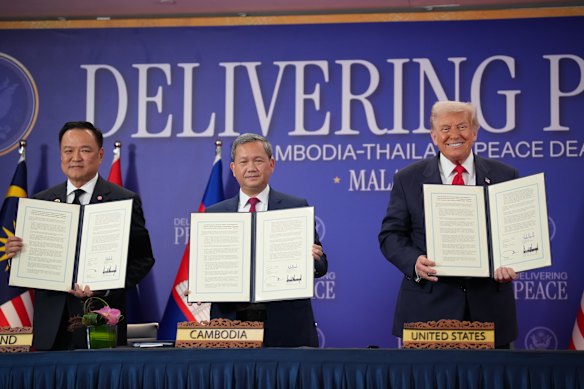
Thai Prime Minister Anutin Charnviraku (left), Cambodian Prime Minister Hun Manet and US President Donald Trump pose for photos following the signing of a Cambodia-Thailand peace deal in Kuala Lumpur on October 26.Credit: Getty Images
Cambodia’s de facto ruler, Hun Sen, who officially handed power to his son Hun Manet in 2023, called on his troops to be patient because the “invaders” were using “all kinds of weapons” – adding ominously but vaguely that a red line had been drawn.
Cambodian lieutenant-general Maly Socheata said Thailand’s actions were inhumane and brutal.
The Thai military, however, said Cambodian troops opened fire first on a security team protecting road builders in Sisaket province on Sunday, injuring two of its soldiers.
Loading
Clashes followed in Ubon Ratchathani province on Monday morning that killed at least one Thai soldier, according to local media.
The two nations fought for five days in July after months of building tensions over disputed sections along the 800-kilometre border until a ceasefire was brokered by the US president, who wielded the threat of higher tariffs, and Malaysian Prime Minister Anwar Ibrahim, this year’s chair of the Association of Southeast Asian Nations.
More than 40 people, including civilians, were killed in the July conflict.
Trump made a special visit to the ASEAN summit in Kuala Lumpur in September to preside, alongside Ibrahim, over fresh Thailand-Cambodia peace accords that he heralded as historic. He has claimed the conflict as one of eight that he has “solved” as president.
But the deal was fragile from the outset, with Thailand signalling it was a starting point to peace rather than the conclusion of hostilities.
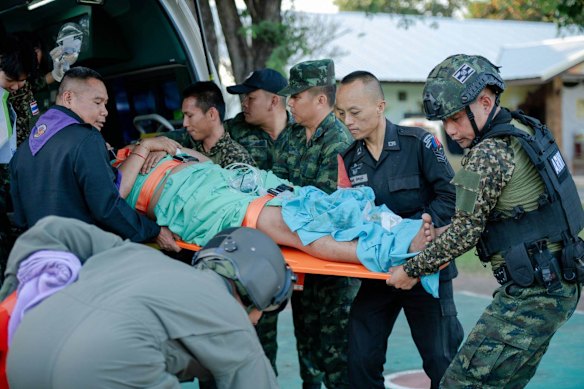
In this photo released by the Royal Thai Army, a wounded Thai soldier is carried to be transferred to a hospital in Si Sa Ket province.Credit: AP
Barely a fortnight later, fresh fighting broke out at the border. Phnom Penh said a civilian had been killed in the fighting. Thailand had earlier accused Cambodia of planting landmines that injured several soldiers.
The latest clashes have sparked another round of evacuations for weary civilians on both sides of the border.
Cambodia wishes to take the border disputes, which have their origin in colonial-era map-making, to the International Court of Justice, where it has previously had success. Thailand wants to settle the matters bilaterally.
Loading
The nationalist sentiment in both countries makes it politically difficult for either leader to be seen to cede sovereign territory. Critics say the Hun Sen and Hun Manet regime, which does not tolerate dissent or opposition, has used the conflict to shore up their party’s power.
Thai Prime Minister Anutin Charnvirakul, meanwhile, has promised elections in the new year, and is facing a backlash for his administration’s handling of the flood crisis in the southern part of the country.
Get a note directly from our foreign correspondents on what’s making headlines around the world. Sign up for our weekly What in the World newsletter.
Most Viewed in World
Loading