3 months ago
19
3 months ago
19
Opinion
December 8, 2025 — 11.57am
December 8, 2025 — 11.57am
As a US Supreme Court ruling on Donald Trump’s “Liberation Day” tariffs looms, US companies are queuing to be in line for refunds should the court rule against them.
Costco is probably the biggest of the companies to sue the administration in the US Court of International Trade, where it joined about 90 others, including Revlon, Kawasaki, EssilorLuxottica and auto parts and food importers earlier this month, seeking to position themselves for refunds of the tariffs they’ve paid should the court rule against the administration.
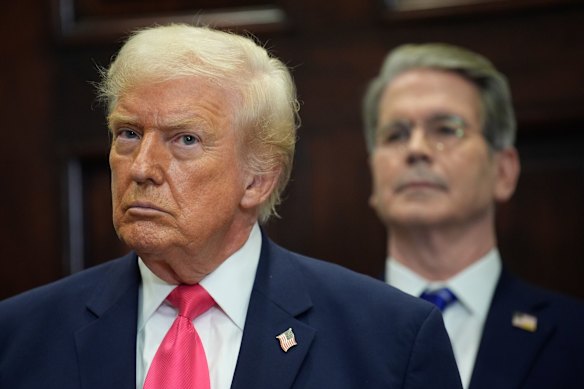
US President Donald Trump (left) and US Treasury Secretary Scott Bessent. Credit: Bloomberg
A decision in the case, an appeal against several lower court rulings that deemed the “reciprocal” and baseline tariffs illegal, is expected if not by the end of this year, then early next year.
The reason Costco and others have taken court action is that there is no certainty about what would happen to the revenue already raised should the court decide the tariffs are illegal.
Loading
Costco had asked the Customs and Border Protection agency that collects the tariffs when goods enter the US for an extension of the schedule for finalising tariff determinations until the case was decided. It had until December 15 to file its actions because that is the date on which Customs and Border Protection will “liquidate”, or finalise, its tariff obligations.
Other companies have eschewed the legal process, instead petitioning the Supreme Court directly, as “friends of the court”, to order refunds while others, not prepared or able to fund litigation, or take the risk of an adverse judgment, have been selling their potential rights to refunds to hedge funds and distressed debt funds for 20 to 30 cents in the dollar.
Costco’s action is significant because it is the 12th largest company by revenue in the US and about a third of its $US270 billion ($407 billion) of sales last financial year were, it has said, generated by imported goods and food. There are billions of dollars at stake for the company, depending on the Supreme Court’s decision.
Revenue from tariffs is approaching $US200 billion this year, and US Treasury Secretary Scott Bessent has said that revenue from the Liberation Day tariffs under threat represents about half the amount collected this year, so an adverse judgment might see close to $US100 billion having to be refunded – if the court orders refunds. It could, of course, make any judgment prospective, and allow the administration to keep what has already been received.
The court is considering only the Liberation Day tariffs that Trump imposed on every country that trades with the United States.
Those tariffs, unlike the sectoral tariffs on steel, aluminium, cars and other products that aren’t being challenged, came after Trump invoked the International Emergency Economic Powers Act (IEEPA), which has previously been used only to sanction terrorists and rogue states and which contains no mention of tariffs.
Trump claimed a national emergency, citing America’s trade deficit. The US has, of course, run a trade deficit for half a century without that trade imbalance causing any alarm for previous administrations.
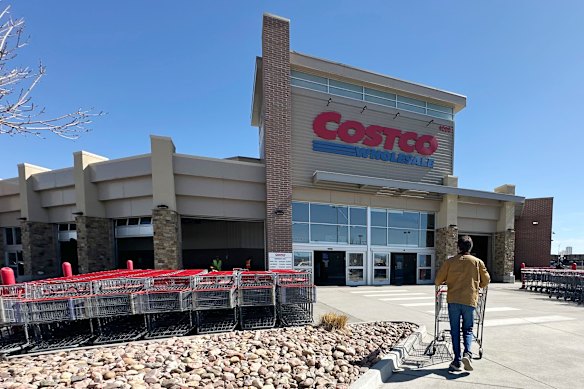
Costco’s action is significant because it is the 12th largest company by revenue in the US and about a third of its $US270 billion ($407 billion) of sales last financial year were, it has said, generated by imported goods and food.Credit: AP
Now he says it would be “catastrophic”, would “literally destroy the US” and prevent America from being “wealthy again”, if the court rules against the administration. He also said it will cost the US $US3 trillion (he had previously assessed the damage at $US2 trillion) if he was forced to refund the tariffs.
The $US195 billion of all tariff revenues collected so far this year isn’t $US2 trillion, let alone $US3 trillion, so Trump must be referring to the prospect of having to tear up some of the agreements he made with other countries under which they would invest hundreds of billions of dollars in the US in return for lower tariffs.
Loading
A lot of those promises are vague, included spending that would occur, if it occurred, well beyond the life-span of this administration. Some of them relate to spending that was already planned. They are probably unenforceable, but were only indirectly related to the IEEPA legislation, which was used as leverage, so aren’t directly affected by any judgment.
The countries that negotiated with the administration are well aware that there are other avenues to impose tariffs – Bessent has said the administration can replicate them – albeit that the most obvious options involve more time-consuming investigation and reporting processes and have sunset clauses in them. It would be a brave decision to tear up the agreements they have with the administration, at least while Trump is in office.
The decision by Costco and other US companies to seek refunds ought to finally dispel any doubt among US consumers and voters about who pays the tariffs. Contrary to the assertions of Trump and some of his cabinet (the less economically illiterate dodge the question), it is US companies who pay, with some of the cost then passed onto consumers.
For much of this year, because of delays in their imposition and uncertainty as the administration negotiated individual deals with other countries, companies built their inventories of pre-tariff goods, deferring their cost.
Trump claimed a national emergency, citing America’s trade deficit. The US has, of course, run a trade deficit for half a century without that trade imbalance causing any alarm for previous administrations.
Subsequently, as the tariffs have started to bite, they have absorbed some of the costs, hurting their margins and leading to cost-cutting and lay-offs, while passing only some of their costs on. Goldman Sachs estimated earlier this year that about half the tariffs’ impact has been absorbed and about a third had been passed onto consumers. The longer they are in place, the more consumers will pick up the tab.
Trump thinks the tariffs are magical. He has touted the idea of $US2000 tariff “dividends” for US households, along with the abolition of income taxes and the repayment of America’s $US38.2 trillion of government debt.
Most estimates of the revenue that could be generated by all US tariffs are for a net $US2.3 trillion to $US2.5 trillion over a decade.
US GDP is more than $US30 trillion, the government’s revenue base is more than $US5 trillion a year and its deficit is about $US1.8 trillion, so the IEEPA tariff revenues are effectively irrelevant in the context of the government’s finances and are certainly incapable of funding even a fraction of all the things Trump says they will fund.
Loading
One thing that Bessent did get right about the tariffs was that their rejection by the Supreme Court would create a “dangerous diplomatic embarrassment” for the US, although it would be the administration and the self-labelled “Tariff Man” himself who would be the most embarrassed for embarking on a global trade war using a fallacious justification and unlawful powers.
The Business Briefing newsletter delivers major stories, exclusive coverage and expert opinion. Sign up to get it every weekday morning.
Most Viewed in Business
Loading