3 months ago
41
3 months ago
41
The extraordinary response by economists and central bankers this week to the unprecedented criminal investigation of current Fed chair Jerome Powell by Donald Trump’s Department of Justice draws a direct line to Richard Nixon and other phone calls he had with Burns in the early 1970s.
Powell, labelled everything from a “fool” to a “major loser” by Trump, went public on Sunday night to confirm a criminal probe into evidence he had given to a Congressional committee on the overrun in the cost of rebuilding a part of the Fed’s Washington offices.
Declaring that no one was above the law, he said the investigation was simply a pretext to pressure the Fed into cutting rates to aid Trump, who faces midterm elections in November.
“The threat of criminal charges is a consequence of the Federal Reserve setting interest rates based on our best assessment of what will serve the public, rather than following the preferences of the president,” he said.
“This is about whether the Fed will be able to continue to set interest rates based on evidence and economic conditions – or whether instead monetary policy will be directed by political pressure or intimidation.”
The three still-living former Fed chairs – Alan Greenspan, Ben Bernanke and Janet Yellen – rallied to Powell’s support, likening Trumps’ actions to developing countries riven by weak central banks and high inflation.
“It has no place in the United States, whose greatest strength is the rule of law, which is at the foundation of our economic success,” they declared.
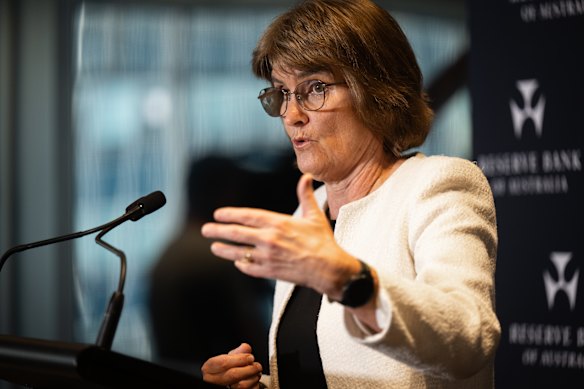
RBA governor Michele Bullock was one of 13 leading central bankers to defend the independence of Jerome Powell.Credit: Louie Douvis
A day later, 13 senior central bankers, including the Reserve Bank of Australia’s Michele Bullock, released their own statement defending Powell and warning of the dangers of politicians interfering in the setting of interest rates.
“The independence of central banks is a cornerstone of price, financial and economic stability in the interest of the citizens that we serve,” they said.
“It is therefore critical to preserve that independence, with full respect for the rule of law and democratic accountability.”
Loading
These are not people who throw around words lightly, parsing printed words to within an inch of their meaning. But seeing what is at stake, they decided to make their support for Powell known.
The heads of the world’s two oldest central banks, Erik Thedeen from Sveriges Riksbank and Andrew Bailey from the Bank of England, signed up.
Christine Lagarde, who has headed the European Central Bank since 2019, signed along with Anna Breman, who has been in charge of the Reserve Bank of New Zealand for less than two months (and who copped criticism from the populist NZ Foreign Minister Winston Peters, who struggled with the concept of independent central banking).
These bankers are worried not just about a rerun of Nixon and Burns. They are fearful that actions like launching a criminal investigation against a central banker for not cutting interest rates is being normalised.
Westpac’s chief economist, Luci Ellis, previously a senior Reserve Bank executive, noted central bankers know what happens when their hard-won independence is surrendered.
Nixon and Burns unleashed inflation on the US economy for a decade. More recently, Argentina in the late 2000s and Turkey last year, where inflation reached 80 per cent, have all suffered from populist leaders fiddling with interest rates for political ends.
Ellis said the biggest problem could be when Powell’s term ends in a few months time.
“This turn of events poisons the well for Powell’s successor – an appointment that is yet to be announced. Who would agree to take a position in government service in the US knowing that you might be subjected to trumped-up criminal investigations?” she said.
Keeping up with Trump’s policy prognostications is difficult at the best of times. But the move against Powell followed an avalanche of proposals that would normally dominate public debate.
They include introducing a 10 per cent cap on interest charged on credit cards, a plan to have America’s two huge publicly owned housing finance agencies, Fannie Mae and Freddie Mac, buy $US200 billion ($350 billion) in mortgage bonds to push down lending rates, and a ban on large institutional investors buying family homes.
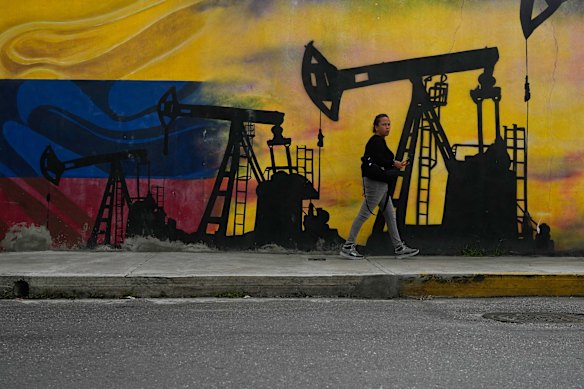
A local walks past a mural featuring oil pumps and wells in Caracas, Venezuela, this week.Credit: AP
The military action against Venezuela, initially described as an effort to stop illegal drugs and criminal migrants flowing into the US, is now clearly a claim on that nation’s oil supplies, with a stated aim of bring oil down to $US50 a barrel (although crude has climbed 10 per cent since the military action).
Trump’s ambition for Greenland is as much an economic as a political play as he seeks to garner the resources of the Danish territory.
Throw in his ongoing tariffs (which could be struck down by the Supreme Court at any time) which are supposed to fund a $2000 per person “dividend” to American voters by year’s end, and that’s just the past 10 days of economic debate out of the White House.
Loading
Trump, whose poll numbers are falling like temperatures in a Greenland winter, is running into a problem many political populists face – their rhetoric doesn’t match the lived experience of ordinary people.
Inflation has been above the Fed’s 2 per cent target for almost four years. Without big tech’s data centre building boom, the economy would have flatlined last year.
Figures last week from the Bureau of Labour Statistics – the agency whose head Erika McEntarfer was sacked last year – confirmed trouble in the American jobs market.
Through 2025, the US generated a net 584,000 jobs. That compares with 2 million each in 2023 and 2024.
Blue-collar jobs are disappearing on Trump’s watch. Manufacturing, which was supposed to be supercharged by Trump’s tariffs, shed almost 68,000 positions. Other losses were recorded in mining and logging (16,000), transportation and warehousing (59,000) and professional services (97,000).
It was the healthcare and social services sector that boomed last year, accounting for almost 70 per cent of all jobs created, including a 30 per cent jump in hospitals staff.
There has also been a steep increase in the number of people employed part-time whose hours had been cut.
While central bankers and economists quickly condemned Trump’s move on Powell, the business community was almost silent.
Respected economic historian Adam Tooze noted with alarm this seeming indifference among investors and business leaders, who now only care about their immediate fortunes.
“[To them] institutions don’t matter. All that matters are the flows of money and power. As far as POLITICAL economy goes, it is a moment of sheer nihilism,” he wrote to his Substack subscribers.

Economic historian Adam Tooze says the response by business leaders to the assault on Powell suggests nihilism has overtaken America’s business elite.Credit: Getty
Monash University economist and former RBA economist Zac Gross said among all the ideas coming out of Trump at present, finding those that have “real bite” compared with those that are “mostly bark”(like the cap on credit card rates) is proving difficult.
A repeat of what happened in the 1970s or Turkey last year would lead to high inflation and probably a recession.
“Even some Republican senators appear unwilling to risk that kind of economic disaster, and the Supreme Court has signalled that Federal Reserve independence is one area where presidential power is not unlimited,” he said. “Still, that feels like fairly cold comfort given how large the potential economic damage could be.”
Nixon won 49 states at the 1972 election. But within two years he had resigned in disgrace, while Arthur Burns was left overseeing a recession that he and the president helped engineer.
Start the day with a summary of the day’s most important and interesting stories, analysis and insights. Sign up for our Morning Edition newsletter.