2 months ago
18
2 months ago
18
“We can’t retraumatise these kids,” the senior detective said.
“Let’s say he gets out in 25 years. These kids will be 30, and suddenly they’ll find out they’re victims.
“Do they need to know that?”
Griffith is appealing the severity of his sentence. Once that is completed, the extradition request will progress.
But Yeomans will be retired by then. On Friday, he will mark the end of his 45-year career by marching off Goulburn police academy parade grounds as the latest class of recruits take up the blue uniform.
Yeomans was their age in 1980 when he put on the same uniform.
Loading
“I still know exactly where my first fatal crash was – the telegraph pole still has the mark,” he says. A week into the job, a seven-year-old girl died in his arms.
“It was the most upsetting thing I’d done. But then I looked up and realised her mum was driving the car. It wasn’t about cops.”
The moment stayed with him. It taught him that “compassion is not weakness” in policing – a lesson that would guide him into child protection, long before the public was ready to hear children’s stories.
In the early days of the Child Abuse Squad, juries rarely believed young victims. Newspapers refused to name offenders. The conviction rate hovered around 8 per cent.
“I’ve been saying to my troops for a long time – someone has to be the voice for these kids,” Yeomans says.
“Because unlike many other major crime types, these offenders are recidivist. They will always repeat what they do.”
The landscape slowly shifted. Yeomans gave evidence at the royal commission as Australia confronted the crimes inside its churches, schools and youth groups. Courts changed. Juries listened. Today, the conviction rate is closer to 80 per cent – among the highest in NSW Police.
However, the case which casts the longest shadow in Yeomans’ career was not child abuse – it was murder.
The body of Scott Johnson, an American university student, was found at the bottom of North Head in December 1988. His death was deemed a suicide.
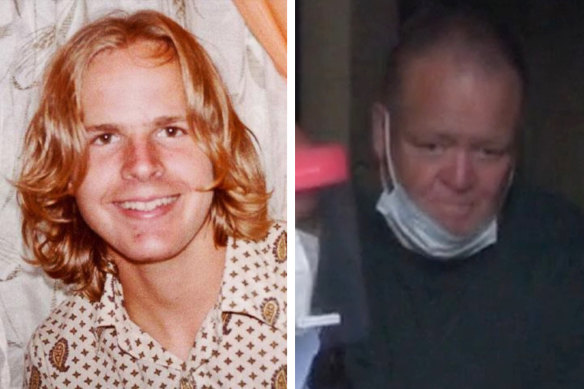
Scott Johnson (left) and his killer, Scott White.
Johnson’s brother, Steve, campaigned for decades to have the case reinvestigated. In 2017, a coroner ruled Johnson had been killed in a gay hate crime and urged police to try again.
Yeomans, an outsider to homicide, was tasked with solving a case with no body, no forensics, no DNA, and 30 years of faded memories.
Three years later, Yeomans was sitting in his police car with Scott White, who was eventually jailed over Johnson’s death, handcuffed in the back. The first person he called was Steve Johnson.
“I’ve just arrested the murderer of your brother, Scott,” Yeomans said, his voice cracking even retelling the story.
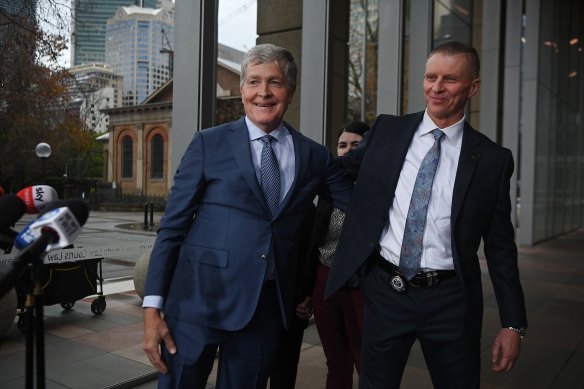
Steve Johnson (left) and Detective Chief Inspector Peter Yeomans after the sentencing of Scott White for Scott Johnson’s manslaughter.Credit: Kate Geraghty
“Steve’s whole life, for 30 years, has been about getting an answer, and that was a big one for me.”
Johnson’s murder was just one of many in Sydney’s dark days of gay hate crime murders and assaults. Police had been reluctant, sometimes hostile, to help victims in the 1980s. They are missteps for which the force is still atoning.
“I want people to know there will be no bias, and no passage of time, that would inhibit us to look at these matters,” Yeomans said.
“Same as with child abuse.”
In that vein, he tells the Herald of “one of the rules I have up in my office”.
“Victims and their families have entrusted you alone, they have no one else. So do your job with professionalism, passion and persistence, or not at all.”
Last year, Yeomans’ squad arrested 600 child abusers. This year, another 600. The work will go on without him.
“I watch these kids grow up, they’re from South-East Asia or Eastern Bloc countries, I see their images all the time,” Yeomans said.
“I recognise them. There’s a sadness in their face.”
At Yeomans’ final meeting with his superiors, where it’s customary to ask for additional resources or staff, the senior detective asked for something much harder.
“I just said ‘Boss, I want to know how we reduce that number’.
“I’d like to say we can’t arrest our way out of this, but we have to stop them.”
Support is available from Lifeline 13 11 14; Beyond Blue 1800 512 348; Kids Helpline 1800 55 1800; National Domestic Family and Sexual Violence Counselling Service 1800RESPECT (1800 737 732).