
 2 months ago
91
2 months ago
91
We’re gliding through inky black water in a canoe made from a hollowed-out tree trunk, along a riverbank dripping in greenery beneath cascades of hanging vines.
The only sounds are the rhythmic slap of the paddle on the water, the distant shrieking of howler monkeys and the flutter of wings from a skewer of egrets taking off from their submerged tree branch as we approach.
I feel my breathing slow as I drink in the serene vista all around me. This is nature at its absolute finest, deep in an eerie floating forest, along a far-flung tributary of the biggest, mightiest river in the world.
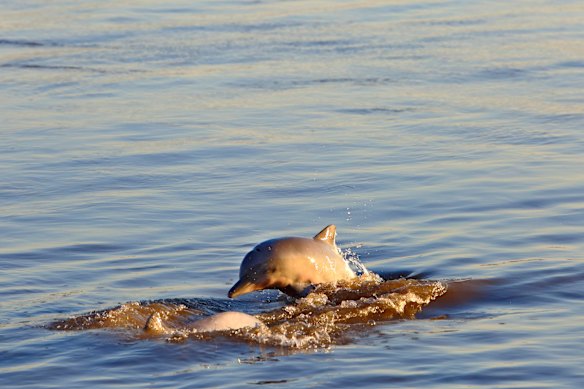
And then, suddenly, it happens. A nose breaks the water, a flank, and a flash of bright, bright pink. It’s a pink river dolphin, an illustrious endangered native of this Peruvian part of the Amazon, which has flashed by to take a sticky-snout at his visitors.
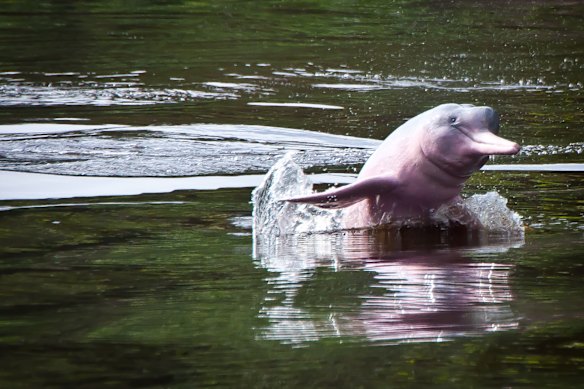
For the next few minutes, our lone caller twists and turns through the water, flouting his pink belly and gambolling close by our canoe. “He is good, right?” my paddler says as I twist round to share my delight. “But he is big. We must take care.”
Sign up for the Traveller Deals newsletter
Get exclusive travel deals delivered straight to your inbox. Sign up now.
I estimate he’s about two metres long as his breed grows much larger than the more common marine dolphin and, of course, he could topple us at any moment into the water. But that’s probably not what my indigenous guide means.
He’s from one of the 51 ethnic tribes that live along this section of the Yanayacu-Pucate River, just two of the waterways constituting the Amazon, and local superstition has it that pink dolphins are magical shape-shifters that have the power to turn into handsome men to impregnate passing women.
I nod, soberly, at the warning. But I’m actually thrilled to see this elusive creature in such a stunning spot, where time has stood still for centuries, and where daily life is infused with a potent mix of mysticism and fantasy, so far from absolutely anywhere.
Because for getting away from it all, nowhere beats the Amazon: among the few places in the world that, along with housing astounding scenery and wildlife, is still home to people who have no contact with outsiders and who pursue a traditional way of life.
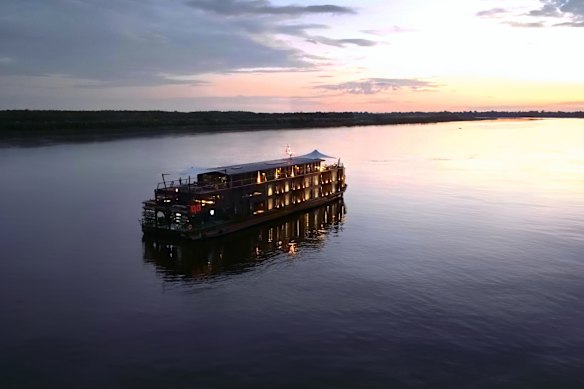
I’m experiencing the Amazon aboard a luxury four-night, five-day river expedition-style cruise with Aqua Expeditions’ Aqua Nera vessel, based near the Peruvian city of Iquitos, with its 20 suites, 37 crew and a maximum passenger capacity of 40.
Getting here marks the start of the adventure, with the flight from Australia going via Santiago, Chile, then Lima, Peru, finally to Iquitos, the gateway to the Peruvian Amazon. In total, it involves 18 hours in the air, with a few more hours here and there waiting for flights. But it’s all worth it since this is one of the most incredible parts of the planet.
The river is the world’s largest by water volume, with about 20 per cent of the globe’s freshwater, winding 6400 kilometres from the Peruvian Andes into the Atlantic Ocean with not a single bridge. The rainforest is so massive, at six million square kilometres, that it stabilises the planet’s climate, drives its water cycle and is home to more biodiversity than any other ecosystem.
Those features alone make it a fascinating place to explore, whether from Peru, Brazil, Colombia or Ecuador – four of the nine South American nations through which it passes.
And while it’s rugged and raw and unbelievably remote, today it is at last possible to visit easily and quickly and to explore aboard a huge variety of boats, from a local cargo ship to, if you choose, the absolute lap of luxury on a small expedition ship especially designed for the Amazon.
THE ARRIVAL
Iquitos, Peru
I’ve visited the Amazon before, but this time I want to see it from a Peruvian perspective. This is where the river actually begins and, while it has a lesser share of the rainforest than Brazil, it’s particularly special for its flooded forests, blackwater tributaries, concentration of wildlife and number of indigenous groups living as they always have.
My previous visit was aboard a Brazilian freighter when more than 100 of us squeezed onto one deck where we slept on the hard timber and I travelled there via a short, canoe trip in Colombia.
My cruise aboard the considerably more luxurious and exclusive Aqua Nera, suffice to say, is quite the contrast. Ahead of the voyage, it’s great to spend at least a night at Iquitos, a city surprisingly large and surprisingly hard to get to.
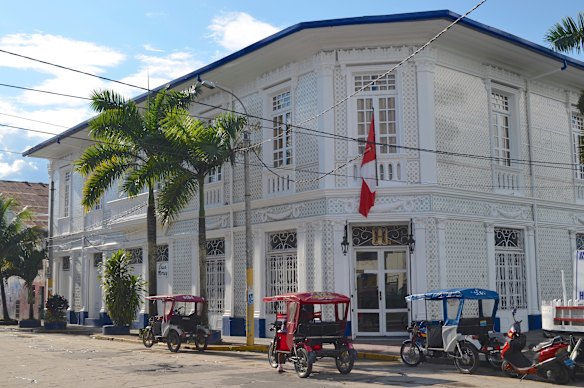
Flanked on one side by thick jungle, and on the other by water, the only way in is to fly or to catch a boat, or ship, making it the biggest city in the world – a teeming hub of half a million people – that can’t be reached by road.
In the 19th century it was a centre for the rubber boom, along with Brazil’s much larger Amazonian city of Manaus, and there are still plenty of magnificent, tiled mansions lining the streets that once belonged to the rubber barons.
One is a metal house, said to have been designed by Gustav Eiffel. It was transported in segments by its owner from Paris through the jungle to its final resting place in the historical centre of town.
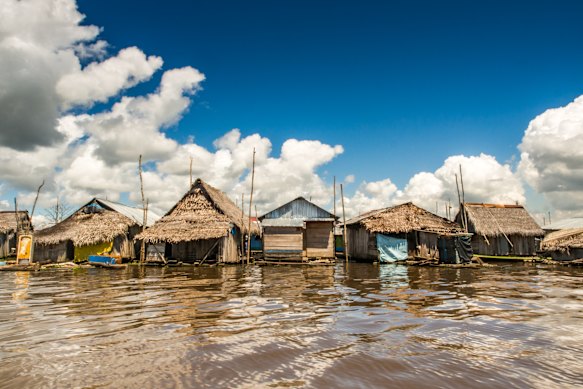
In stark contrast with the grandeur, on the riverfront, there’s the “floating city” of Belen, cluttered with stilt houses and a lively open-air market. There’s a constant stream of men on motorised tricycles eager to show visitors around the sights for small sums.
THE AMAZON AWAITS
Day one of the expedition cruise
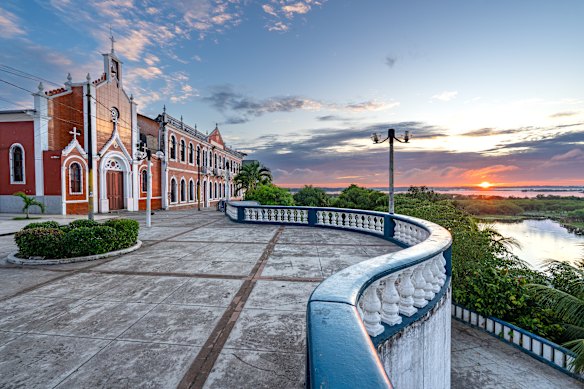
I’m collected in Iquitos and driven to the end of the city’s only road in Nauta, two hours away. There, I hop aboard a skiff to be taken to my home for the next four nights: Aqua Nera. This 62-metre ship was built in 2020 specially for the Amazon.
Its dark-wood paletten is designed to reflect the black water lagoons of the Amazon we’ll pass over. Noor Design, a Vietnam-based interior architecture studio, also uses colourful features from Peruvian culture, plus sofas and moody lighting reminiscent of the rubber era.
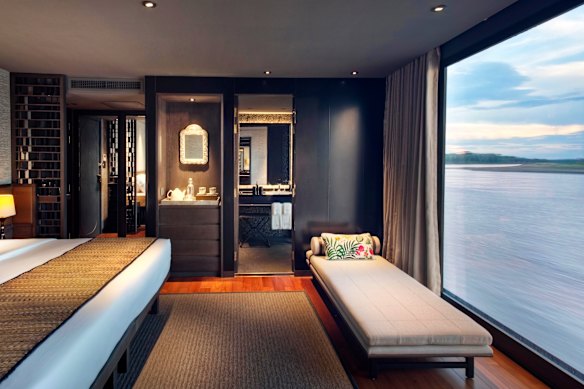
As a result, the atmosphere is old-colonial-meets-modern-South-American, with an overlay of luxury. The air-conditioned suites reflect this too, with floor-to-ceiling windows to make the most of the river and rainforest views, king-sized beds, daybeds, and bathrooms tiled in intricate tribal Amazonian prints with walk-in rain showers. There are no room keys, unless requested.
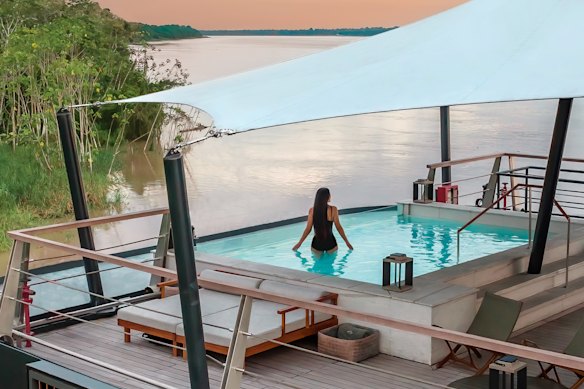
The vessel also has indoor and outdoor lounges, a bar, a restaurant that pivots to an outside deck for sunny mornings, a plunge pool, spa, gym, cinema room – where popcorn, ice cream and burgers are served during documentaries or movies – a billiards room, boutique, observation deck and bars.
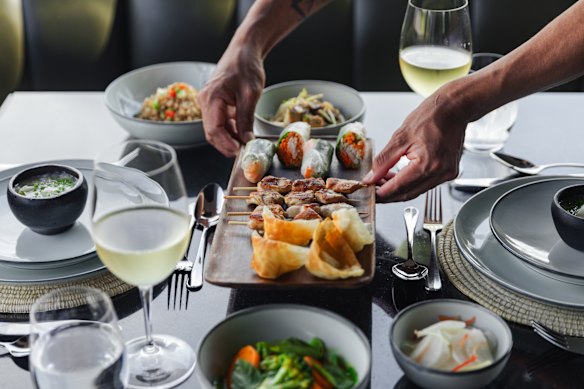
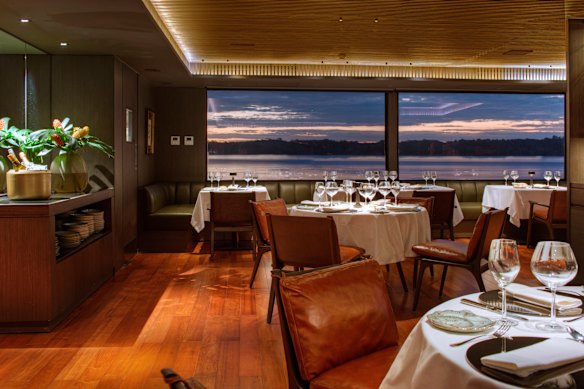
The restaurant is another stand-out space on the second deck to catch the best views, with ceiling louvres and slats that evoke the feel of the jungle canopy, and pops of vibrant Peruvian colour. Lunch and dinner are from three or four-course fine dining menus drawn up by renowned Peruvian chef Pedro Miguel Schiaffino, served on Amazonia-inspired gold leaf plates.
Even amid so much luxury, the environment is never forgotten. The low-emission boat is built from sustainably sourced wood and has large solar panels to power the outside lights, with flooring and cladding made from rice husk, rugs from recycled fishing nets, and carpets from plastic bottles.
Water in the ship’s showers is chemically treated river water; drinking water is produced on board through its reverse osmosis and UV water treatment plant, and 70 per cent of the food is sourced locally. The entire crew is Peruvian.
The skiffs we go out in every day are powered by electricity with rechargeable batteries. We travel in small groups to ensure we don’t disturb wildlife or overwhelm locals. I’m also delighted to find the Wi-Fi is fast, overnight laundry is complimentary, and rooms are serviced no fewer than three times a day.
INTO THE RAINFOREST
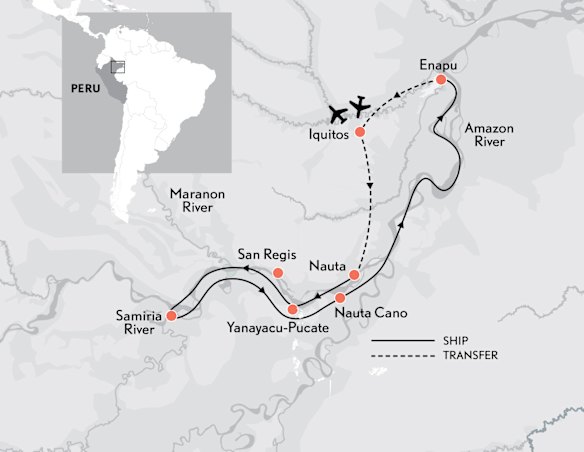
Day two, the Maranon River/Yanayacu-Pucate River
I wake to the glow of a golden sunrise over the river through a gap in my curtains, throw on my life vest and head off to pick up a skiff for an early birdwatching session. While each skiff can seat 12, there are only four people on mine, plus a guide, for a much more personalised experience.
We head out into the upper reaches of the rivers, as the rainforest ignites to the sound of birdsong. We watch a chestnut-brown wattled jacana take off from clumps of lilies and shudder at the sight of a sea serpent powering along on the surface of the water.
The sky is dark and overcast as it’s almost the rainy season, but we spot green Mealy parrots overhead and squirrel-sized saddle-back tamarin monkeys in the rainforest, racing up trees and jumping between branches. An ear-splitting roar makes us jump – that’s from the largest of the nine species of monkeys here, the red howler. Its bellow can be heard from a good five kilometres away.
“It’s a jungle out there,” someone says, and our guide, Alejandro Enriquez Aguilar, laughs. “It is,” he responds. “Everything there is part of a constant competition for food and needs to be up and out moving every day.”
He stops to point out a species of toucan, the aracari, a tiny Amazonian royal flycatcher sporting a brilliant red crest with blue tips, a bronzy-green Amazon kingfisher and a bright blue-and-yellow macaw.

“Colombia used to be the world’s number one country for birdwatching,” he says, “but now it is Peru. We have a lot more endemic species that can be found nowhere else.” Indeed, the world record for bird-spotting was set in Peru, with 331 species identified in a single day in 1982.
We return to our ship for a hearty breakfast on the deck with choices of cereal, quinoa porridge, fruit, omelettes, tamales, breads and cakes, and by 10.30am we’re back out on the water. This time, we spot our first pod of pink dolphins, rolling through the water, and stop to watch.
They don’t jump like grey dolphins, but they’re fascinating creatures, with, astoundingly, 40 per cent more brain capacity than humans.
We’re also busy looking out for anacondas, which have been known to grow up to eight metres and can eat up to 75 per cent of their own weight in food. So far nothing. Instead, we’re startled by a loud braying – the “donkey bird” of the Amazon – a Hoatzin, that makes a terrible noise and smells just as bad.
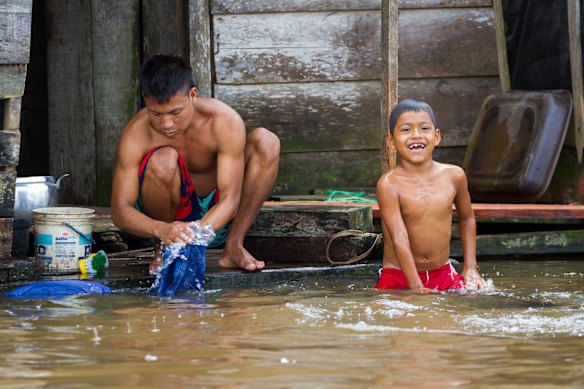
Along this section of the river, we can see the odd tiny village perched on the banks – wooden huts with thatched or tin roofs and washing hanging on trees. We pull over to visit one, much to the delight of several children rushing to welcome us.
It’s called, oddly, Buenos Aires, and we wander around looking at the open-air homes with hammocks on their front decks, a small school with bright murals warning of the dangers of mosquitoes and malaria, and buy a few handicrafts from locals.
After returning to the mother ship for lunch and a rest, we set out again at 4pm. This time we stop at another village, San Regis, to meet local shaman, healer and spiritual guide, Carolla, whose grandfather was a traditional medicine man.
“Welcome to the largest green pharmacy in the world,” says the tiny woman with a mane of raven-black hair as she points to the forest. “This is the future of the pharma industry. So many modern medicines have originated here in the rainforest, treating everything from inflammation to cancer, diabetes to Montezuma’s Revenge and even COVID.”
Certainly, while many local people fell sick during the pandemic, no deaths were recorded, with people like Carolla, who underwent eight years of training under her grandfather, treating them with plants dating from the 5th century, leaves, flowers, tree sap, honey and the infamous hallucinogenic distillation, ayahuasca.
“We have used many of these plants for 20,000 years,” she says, demonstrating how to extract sap – she calls ‘dragon’s blood’ – from a tree to act as a mosquito repellent. “This is all very powerful.”
FISHING FOR PIRANHA
Day three, Samiria River
Every expedition into this wonderland is filled with new sights, sounds and experiences. Aguilar tells us about the local people and how they’ll drink both from the black waters and the brown – with the nutrient-rich sediment giving it its colour – and eat fish, honey, bushmeat, fruits and plants. The women will often collect turtle eggs, too, using some for food, but keeping others to preserve turtle numbers.
“But these are the cannonball fruits,” he says, pointing to a large tangle of brown balls growing on a vine from a tree trunk, “that we don’t like to eat. It’s a stinky fruit like durian, and it’s good when we go hunting. You bathe yourself in it, and it masks every human smell …”
Once, people came to Peru for the Incas and to see Machu Picchu, he says. Now, they’re increasingly coming to see the Amazonians and learn about their environment.
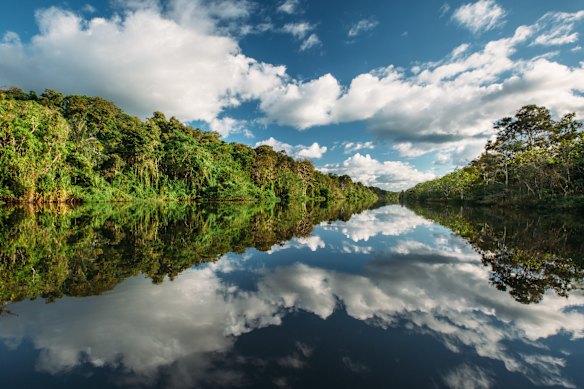
You can understand why when we decamp to canoes or kayaks. I don’t think I’ve ever felt so much at peace drifting on a canoe across the ghostly drowned forest – the water level can rise by as much as 30 metres in the rainy season, leaving 90 per cent of the land and many of the trees submerged, and then drop in the dry. And seeing pink dolphins … magical.
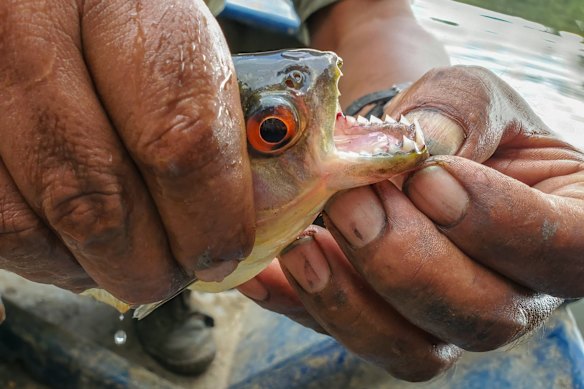
Later, we fish for piranhas with rods made of simple wooden canes, strings and hooks. Aguilar expertly takes one and shows us its 20 razor-sharp teeth that allow it to expertly slice through flesh. In fact, it cuts through skin so cleanly, most people don’t even notice they’ve been bitten. At first.
“So, who’d like to have a swim?” he asks. He’s not joking. Piranhas only tend to be more aggressive towards humans when the water is low, he assures us. Tend. He’s so persuasive I jump straight in … and live to tell the tale.
Soon our skiff joins the others, around a kitchen of sorts set up on another, and we’re served an elaborate picnic lunch in our seats, using the rims of the boats as tables.
Later we take another jungle walk, this time through the Pacaya Samiria National Reserve and see a sloth hanging from a branch. He seems to be eyeing us warily. Then we spot another a little way along the track with a baby clinging to its chest hair.
Beside us there’s a disturbance: it’s a huge green caiman lizard, with scales along its back, marching across floating lettuce on a creek.
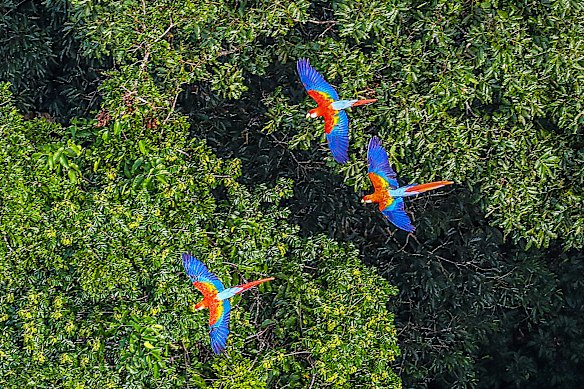
We examine a massive wasp nest, having been guaranteed that these are nocturnal, and the hanging nests of the glossy black cacique, while yellow-headed caracara raptors flutter around, along with scarlet macaws. “This jungle keeps all this alive all around us,” says Aguilar. “This might be the last job that AI can’t do.”
IN THE PATH OF PREDATORS
Day four, Nauta Cano River
What do you do if a jaguar suddenly appears and gives chase, we’re asked? I feel uneasy. But the answer is simple. Aguilar points to the stilt-like roots of a walking palm which form a cage around the base of the trunk. “Hide in there,” he says.
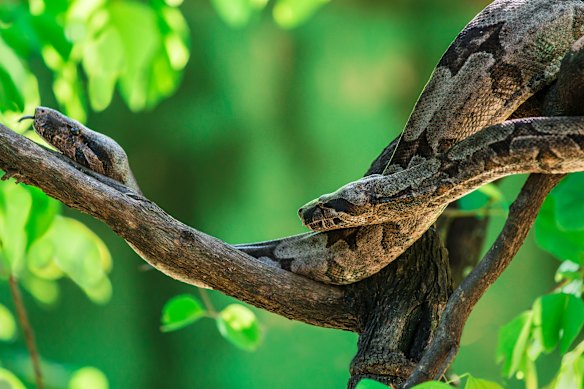
It’s a tip you hope you’ll never have to use in a jungle where so many things can kill you and, just as we’re being told about several, we chance upon a three-metre boa constrictor lying languidly along a tree branch above our heads. It’s a magnificent sight, but we leave it well alone.
The next predator is a huge shock. I’d been looking at photos of poison dart frogs, and had been sure to be wary of anything so brightly coloured, as they are among the most toxic creatures on Earth. Their toxins can both disrupt nerve and muscle signalling and cause paralysis, leading to a heart attack, with no known antidote.
But when I finally see one with a fiery red head and back, and an electric blue body, a strawberry tree frog, it is tiny, no bigger than a thumbnail. It’s intriguing, but I’m still keen not to get too close.
It’s the same story when another guide points out a massive tarantula, bigger than his hand. Yes, while their bites only inflict a little pain and irritation, and their hairs can only cause rashes and itching with the tiny barbs they flick, I’m not at all interested in becoming more intimate.

Even some of the vines can be dangerous. The liana, for instance, is used by hunters to make blow-dart poison and can be toxic if it hits the bloodstream. Other plants have been used for centuries as medicine. “This is our grocery store, here,” says Aguilar.
But, of course, humans are far more dangerous in this increasingly fragile ecosystem. In the past, logging has been the biggest problem, but now, as well, there’s gold mining in southern Peru. “That started six years ago,” Aguilar says, sadly. “And we are nervous it might come here in 20 to 30 years, too.”
Back on the ship, there’s one more wondrous sight close to Iquitos: the meeting of the charcoal-coloured Nanay River and the blue Amazon. You can see a distinct line where the two rivers meet and run alongside each other without mixing, because of the differences in the level of sediment in each, their temperature and speed of flow. Astonishing.
Five more things to see and do
Savour a natural high
Take a 500-metre stroll along the Ceiba Tops Canopy Walkway downstream of Iquitos, suspended 35 metres above the jungle floor, and spot birds, monkeys and treetops close up.
Marvel at macaws
View the region’s brightly coloured macaws clustering on the tasty clay licks at Chuncho in the Tambopata National Reserve, which is also famous for its tapirs and giant otters.
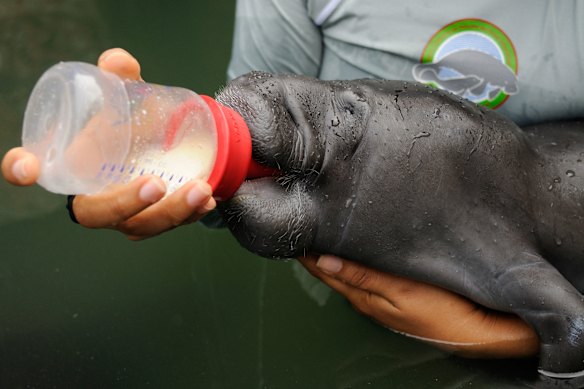
Help save the manatees
Visit the Amazon Rescue Centre specialising in the rehabilitation, rescue, treatment, and then release of endangered manatees, marine mammals also known as “sea cows”.
Discover the ways of the Amazon
Learn jungle survival skills, such as building a shelter, how to find water, and identifying food and medicinal plants, on a course run by local indigenous Amazon guides.
It’s a jungle in there
Book a room and a guided tour at one of the lodges – such as Muyana or Treehouse – just outside Iquitos to experience what it’s like to spend a few nights in the middle of the Amazonian jungle.
Five river cruises of a lifetime
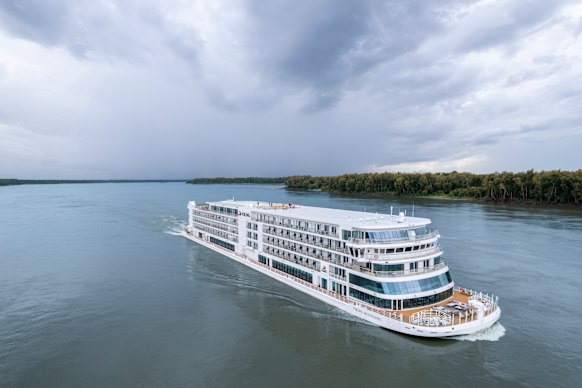
Mississippi, US This mighty, muddy river slurps past southern plantations and historic antebellum towns and is dense in European- and African-influenced culture. Best of all, though, are its connections to pop music history in cities such as New Orleans (jazz and blues), Nashville (country) and Memphis (rock and roll). See vikingrivercruises.com.au
Danube, Eastern Europe A cruise through Hungary, Croatia, Serbia, Bulgaria and Romania gives you a refreshingly different look at Europe. The scenery is in parts grand (mighty gorges, snow-capped mountains) and attractions range from historical towns and forts to the burgeoning sophistication of cities such as Belgrade and Bucharest. See aptouring.com
Rhine, Western Europe Often a first choice for novice river cruisers, and for good reason. The Rhine slides through the Netherlands and Germany, borders France and finishes in Switzerland. It packs in modern cities, quaint villages, castles and palaces, cliff-top monasteries, vineyards and the Middle Rhine gorges. See scenic.com.au
Nile, Egypt This river-cruise hotspot showcases one of the worlds’ most impressive ancient civilisations but has Islamic monuments and bustling contemporary life too. The slow glide through the unfolding agricultural and desert scenery of the Nile is mesmerising and romantic, especially when aglow at sunset. See uniworld.com
Yangtze, China Cruises here highlight two astonishments, the mighty Three Gorges along a 250 kilometres river stretch, and the electrifying modernisation of China in glittering, humming, sky-scraping mega-city Chongqing. You also get expected centuries of ancient history and architecture, and satisfyingly spicy Sichuan cuisine. See wendywutours.com.au
THE DETAILS
CRUISE
Aqua Expeditions operates two vessels which explore the Peruvian Amazon, namely the featured Aqua Nera as well as the Aria Amazon with its 16 suites. See aquaexpeditions.com
BOOK
The Aqua Nera has itineraries from three nights to seven, with all meals, house wines and beer, excursions, park entry fees and transfers included. From $US5130 ($7172) a person with international and domestic flights extra. See aquaexpeditions.com
FLY
Qantas, code-sharing with LATAM, has four direct flights a week from Sydney to Santiago and three from Melbourne. There are connecting flights operated by LATAM from Santiago to Lima, then Lima to Iquitos. See qantas.com and latamairlines.com
MORE
peru.travel
The writer travelled as a guest of Aqua Expeditions.

















































