3 months ago
32
3 months ago
32
Opinion
January 17, 2026 — 4.30pm
January 17, 2026 — 4.30pm
On the back of the NSW Breakers’ training and playing apparel is the number 1934. It signifies the year the NSW women’s team was formally constituted, having played their maiden first-class fixture against Victoria.
Despite having a match recorded in the late 19th century, 1934 is the start of the formal evolution of the women’s game in NSW. The men’s team has 1856 on its clothing, pointing to the first intercolonial game in that year.
It is a significant origin for a sport that had serious consideration almost 100 years ago, but never truly strode into the mainstream of national and professional sports until the mid-1990s when the National Championships morphed into the Women’s National Cricket League. Belinda Clark, Christina Matthews and Lisa Keightley led the way into a record-breaking 20 titles, then the Blackwell sisters, Alex and Kate, and Lisa Sthalekar handed the baton to Ellyse Perry et al.
The list of NSW international representatives now approaches 100. To stand out among the standouts, a player needs to be better than special, and we are about to see the end of the storied and innovative career of such a woman.
Alyssa Healy has been an all-rounder of the more recent iteration: a wicketkeeper-batter in an age when keepers are more likely to be considered for selection firstly for their batting skills and then for their glove work.
Her life story is both standard and exceptional. Playing junior cricket in the boys teams was de rigeur for any aspiring young girl who loved the game and wanted to play every day, inspired by the men’s and the women’s elite teams. Her skills and desire matched any of the boys, but she did not get to keep wickets. The subsequent recognition that Healy was much better with the gloves was fortuitous for Australian national teams for decades down the track.
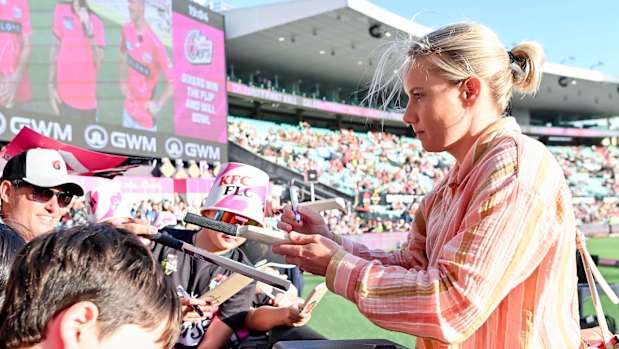
Alyssa Healy signs autographs at the SCG during the pink Test.Credit: Getty Images
Out of the co-ed Barker College, the Blackwell twins and Sthalekar would become Australian cricket royalty, but it wasn’t until Healy arrived in year 10, with the First XI needing a quality wicketkeeper-batter, that she became the first woman to be named in the previously all-boys competition, a unique milestone as a teenager on the road to many more.
Healy’s onfield achievements cover pages, from national titles to World Cup wins. She has always put team results above her own; her influence on teammates doesn’t appear in the stats.
There is a saying in professional sport that “after you retire all that is left is the numbers”, and Healy’s numbers are spectacular for NSW, the Sydney Sixers, Australia, in the Women’s Premier League and The Hundred. In 123 ODIs, 162 T20Is and 10 Tests, she produced more than 7000 runs. Perhaps her one regret is a top Test score of 99.
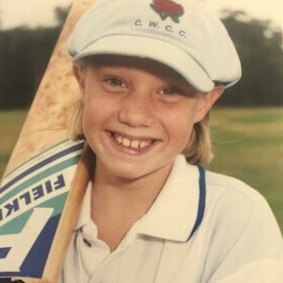
Alyssa Healy as a junior at Carlingford Waratah cricket club, where she remains patron.
Behind the sticks, she snared 172 catches. But perhaps the most revealing numbers come from her T20I victims: 65 catches to go with 63 stumpings – a rarefied ratio.
The numbers will be added to in her final series against India in the coming weeks. It is difficult to compare wicketkeeping techniques and eras as that profession is so often judged by errors rather than successes. “Silky” is a descriptor oft used for movement that appears effortless under pressure, a golf swing with a title on the line, a goal kicker needing depth and accuracy, a basketballer shooting the three-pointer; Adam Scott, Nathan Cleary, John Aloisi, Eddie Betts, Josh Giddey, you get the picture.
Consistent silky glove work is inherent to great keepers. The physical challenges of the job can so easily impair the efficacy, yet Healy would be slick from first ball until the last. Off balance batters were silently pickpocketed, bails removed seemingly before the zing had a chance to.
Maybe the qualities are intrinsic to Healy DNA?
Uncle Ian’s keeping up to the maestro Shane Warne featured the “silk”, becoming a magic part of the Warne supremacy. Stumpings run in the family.
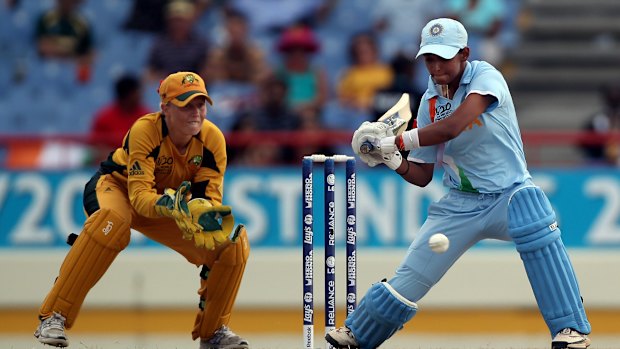
Alyssa Healy playing against India in 2010.Credit: Getty Images
An uncle and niece both wicketkeeping for their country – hard to believe.
Wicketkeepers set the tone for team attitudes in the field: some are loud and unmissable, irritating, putting opponents down and dragging teammates forward; others softly cajole, getting to the stumps every ball, cleaning up wayward throws, a subtle nod and wink to a fielder or bowler in recognition of good work or higher expectations.
Sometimes correspondence with the batters is helpful with suggestions that certain strokes are required, or not. Different teams need different methods. Healy was very much the latter; her presence undeniable, but subtle; her cheeky grin a sign of enjoyment rather than torment.
The traditional role of the wicketkeeper has been the vice-captaincy. They see all the angles and know the bowlers’ foibles and the batters’ early movements. Her elevation to full-time captaincy when Meg Lanning retired in 2023 was natural and successful.
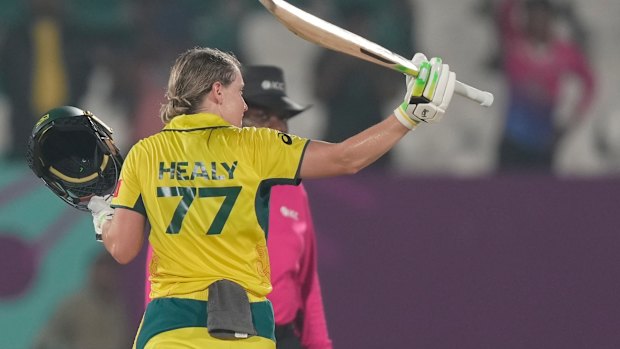
Australian captain Alyssa Healy has thrived at the top of the order in white ball cricket.Credit: AP
And there is Healy’s batting. She made her debut for the Breakers as a batter when Leonie Coleman was the incumbent and Jodie Fields had the national gloves.
The evolution of the women’s game has been characterised by a greater athleticism and the desire to hit the ball over the fence. Healy, when elevated to open, took on the bowlers from ball one. Her stroke play had once been described as “reckless”, but there was deep calculation as to what strokes worked best in the power plays. Sometimes that works and sometimes that doesn’t, but there is a certain audacity to trying it all.
There is more room in the air, apparently.
Loading
Clark was ruthless with the bat, uncompromising and unrelenting, but Healy ripped the game away from defensive bowlers. As the T20 game, in particular, evolved to higher scoring rates it was Healy leading the revolution. The WBBL was not so much made for her as made by her.
The Perry-Healy combination at the top of the order was intimidating: caught Healy bowled Perry took on caught Marsh bowled Lillee proportions.
In 1934, the Peden sisters, Margaret and Barbara, daughters of the President of the Legislative Council Sir John Peden, fairly blazed the trail for women’s cricket. They were allowed to keep their maiden names even though they were married, because they were so well known at the time. For once, the silky wicketkeeper isn’t setting the example.
Well played “Midge”, an inspiration and ornament to the great game.
Most Viewed in Sport
Loading