3 months ago
16
3 months ago
16
Angus Crawford, BBC InvestigationsCorrespondent

 Facebook
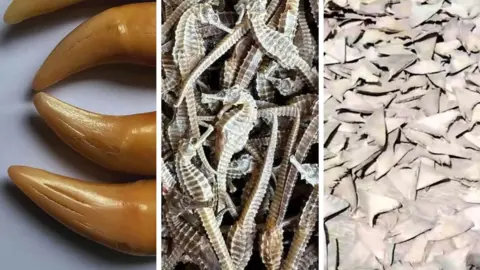
Adverts seen on Facebook showed tiger teeth, dried seahorses and shark fins for sale
Endangered species, including tiger body parts, shark fins and pangolin scales, are being offered for sale on Facebook, BBC News has found.
One Chinese user posted videos of a tiger in a cage that was for sale as well as pictures of tiger bones and teeth, while another included two live tiger cubs in a box.
An image showed a tiger head and bones for sale piled up on scales.
A seller told the BBC his products "can be shipped to the UK".
He said a 10cm-long tooth would cost 2,000 Chines yuan (about £213) and that he could sell me tiger bones for 3,600 yuan per kilo (about £380).
Another seller, who was offering shark fins, claimed to ship from the US to the UK and charged $50 per kilo (about £37).
The sale of endangered species such as tigers and pangolin is illegal in the UK and CITES, the Convention on International Trade in Endangered Species of Wild Fauna and Flora, closely regulates international trade in species under threat.
The voluntary agreement, signed by more than 180 countries and other bodies, only allows the trade if it is both legal and sustainable.
It comes as Interpol has announced the results of a global crackdown on the wildlife trade, which it says led to the seizure of nearly 30,000 live animals.
Meta, which owns Facebook, says it does not allow the sale of endangered species and removes such content.
The UK has strict laws on what species can be imported legally.
However, BBC News also found British companies selling dried seahorses, which can only be traded in the UK if the seller can certify they were sustainably harvested.
In practice, that's not possible and supplying them is likely to break the Wildlife and Countryside Act 1981, punishable by a fine or prison sentence.
One seller was found promoting them as a tonic for mothers who have just given birth and as a medicine for combating coughs. There is no scientific evidence to support this.
When contacted, the seller - based in the north of England - immediately sent pictures of the seahorses they had in stock. Ordering online cost just over £60.
Two days after placing the order three packets containing 15 dead, dried seahorses arrived in the post.
The delivery had no documentation about the origin of the specimens but did include a recipe on how to make soup with them.
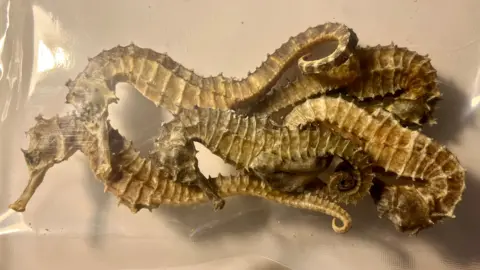
Five dead seahorses, with a pregnant male in the centre, bought from a supplier in the UK
The BBC showed the samples to Neil Garrick-Maidment, from the Seahorse Trust, who said it "made him sick to his stomach". He said they could only have been supplied illegally.
Three pregnant males were among the order - male seahorses carry as many as 200 young.
Mr Garrick-Maidment says that, kilo for kilo, seahorses are currently worth as much as silver and warned further price rises could mean they are fished to extinction.
 Reuters
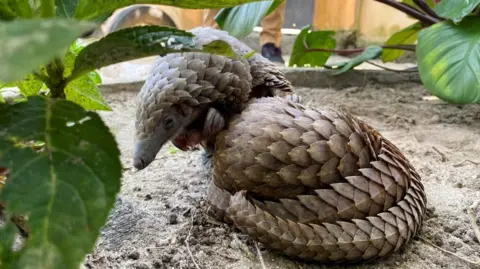
The pangolin are easily recognised by their full armour of scales
The global trade in endangered species is estimated to be worth £17bn per year and Interpol assesses it to be the fourth largest international crime type behind drugs smuggling, people smuggling and arms trafficking.
The pangolin, which is the only mammal completely covered in scales, has become the most trafficked animal on earth and is now critically endangered.
A seller in Laos was found to be offering pangolin scales for sale on Facebook. He told the BBC he charged $150 per kilo.
One user even offered to sell rhino horn and suggested making contact via private message.
In a statement, Meta said: "We do not allow the sale of endangered species on our platforms."
The social media platform says it takes down that kind of material as soon as it becomes aware of it, saying it encourages users to "report any content they think may violate our policies".
Today Interpol announced the result of Operation Thunder, a month-long global initiative to combat the trade in endangered species.
Authorities in 134 countries were involved in the operation which included the seizure of nearly 30,000 live animals and 30 tonnes of animal parts.
Interpol says the growth in live animal seizures is driven by the exotic pet trade, but the market in bushmeat is also on the rise.
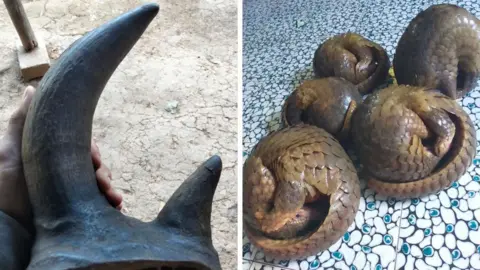
Rhino horn and live pangolins offered for sale by users on Facebook
Kenyan authorities seized 400kg of giraffe meat as part of the global crackdown and, in Belgium, primate flesh was found. More than 4,000 shark fins were also intercepted.
Danny Hewitt, Border Force's director for UK command operations who oversaw the British arm of Op Thunder, said there had been a 73% increase in seizures compared to 2023. That included live snakes, tarantulas and lovebirds found hidden in vehicles stopped at the UK border.
As populations move to the UK they drive demand, he added.
The trade has been driven by organised crime, and in many cases, customers who don't understand the harm they are doing.
Mr Hewitt added: "They may not have been illegal in other parts of the world, but they are illegal in the UK."