3 months ago
16
3 months ago
16
This was the hardest ATAR exam question WA students faced. Can you solve it?
For Dr Vesife Hatisaru, solving mathematics equations can be likened to watching Netflix or going for a walk along the beach – in other words, it’s something she does to unwind and have fun.
But Hatisaru, a lecturer in mathematics education at Edith Cowan University and former high school teacher, says that didn’t come without years of practice and frustration.
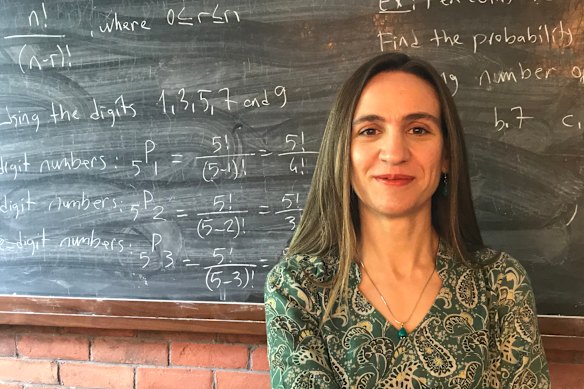
Dr Vesife Hatisaru talks through one of the hardest questions year 12’s faced this year.
“It was a pain, to be honest,” she said.
Hatisaru said that is how year 12 students might have felt this year while studying for their mathematics ATAR exams, particularly those who chose the specialist course which delves deeper into complex problems.
“Students might be experiencing less joy because they are under stress and because they are in the process of learning and practicing,” she said.
“They may have some pain, much like trying to improve at a sport, you need to work hard and sometimes that might make your muscles ache.
“Students need to work for hours. They need to practice for hours. They need to solve hundreds of questions to be fluent in those procedures.
“In terms of thinking, it’s hard work.”
Hatisaru took a look at one of the hardest questions from this year’s mathematics specialist exam, which focused on complex numbers.
While everyday items like mobile phones would not exist without complex numbers, most people wouldn’t have learned about them – or what they do.
“To my understanding, it is mostly students who would be going on to study engineering and quantitative sciences that sit in math specialists – that’s why complex numbers are one of the features aspects,” Hatisaru said.
While part A was “the most straightforward” and required knowledge of one formula, part B and part C required “conceptual, deep understanding” – particularly part B, which had multiple possible answers.
“For part C, I needed to check my textbooks because there are so many formulas you have to understand how to apply,” Hatisaru said.
“For part B, I really needed to refresh my memory.”
Loading
After viewing the question, Hatisaru said the marks allocated seemed low for its complexity.
But after speaking with a colleague who had previously marked the exam, her view changed.
“She explained to me that because the question is difficult and requires substantial mathematical work, they intentionally allocate fewer marks,” she said.
“If students are unable to solve it, that means they will lose less off their overall total, which provides a more accurate end grade.”
Hatisaru said her best advice for students learning mathematics, particularly for those struggling, was to study with their peers.
She also advised trying to teach a new concept to someone else, or to talk it through in front of a mirror.
“It’s a bit like clicking on a ‘save’ button inside your brain,” she said.
Want another challenge? Try your hand at some physics
Most Viewed in National
Loading