
 1 month ago
70
1 month ago
70
If anything should exist that’s cuter than a quokka – those teeny paws, those fluffy ears, that cheeky grin – I reckon I’ve found it. Near to the incessant roar of waterfalls and helicopters, and resolutely unperturbed by both, it’s right here before me, among a cluster of giant boulders.
This cuter-than-a-quokka, near-threatened creature boasts eyes shaped like dates; its paws are, if anything, teenier than a quokka’s; and there’s even the tell-tale hint of a joey’s tail protruding from her pouch.
It is, I’m advised by my guide, a monjon (yep, that really is its name). It’s the tiniest of the rock wallaby species – which number 17 and belong to the genus Petrogale – this one growing to between 30 and 35 centimetres and weighing between 900 grams and 1.4 kilograms.
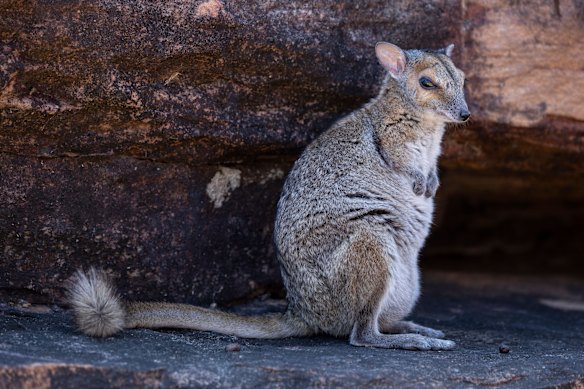
Those boulders, which form a rugged collection of caves and crevices, are its habitat but, for now, it’s delightfully out in the open for all to see.
My mini-Attenborough moment concluded, it should be explained that I’m deep in the Kimberley wilderness region of northern Western Australia, where from here the nearest quokka, at least in the wild, is as much as 3250 kilometres south on Rottnest Island, off the coast of Perth.
Sign up for the Traveller Deals newsletter
Get exclusive travel deals delivered straight to your inbox. Sign up now.
With few direct flights these days, it can take a whole, entirely worthwhile day of air travel to get to Broome, the starting point of most Kimberley adventures, from Sydney and Melbourne. In fact, Jakarta, Indonesia, is closer to this part of Australia than its two biggest cities. The Kimberley itself is as much as 15 per cent larger than Japan.
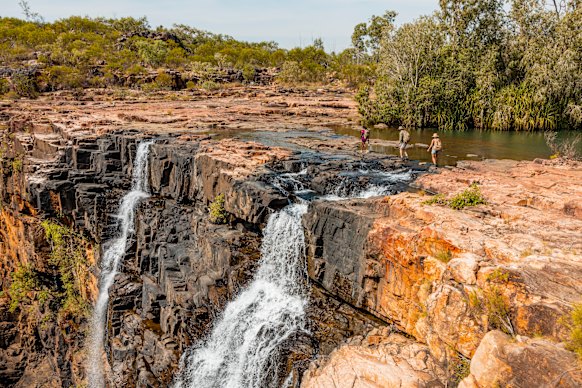
If all that, combined with a rare monjon sighting within cooee of one of the nation’s most dramatic waterfalls, the massively magnificent Mitchell Falls – classified as a tiered, multi-step cascade waterfall and part of the wider Mitchell Plateau region – fails to impress, then surely nothing will.
For me, after much international travel over the preceding months and years, I’m relishing this passport- and visa-free world-class adventure in my own brilliant backyard.
I’m in the Kimberley as a guest of APT Luxury Travel, which is set to celebrate its centenary next year and is eager to show off its network of more-remote-than-remote wilderness lodges, as well as everything wildly spectacular, and spectacularly wild, that exists in this extraordinary and ancient corner of the world.
Since I will barely encounter a foreign tourist in the coming 10 or so days – aside, that is, from the cheerful international backpackers working as baristas, waiters, managers and more at the various wilderness lodges and elsewhere across the region – the Kimberley surely remains one of Australia’s best-kept holiday secrets, with even relatively few eastern states Australians making it here.
True, the Kimberley’s profile has been elevated recently by a boom in luxury expedition cruises that has arguably overshadowed the more traditional and equally rewarding land-based tours, which are the best way to see the region if you’re not experienced at four-wheel-driving in often challenging conditions.
Thanks to the big wet lasting longer than normal at the end of April here in the Kimberley, my visit has been more touch than go. Fortunately, a day or two before my arrival in Broome from Sydney via Perth, the previously flooded road to Mitchell Falls has finally been declared open.
OF PIMM’S, PANDANUS AND FAN PALMS
Mitchell Plateau to Emma Gorge
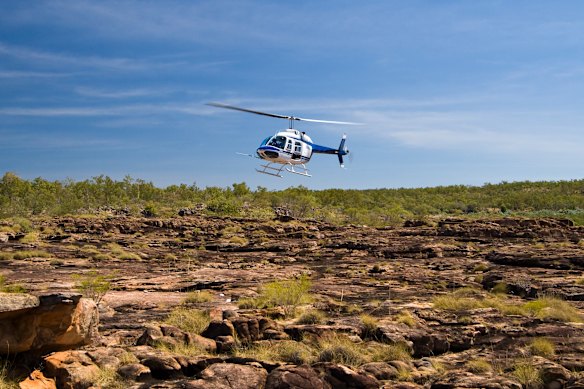
Back in monjon country, the life of a helicopter pilot, like that of any other profession, must have its ups and downs, yet here at Mitchell Falls it can briefly verge on the ridiculous. I’m strapped into one of the rear seats of a doorless wilderness whirlybird, ready to lift off on what must surely be one of the world’s shortest flights.
No more than 50 seconds later, having risen from a clearing in the scrub, we’re back on terra firma or, to be exact, a large and appropriately snooker-table-flat rock face suitable for landing.
Don’t worry. This high-powered leap of faith is only necessary when the normally dry Mitchell River, the waters of which power the falls, is uncrossable by foot, as it is on this day, and after the only recently concluded wet season, the watercourse is temporarily unpassable.
On the opposite side of the river, thanks to the chopper, hikers like me can safely access the full might of the Mitchell Falls.
After alighting from the chopper, the pilot waves me away from the pad zone when I pause to snap a shot of his machine. He needs to lift off again for another tightly scheduled, blink-or-you’ll-miss-it crossing.
To rendezvous with the chopper, I’ve hiked, as one member of a cobbled-together tour group of seven, for 4½ hours, clambering over rocks large and small for much of the way.
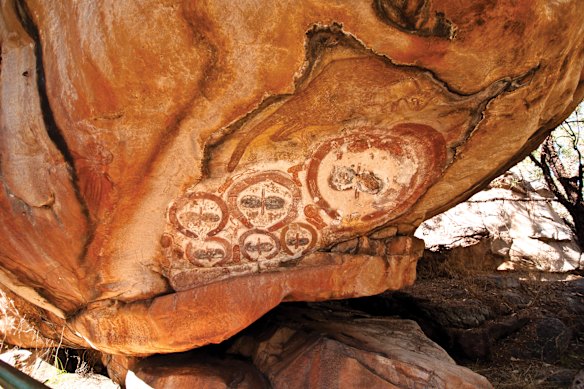
We pause at improbably idyllic waterholes for fresh dips, and at ancient Indigenous Gwion Gwion rock art gallery sites, with one display concealed directly behind a huge liquid curtain of perpetual falling water from the clifftop above.
From the makeshift helicopter landing pad, outlined by a series of rocks crudely daubed white, my guide leads me to a ledge, the bush equivalent of a royal box at an opera house, from where I view a mighty sight-and-sound show of the waterfall plummeting nearly 80 metres over four sandstone tiers.
That wetter than usual wet season – this part of the Kimberley typically receives an average of 1600 millimetres of rain between November and April – has significantly increased the force of the falls, particularly Mitchell Falls.
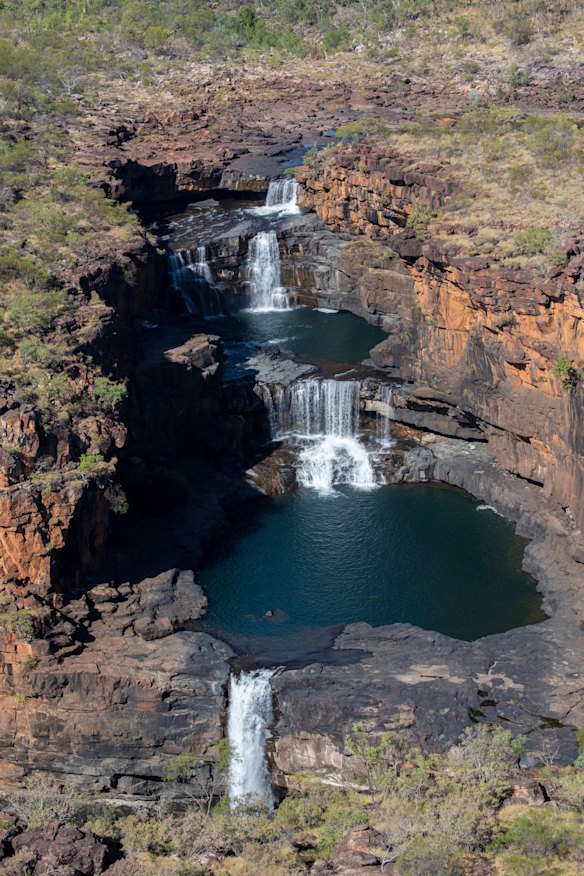
Heroic torrents of water tumble into a system of pools, where it temporarily stops and swirls until resuming its thunderous journey all the way to the bottom – evidence of nature as an accomplished landscape and water feature architect. Give her a prize.
Meanwhile, on my makeshift rocky royal balcony seat (mind the edge), there’s even catering of sorts in the form of a lunchbox packed by the backpacker crew back at APT’s Mitchell Falls Wilderness Lodge.
I discover that the local Indigenous Wunambal people become aware that the rainbow serpent – or Wunngurr, creator of the region’s creeks, rivers, gorges and fall – is at home when a rainbow itself forms at the base of the waterfall. Sure enough, right on cue, a magnificent, shimmering Technicolour arc forms enchantingly in that exact spot.
Soon, having devoured both the contents of the box (a roll, fruit, a slice of cake and a frozen juice) and the astounding view, it’s time to clamber back up to the rock plateau to again meet the helicopter.
It’s ready to convey us, following a few thrilling orbits above the falls, on a nine-minute flight back to the chopper base, where our walk began, and we’re driven back along a corrugated red dirt road to the lodge for the night. The views from above? Spellbinding.
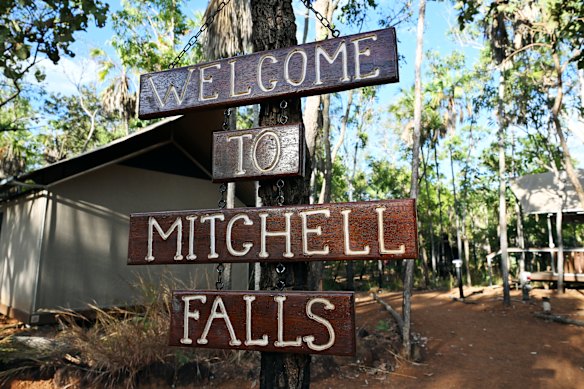
After a tiring but rewarding day exploring the watery wonders of the 315-metre-high Mitchell Plateau, my lodge immediately proves a welcome home, if ever there was one, in the absolute, indisputable middle of nowhere.
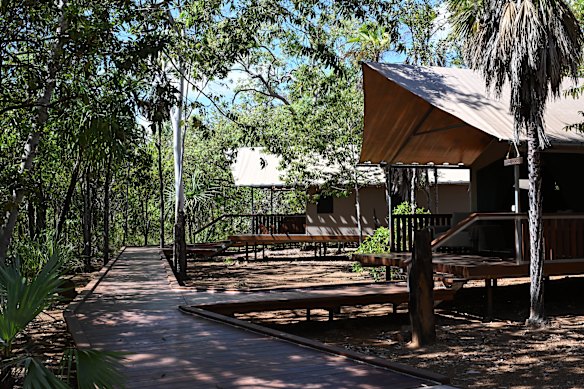
The Mitchell Falls Wilderness Lodge is nestled invitingly and discreetly among a forest of gum trees as well as a host of far less familiar, exotic Kimberley native species such as pandanus and fan palms. The immensely comfortable glamping tents of the lodge are arranged on either side of an alluring stream that runs through the camp and leads to a palm-fringed waterhole, safe for swimming.
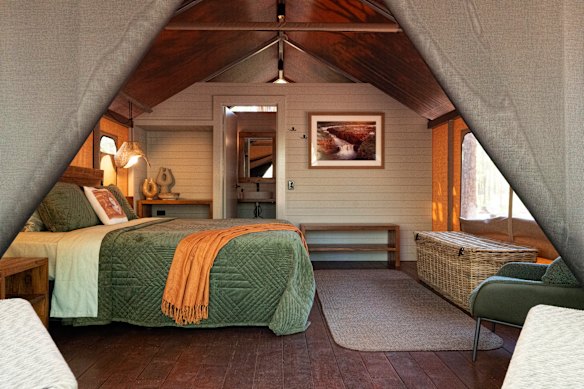
With the lodge refurbished by APT for the 2024 season, and with Broome a mere 17-hour drive away, I’m delighted, if not a little relieved, to discover that my eco-friendly, safari-style tent, one of 24, features no uninvited creatures of note but has various creature comforts.
These include not merely a king-sized bed and an outdoor verandah with twin armchairs but also a fully flushing toilet (look out for froggy intruders) and a sizeable bathroom with a shower with reliably hot water running even faster than the stream outside my tent. Heaven, or as near as you can get to it in such a far-flung locale.
A wander along the timber boardwalk from my tent takes me to the pleasantly airy, attractively designed Ungolan Pavilion. It encompasses a lounge, library, dining area and a bar, behind which I spy inside a fridge, of all things, a bottle of Pimm’s.
Yes, Pimm’s. Is there a better refreshing, civilising beverage, teamed with a dash of cooling lemonade, to toast the end of an unforgettable day? (I must be on to something as both my guide and then the lodge manager order the same tipple.)
Dinner follows with a three-course, how-do-they-do-it-here, restaurant-quality meal with a main course of expertly prepared and cooked duck from Victoria.
The next morning it’s chilly enough (but only until the searing sun rises) for a jumper or jacket. What I dub a “Kimberley light breakfast” – consisting of lashings of bacon, eggs, sausages, tomatoes and mushrooms – soon follows, cooked on a barbecue.
WHERE ROCK WALLABIES ROCK
Emma Gorge Resort to Bell Gorge Wilderness Lodge
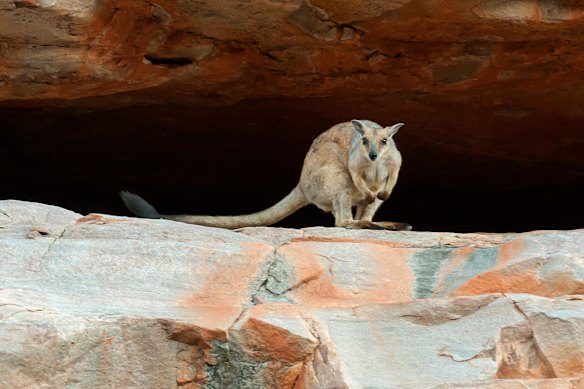
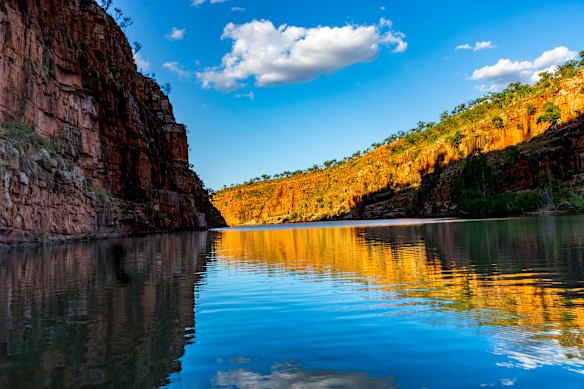
If the excitement of spotting the country’s smallest rock wallaby wasn’t enough – or, for that matter, the plentiful Pimm’s – I train my camera on a much larger member of the species from a sightseeing boat on the waters of Chamberlain Gorge.
The rock wallabies of these parts ostensibly live entirely here, on, in and around the precipitous, ochre-tinged cliff-faces that flank the eponymous river.
Suddenly, through the viewfinder, a rock wallaby I’ve been observing launches off a narrow ledge, leaping and bouncing its way with the grace of a prima ballerina dancing the full length of a stage. Somehow I manage to capture it all on a somewhat shaky video.
I’ve flown here, a distance of about 500 kilometres, aboard a small, fixed-wing Cessna from Mitchell Falls, with the plan to continue my Kimberley odyssey and to connect with a full APT tour group for the remainder of the trip.
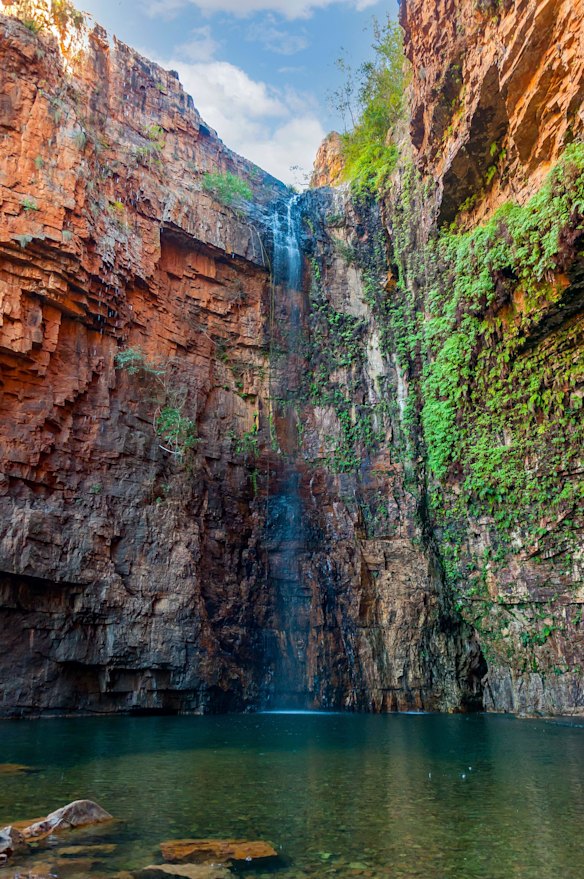
Presently I’m on a sunset cruise along a divine three-kilometre stretch of the Chamberlain River, not far from the Emma Gorge Resort, part of El Questro, an enormous 300,000-hectare wilderness park and working cattle station in East Kimberley.
But those hot-footed rock wallabies aren’t the only creatures to keep us entertained on this cruise. Chamberlain Gorge is also renowned for its archer fish, distinguished by their unique feeding technique in which they spit jets of water from their mouths to stun insect prey – and directly at cruise boat passengers like me, who hold out supplied (and permitted) pellets to them.
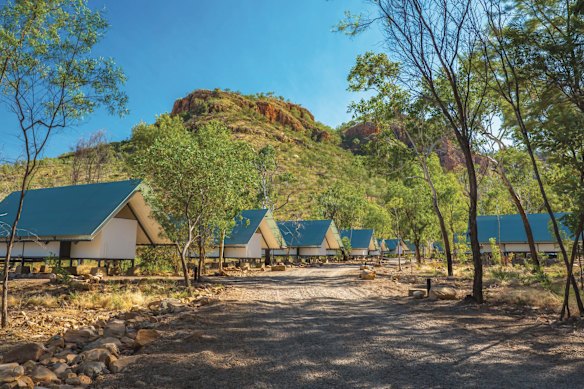
My accommodation is at another safari-like camp with beautifully appointed and laid-out glamping tents arranged against the rugged backdrop of the Cockburn Ranges. This gorgeous spot, shaded by all manner of trees including signature Adansonia gregorii, more commonly known as boab trees, will do nicely for a few nights, thank you very much.
There’s also the bonus, faithful to the resort’s name, of a one-hour-or-so morning walk to Emma Gorge, starting almost right from the resort’s restaurant and swimming pool.
Back at Mitchell Falls I was lulled to sleep by the sound of running water in the stream directly outside my tent, while here at Emma Gorge my slumber is punctuated by the possibly less calming haunting howls of distant dingoes, a soundtrack of the Kimberley if ever there was one.
After a few nights at Emma Gorge it’s time to head off with the tour group down the legendary, if not at times notorious, predominantly unsealed 660-kilometre-long Gibb River Road.
I’ll be travelling aboard one of APT’s robust yet remarkably comfortable and shock-absorbing, custom-built four-wheel-drive vehicles with a driver-guide up front. An amalgam of a truck and tourist coach, it’s a welcome ride in bucket-style leather seats with reliable Wi-Fi.
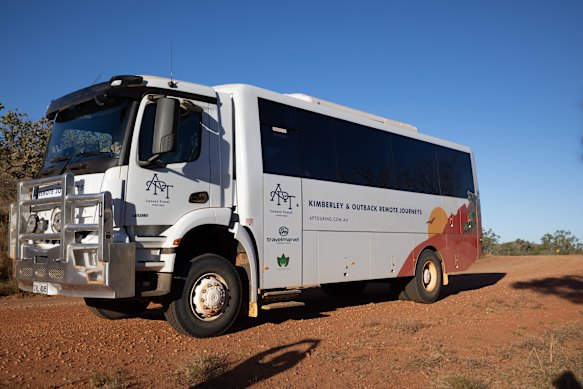
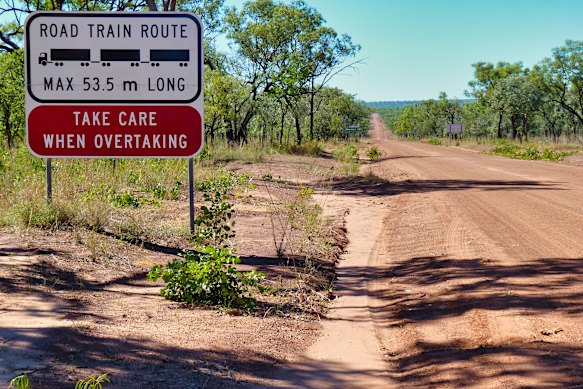
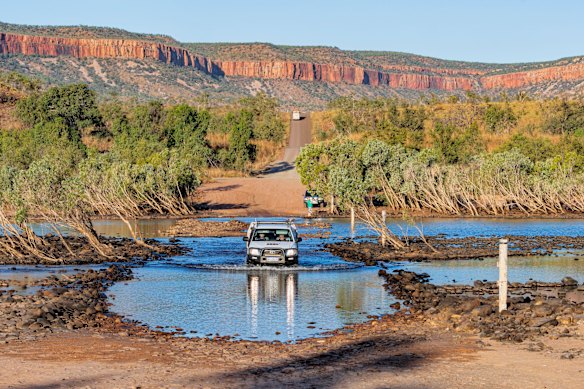
Close to El Questro, of which Emma Gorge Resort is part, is one of the most photographed scenes in all the Kimberley. Even during the dry season there remains water to be crossed along the epic, mostly unsealed and corrugated Gibb River Road, which extends between the towns of Derby and Kununurra.
There’s the Kimberley money shot, and then there’s the money video. Such is the cachet of the crossing for many a motorist, I watch as one driver pauses at the edge of the water and sets up a camera-fitted drone to record the passage, with the buzzing so-called UAV (unmanned aerial vehicle) pursuing his four-wheel-drive all the way to the other side of the shallow, pebble-bottomed watercourse.
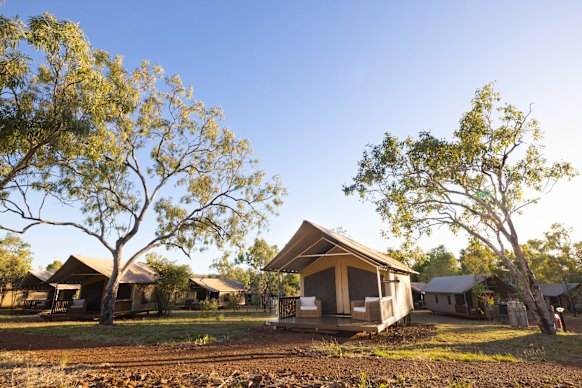
In the afternoon our group heads to APT’s Bell Gorge Wilderness Lodge for another two nights. Every bit as superbly located as its Mitchell Falls counterpart, the lodge is set only 200 metres off the Gibb River Road, on a prime Indigenous-owned site close to the Imintji Aboriginal community.
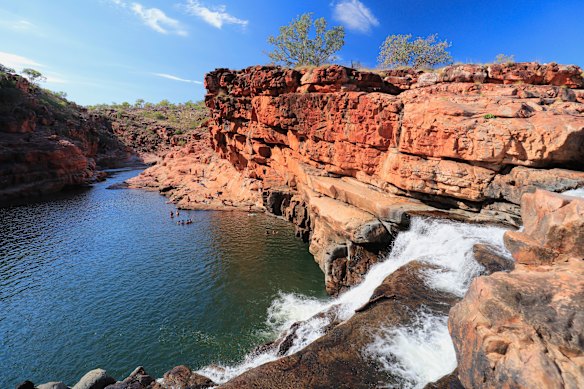
Further along the Gibb from here is Dalmanyi, or Bell Gorge, which features yet another dramatic waterfall that rivals the majesty of Mitchell Falls. Surrounded by towering rock formations the colour of a US president’s make-up artist’s powder puff, at the base of the 150-metre-high Dalmanyi is a large, suitably scenic and croc-free swimming hole.
FROM POLISHED PEARLS TO ROUGH DIAMONDS
Bell Gorge Wilderness Lodge to Broome
Mental As Anything sang that “the nips are getting bigger” but here along the road back to Broome it’s the exotic and corpulent boabs that are getting bigger. Perhaps the biggest one of all is the one with the most tragic tale attached.
It’s the massive Kunumudj, or Boab Prison Tree, located 2½ hours off the highway from Broome. While it’s believed to be 1500 years old, its claim to fame, or infamy, can be traced to a mere pinprick in time.
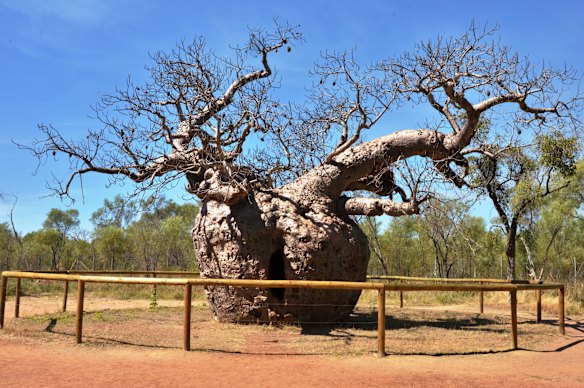
With a circumference of more than 14 metres, the tree bears a sizeable and naturally occurring slit in its solid bark. A culturally significant site for the local Nyikina people, the tree has been used for different purposes, with the most sinister one of all being that it was once a makeshift jail for Aboriginal prisoners.
The signage at the site is much more explicitly factual about the horrors that occurred here than the website of the local tourism body.
“Aboriginal people were kidnapped from the West Kimberley. The kidnappers, known as black birders, were settlers connected to the pearling industry. They wanted divers and workers for the pearling boats. They rounded people up, put them in chains, and marched them to the coast. Some may have held their captives at the Boab Prison Tree while they waited for a boat.”
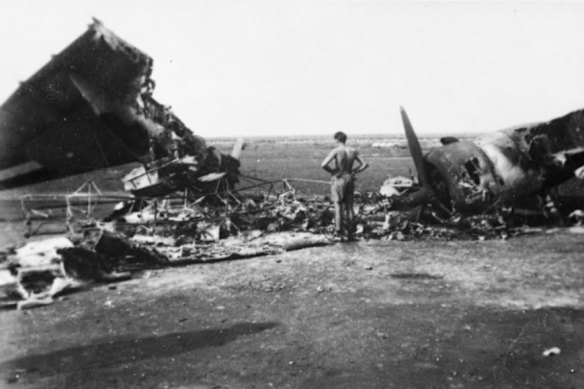
There are whitefella tragedies to be told in these parts, too. At least 88 people were killed in a Japanese World War II air-raid attack on Broome on March 3, 1942, many of them Dutch colonial refugees fleeing Japanese advances on Java, Indonesia, aboard Catalina flying boats.
One other Dutch aircraft, a Douglas DC-3-194, and its crew and passengers were unaware of the Japanese attack, flying straight into the melee to be attacked by the Zeros, making a forced landing at a remote beach north of Broome.
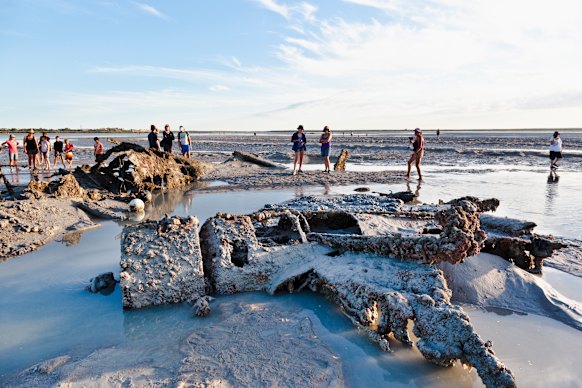
The aircraft’s surviving pilot, Ivan Smirnoff, had been entrusted by Dutch authorities with a sealed package, safe from Axis enemy clutches, containing diamonds believed to be worth as much as the equivalent of $40 million in today’s money.
The precious contents of the package were lost during the forced landing. However, a few days later Jack Palmer, an Australian beachcomber – who would inevitably earn the epithet “Diamond Jack” – sailed to the crash site and found a package full of the precious stones in the sand.
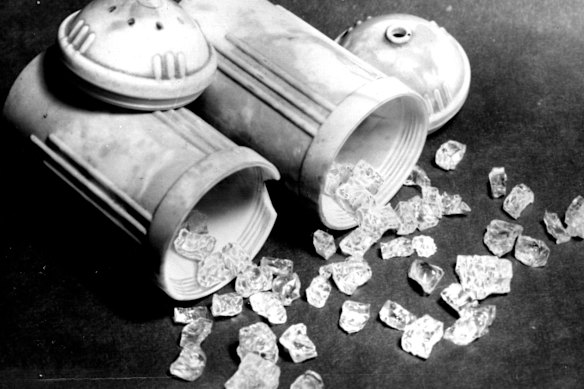
Only weeks later he presented the contents, inside salt and pepper shakers no less, to an Australian Army officer. The quantity of diamonds was less than that contained in the original consignment, so Palmer was charged with stealing, but the case was dismissed and many of the missing diamonds never retrieved.
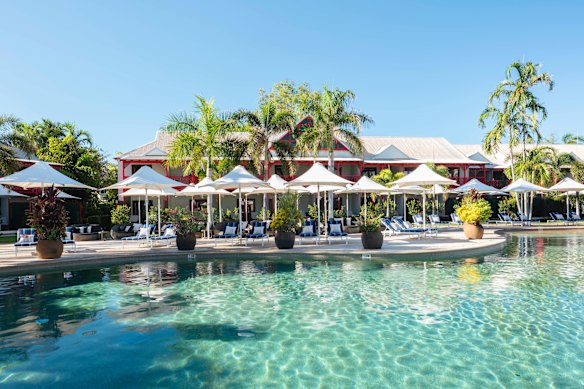
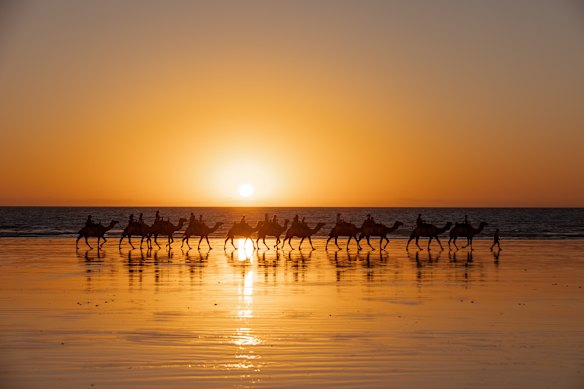
On my final night in the Kimberley I head to the aptly named Sunset Grill at Broome’s Cable Beach Club Resort & Spa. I’ve timed my dinner reservation to coincide with one of Broome’s renowned sunsets over the adjacent, turquoise-coloured Indian Ocean.
Right on time, dusk descends, complete with a signature Broome team of camels being led along the famed and seemingly endless Cable Beach sands. A fiesta of intensifying fairy-floss pinks and toffee-apple reds and, yes, Trump tangerines, the colours of the sunset don’t disappoint. All that remains, really, following these past 10 days in this extraordinary corner of Australia, is a toast to the Kimberley. “Waiter, please bring me a Pimm’s.”
FIVE MORE THINGS TO SEE AND DO IN THE KIMBERLEY
Ellenbrae Station, Durack
A popular stop off the Gibb River Road on many a Kimberley tour, the scones are always on for visitors to this oasis-like working cattle station and campsite covering nearly 300,000 hectares.
See ellenbraestation.com.au
Norval Gallery, Derby
The rambling art gallery and cafe of Kimberley Indigenous art champions Mark and Mary Norval is brimful with the paintings and sculptures of leading local and regional artists, including Mark’s own pieces. See australiasboabcountry.com.au
Sculptures on the Marsh, Derby
Best viewed at sunrise or sunset, this site consists of eight giant silhouette-style sculptures set in a marshland area of the town of Derby, about 2½ hours north-east of Broome.
See sdwk.wa.gov.au
Nine Zeros, Nine Stories, Broome
A group of Japanese Zero fighter planes attacked Broome on March 3, 1942. You can pay your respects to the victims of the World War II raid at this poignant sculpture.
See placesofpride.awm.gov.au
Cable Beach Club Resort & Spa, Broome
Alistair McAlpine, a successful British businessman and adviser to Margaret Thatcher, was the brainchild behind this tropical garden resort that’s only a few years shy of its ruby anniversary.
See cablebeachclub.com
THE DETAILS
TOUR
APT’s 15-day Kimberley Complete Broome-to-Broome small group tour, with a maximum of 22 guests. The tour includes stays at APT’s exclusive network of luxury wilderness lodges, with three-course dinners and drinks, experiences in 17 destinations and the services of an expert driver-guide. The Kimberley Complete tour, with scheduled departures from May 2027, starts from $13,595 a person with a special savings offer of $2600 a couple. See aptouring.com
FLY
Virgin Australia and Qantas operate a limited number of direct seasonal flights from both Sydney and Melbourne to Broome during the dry season, typically between April and October, and taking up to five hours. Alternatively, fly to Perth and take a connecting service to Broome. See virginaustralia.com; qantas.com
The writer travelled as a guest of APT.

















































