3 months ago
32
3 months ago
32
There is no place quite like the Sorrento main street on a sunny summer afternoon.
Women walk past with well-groomed dogs, peering into designer clothing boutiques or expensive coffee stores. Teenagers stroll around in bathers and sandals. Expensive cars make their way down the bitumen – a Porsche, a Mercedes-Benz convertible, a P-plater driving a sleek black Corvette.
Car parks are full and the roads are jam packed. Cafes have queues out the door and retail shops are fully staffed. Many people have travelled from the sprawling suburbs of Melbourne for a brief escape from the January heat.
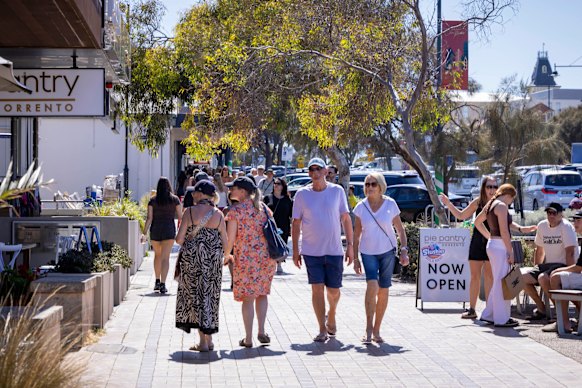
Shoppers on Ocean Beach Road, Sorrento’s main street. Credit: Wayne Taylor
This influx of young families and teenagers bring a youthful spark to a town that skews towards an older demographic.
Located in a prime position near the tip of the Mornington Peninsula, you don’t need to travel far to find a beach. The water there is deep blue and crystal clear, putting the urban swimming spots of St Kilda or Port Melbourne to shame.
Sorrento is mainly known as a summer playground for the wealthy. It’s occasionally mistaken for the much larger Italian town with the same name. But it’s also home to a thriving community that are proud of their slice of coastal heaven.
Sorrento’s history
Sorrento sits on the traditional lands of the Boonwurrung (also known as the Bunurong) people of the Kulin Nation. Their country spans from Gippsland in Victoria’s south-east to Werribee in the west.
The town was the site of Victoria’s first European settlement in 1803, but the short-lived outpost struggled with access to drinking water and farming soil. The colony soon moved further south to Tasmania, along the banks of the River Derwent.
One convict, William Buckley, escaped and lived with the Wathaurong people on the Bellarine Peninsula for more than three decades. The idiom “Buckley’s chance” (used to express a slim chance of success) is widely believed to be named after him. Sorrento pays its own homage with an eponymous cafe on Ocean Beach Road.
The town re-emerged as an area of limestone production in the 1830s. Men travelled from Melbourne to dig, crush and burn the stone – a valuable building commodity. Many structures in Sorrento were built from the white coloured material.
Englishman George Coppin is often described as the area’s first developer. He established a steam tram and boat service within Sorrento, and also opened the Continental Hotel, still in business today.
Sorrento soon found its place as a destination for Melbourne’s wealthy.
Clive Smith, president of the Nepean Historical Society, says that it was the natural beauty of the coastal cliffs that first inspired the tourism industry.
“A lot of the land that was bought here at that time … [was by] politicians and lawyers, and doctors and shipowners,” Smith says. “Those big blocks … that was all for people’s holiday homes.”
Modern-day Sorrento remains a remarkably affluent suburb. The latest census data from the Australian Bureau of Statistics shows that 64 per cent of residents own their home outright, almost double the state average. It also paints a picture of a population that is older with more retirees. The median age is 64, 26 years higher than the average Victorian.
It’s also overwhelmingly white. The top places of ancestry include no countries outside of Australia or Western Europe. No residents identified as being Aboriginal or Torres Strait Islander in the census.
Some elements of Sorrento’s 19th-century character are still visible today. Smith says that the history of the area is well-preserved. But there has been an undeniable shift towards modernity.
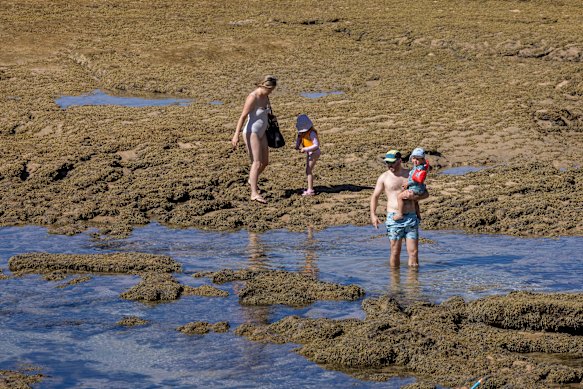
Beachgoers explore rock pools at the back beach. Credit: Wayne Taylor
“It’s inevitably been swamped … you now get a little old limestone cottage with two huge concrete boxes on either side,” Smith says of today’s holiday houses, as he sits at his desk in the museum.
A coastal day out
During the peak of summer, sleepy seaside Sorrento swells to a capacity it can barely handle. Locals complain about the traffic. But many traders are grateful for the influx. A shop owner can make enough to last until the next summer if they’re lucky.
Two of the area’s most famous watering holes glisten proudly in the sun, outdoor tables overflowing with customers.
Hotel Sorrento, opened in 1872, is the oldest surviving establishment of its kind on the Mornington Peninsula. It is the namesake of an Australian play from the 1990s, which was later adapted into a feature film starring Caroline Goodall, Tara Morice and Caroline Gillmer.
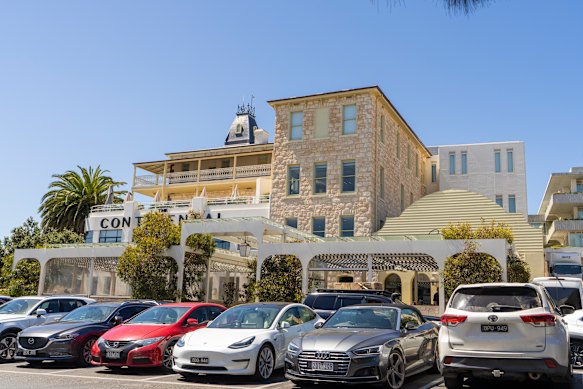
The Continental Hotel.Credit: Eamon Gallagher
Around the corner, the Continental Hotel (locally known as the Conti) was established by George Coppin about three years after Hotel Sorrento. A no-frills nightclub during the 1990s and early 2000s, it has since expanded under a multimillion-dollar renovation to include a luxurious hotel, hospitality and event space.
Craig Shearer, the founder and director of Kick On Group that operates the Continental, says the hotel is an iconic part of Sorrento’s visual landscape.
The warmest summer weeks bring the biggest demand at the venue. In the first week of 2026, the business raked in its highest revenue since current management took over three years ago, Shearer says.
“I remember the Conti in the old days, when I was a teenager visiting … it was always the place that you went for a late night, for a party,” he says.
“Late night entertainment at that site is really important to the fabric of what the Conti has always been.”
Modern industry in Sorrento has advanced far past the humble limestone trade of the 19th century and the coastal chic of the noughties.
A stroll down the main street is like paying a visit to a shopping centre. Major retailers like Kookai, Gorman and Country Road all have a presence. A new addition this summer is an unstaffed 7-Eleven seasonal pop-up store.
The heritage-listed Sorrento Athenaeum building, constructed in the 19th century and formerly a cinema, now houses Cotton On and Lululemon. Eager teenagers float in and out of these two shopfronts, holding paper shopping bags.
Then there are the independent retailers who have become a mainstay of the shopping strip. Marlene Miller has owned her Sorrento antiques business for four decades. What originally started as an art gallery morphed into the eclectic store, which still operates on Ocean Beach Road.
Her treasure trove stocks bottle openers in the shape of mermaids and stained-glass lampshades shaped like animals. A beaded door curtain depicting painter Frida Kahlo hangs from the second floor.
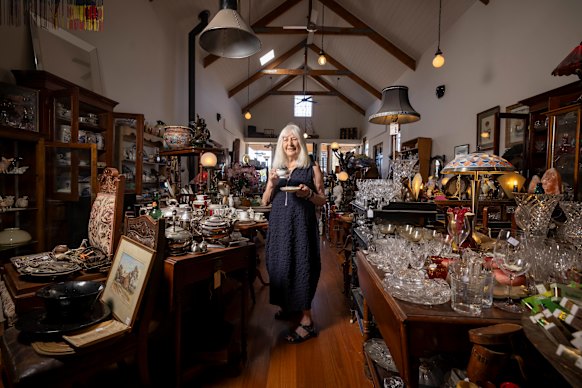
Marlene Miller in her Sorrento antique shop.Credit: Wayne Taylor
Miller proudly showcases one of her newest finds, a 200-year-old oversized mug with an illustration of a dog chasing a bird.
“We’ve got a lot of people [who visit]. They all love it. I’ve got one man [who] comes from Paris,” she says. “It’s more Melbourne people … locals think it’s boring.”
Miller admits that rent is steep along the popular strip, a cost that has driven away many independent businesses. But she doesn’t begrudge the influx of major stores.
“That’s where people buy things. They don’t buy from the smaller retailer,” she says.
The great outdoors
Sorrento has beaches on both sides. Its front is on the shores of Port Phillip, the horseshoe-shaped bay that stretches to Melbourne and across to Geelong. The back beach looks towards the Bass Strait, the unpredictable waterway between the mainland and Tasmania.
Geoff Coker grew up surfing the waves and fishing for crayfish in the area. Born near Sorrento’s football oval and later a student at Rosebud High School, he feels an immense connection to the water.
“This is where I belong. This is what I understand … I can tell you exactly what’s under the water in every one of these ledges,” he says.
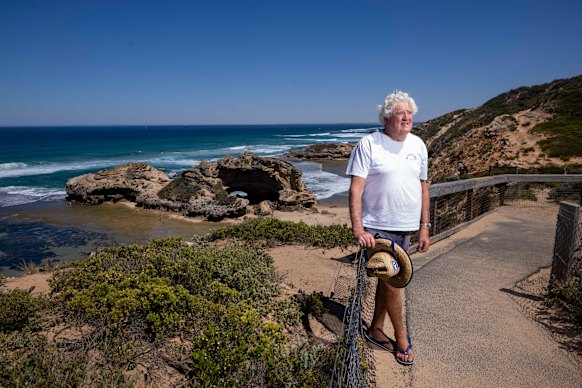
Geoff Coker at the London Bridge lookout. Credit: Wayne Taylor
Coker stands at a lookout point at London Bridge. Technically in the neighbouring suburb of Portsea, he insists that this location was the best representation of his childhood. It’s around the corner from what was his dad’s favourite crayfish spot.
“We grew up along her in the water, crayfishing and surf fishing … it was idyllic,” he says, as he casts his eye across the blue waters.
Not too far from the rugged coast, the grave of cricket legend Shane Warne sits in the Sorrento Community Cemetery. The headstone pays tribute to a cherished son, brother and father. A few VB stubbies and cans of Heinz Baked Beans have been place on the tomb.
In the calmer conditions on Port Phillip Bay, roughly two kilometres away, a wooden boat called Polperro has been traversing the bay since the 1980s. Originally a vessel for a dolphin research project, it now escorts tour groups to swim with dolphins, seals and spot weedy sea dragons.
The company was founded by Troy Muir’s parents. He’s since taken over as captain, and often guides tours alongside his two daughters.
Muir, who lives on the Mornington Peninsula, agrees that aspects of Sorrento have changed dramatically. That’s why he values environmental features like the bay and its wildlife.
“The thing that’s remained the same is the natural attractions. I think that’s the most important part,” he says.
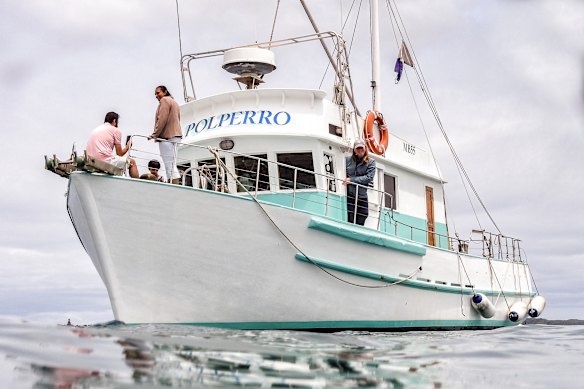
Captain Troy Muir (facing camera) aboard the Polperro.Credit: Yanni Dellaportas
“Every year, with tourism, they ask, ‘How can you improve your product?’ But perhaps … it’s about experience. We think it’s pretty special as it is, so we don’t want to change it.”
On Sorrento’s ocean coast, glassy water is replaced by rolling waves. Young children explore the rock pools at low tide, and the occasional surfer braves the break.
The Sorrento Surf Life Saving Club was established here in 1998. Today volunteers patrol the beach during peak season and run a nippers program for kids in the summer.
It’s a time of evolution for the organisation. Their two-decade-old clubhouse is being rebuilt, and president Jane Wright has ambitions to establish a new community gathering place.
“In a small place like Sorrento, you need those sorts of things … It swells over summer to this massive group of people. But in winter, there’s no one else here,” Wright says.
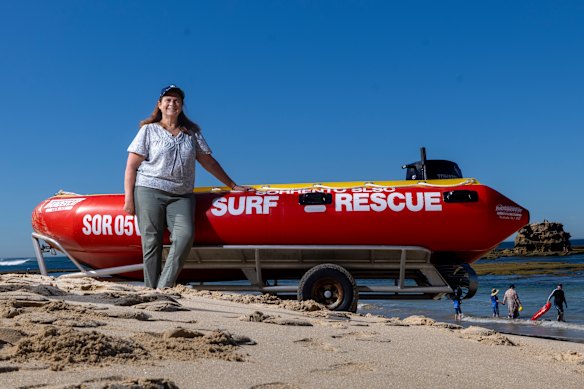
Sorrento Surf Life Saving president Jane Wright.Credit: Wayne Taylor
Sorrento is home to many holiday houses, and an increasing number of short-term rentals. The wider Mornington Peninsula has been home to a 28 per cent rise in non-hosted Airbnb listings (where investors lease their second properties) over the past four years. The approach is often criticised for placing pressure on the long-term rental market.
Construction of the new lifesaving clubhouse was jointly funded by the Victorian government and the Mornington Peninsula Shire, and the rest raised through donations. The build is expected to be done in time for next summer. Meanwhile, lifesavers and nippers programs are run out of shipping containers.
Wright says she’s looking forward to enjoying a glass of prosecco and enjoying the ocean views on the newly built deck with her club members, a lifestyle she cherishes.
“There’s a whole community that sort of looks after you … It’s not the Gold Coast. But it is still a family, community sort of feel. We’re really, really keen to make sure that doesn’t disappear.”
Start the day with a summary of the day’s most important and interesting stories, analysis and insights. Sign up for our Morning Edition newsletter.