
 4 months ago
95
4 months ago
95
This body has no business on that mountain. It was inevitable, my daughter warned, that I would tumble down like a ball of Gloucester cheese on an English hill. My wife had been waiting for this motivation for me to get away from my desk and start moving. It’s no coincidence it took risk of disfigurement and fear of death to finally get me into the gym a month before departure.
I was on my way to Whistler Blackcomb in British Columbia, Canada, the largest ski resort in North America. More than 200 marked runs, 16 alpine bowls and 3300 hectares of skiable terrain, all weighing down on ankles that hadn’t felt the pinch of ski boots for nearly two decades. “Too long,” I would argue to anyone who cared. My body is not what it never was.
We arrive at the Fairmont Chateau Whistler, a ski-in ski-out property at the foot of the Blackcomb gondola. My quads ache while I look up at Whistler-Blackcomb’s twin peaks, basking in early spring sun. Robe culture runs wild here: entire families in uniform white, complete with slippers, parade through the grand wood and stone lobby on their way to the health club and Vida Spa. The amused concierge informs me there is a more discreet path. Robed up, I squeeze my feet into the miniature slippers and shuffle down the hall to the pool.
After 24 hours of travel, there are few combinations more soothing than an outdoor jetted hot tub during a snow flurry. Hot pressure attacks joints beneath the water; above it, frozen flakes gently tickle the body’s extremities. Time slows as snow piles around me.
When I open the curtains in my deluxe room the next morning, my sigh is audible. Waking to fresh powder on a ski trip is a treat for any Australian, but I am nervous. Problematic knees and being far from my best shape weren’t risk factors enough to deter me from this trip. Nor could they be remedied with one month’s notice – no matter how many thrashing pool laps or frenzied workouts I tried to squeeze in. Only time would tell how my body would hold up.
Fitted and kitted at the hotel’s ski valet, I meet the mountain guide tasked with assessing my mental state. “I’m Julia, are you ready for this?”
Those seven words pierce my confidence. Am I? I feel conspicuous among svelte skiers and snowboarders desperate to capitalise on 15 centimetres of fresh snow.
She doesn’t wait for me to respond. “Let’s go.”
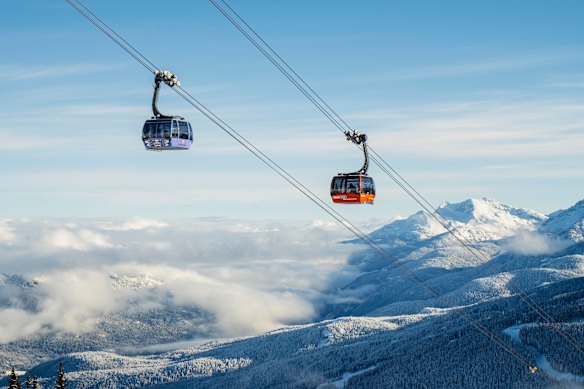
With a swivel and a powerful push of her left leg, Julia glides toward the lift, barking orders at young boarders to make way. My fellow skiers and I clumsily catch up and board the Blackcomb gondola, a metal cage trundling us up to the mid-mountain station.
Julia is the mountain’s matriarch – a commanding presence you hear and feel. It’s no coincidence she is assigned to me and two other middle-aged men of varying competence and confidence. “We’ll try Jersey Cream first, let’s see how you like it.” We wait for Julia to stop halfway down the run, then we each have our chance to impress. I’ll never forget that first run, the edge of my ski cutting through the snow like soft butter. The rhythm of skis running over corduroy, alone in my head, breathing, with focused thought. Yes, I am rusty but it all comes back to me surprisingly fast.
“Alex!” Julia bellows to nearly everyone on the mountain. “How long did you say it’s been since you skied?” I puff up and smile, awaiting validation. “Your skies are way too parallel; you need more control. This isn’t the ’90s. Times have changed.”
I shrink, crestfallen. Jersey Cream turns sour.
Through gritted teeth, I widen my knees and skis, leaning further forward into my boots. The impact is immediate – more control, responsiveness and balance. Old dogs can learn new tricks.
I flatten out my turns and pick up speed, my torso facing exclusively downhill. A flash of red catches the corner of my eye, a bearded man-child flying past me wearing lycra and a cape. Accelerating, I keep up, quads and glutes screaming, my left knee clicking at each turn. I’m not Superman, but I feel like him. Wisdom is chasing me but I am faster. In an instant, Lycra Man catches an edge, and with arms flailing he careers into the subalpine fir treeline. I never see him again. I check my speed. That was equal parts validation and warning.
Julia passes down mountain lore as we ascend Blackcomb’s Symphony Express Chairlift again. She points at two snowboarders in the woods: one half-buried and motionless, the other struggling free. “Tree well,” she explains – low-hanging branches that create deep, hidden holes for snowboarders to fall into. “That’s why you always ski in pairs.” Julia looks me in the eye. “You’ve got to be careful up here.”
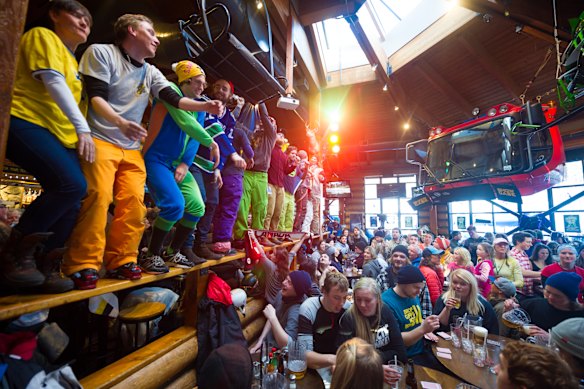
I’d been warned, too, about the après in Whistler, rumoured to be the wildest in North America. Legs numb from our final run, we’re at Merlin’s, spiritual home to rockers The Hairfarmers, “Whistler’s local favourite since 2001”. It’s Tuesday afternoon and the cabin is heaving.
The band is two songs in and revellers straight from the slopes dance on speakers, tables, chairs and shoulders under a Snowcat suspended from the roof. We have to get involved. From behind the bar, an antique ski fitted with four shot glasses is paraded through the party. Before I know it, the ski is in front of me. Down the hatch. Thank god it’s tequila.
My eyes fixate on the poster behind the band’s frontman: Welcome to Spring Break. Of course it is, it all makes sense to me now. Lycra Man, the 4pm frat party: I’ve stumbled across the university blowout I avoided 20 years ago – and I was enjoying it. Looking around, I can’t help but think – did I make the most of my time all those years ago?
Conditions deteriorate overnight. The Pineapple Express takes Whistler hostage. This is not the mind-altering variety my new spring break friends sought at the cannabis dispensary, but an atmospheric phenomenon. It picks up a river of warm moisture from near Hawaii before dumping it as rain on the west coast of Canada, once or twice a season.
Rain on snow is the worst possible combination for a ski holiday, but it gives us time to explore greater Whistler’s surroundings. Whistler has 14,000 permanent residents, allowing it to straddle authenticity and commercial appeal, something not many ski towns manage year-round. The 4.4km-long Peak-2-Peak Gondola, linking Whistler and Blackcomb mountains, is part of the Epic Australia Pass network.
The Callaghan Valley is a mysterious, high-elevation wilderness, known for its old-growth forests, 25 kilometres south of Whistler village. In a modified snowcat with bucket seats, a thumping sound system and safety straps hanging from the roof, we chug up an undulating track deep into British Columbia back country. The ploughed, snowy path ends at a secluded cabin next to a frozen crystal-blue lake. When the sun sets, the cabin emanates a seductive warmth. Inside, we strip off layers as a log fire does the hard work for the rest of the night. We dine on French onion soup and seared scallops before being forced to choose between Alberta beef or Arctic char.
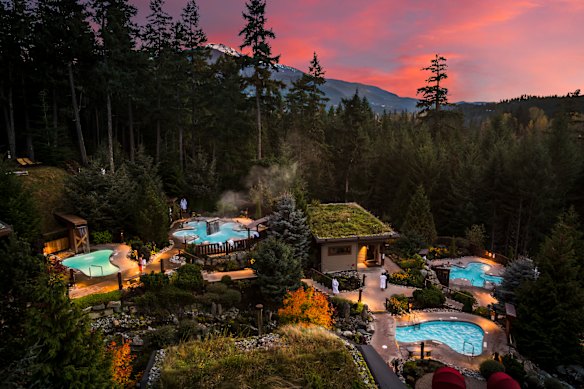
“Hot, cold, relax” is the mantra at Scandinave Spa, a cascading outdoor complex of hot baths and cold plunge pools within Whistler’s moss-green rainforest. Standing under a waterfall, I count to 10, panting as near-freezing water barrels down. “Your journey towards relaxation will challenge you as you move through intense stages of heat and cold,” we’re told. Just as well phones are banned; this is no sight for sore eyes. There are dry saunas, a eucalyptus steam room and three wooden solariums. Eyes unfocused, staring out into the elements, my broken body starts to repair.
That night, we descend into the belly of Whistler’s premier fine-dining restaurant, Bearfoot Bistro, where more than 15,000 bottles line Western Canada’s largest cellar. There we savour champagne, sample rare vodkas in an ice bar and drink wine paired with seared Quebec foie gras, albacore tuna, Dungeness crab and elk tenderloin with truffles, all produced in a pristine environment. I tell my fellow diners it’s residual childhood guilt forcing me to finish every morsel. The truth? Every mouthful is delicious – it can’t go to waste.
The meal is complete with one final performance – liquid nitrogen ice-cream hand-churned at the table. If I don’t have gout, I definitely should. I don’t care: the benefit this trip gives to my brain trumps any deficit to my body.
The writer was a guest of Vail Resorts-Epic Australia Pass, Whistler Blackcomb, Tourism Whistler and Fairmont Chateau Whistler
24 hours in Vancouver
The outdoor wonderland that is Vancouver does not disappoint. Bike around Stanley Park, board the chairlift up Grouse Mountain or simply grip the rail while walking across the swinging planks of the 140m-long Capilano Suspension Bridge Park.

















































