
 4 months ago
78
4 months ago
78
According to the executors of his estate, Graham Richardson died penniless.
The former Labor senator and lobbyist was the master of stealth enrichment, from soliciting bribes to shaving personal gratuities from political donations, securing retainers from property developers and squirrelling assets in Swiss bank accounts.
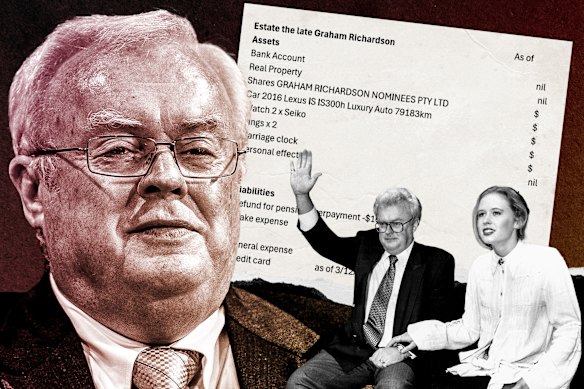
But when it came time for the distribution of his assets, the cupboard was bare. His only daughter, Kate Ausden, was told there were no funds to dispense her $10,000 legacy, and she might like to contribute to the estate duties instead.
Richardson’s residual assets had been swallowed by his credit card bill, legal and accounting fees and an $18,500 wake at the Golden Century restaurant that cost nearly twice what Ausden had been promised in the will. The estate was left $38,201.49 in deficit.
It was a fitting epilogue to a life littered with unfilled promises and vanishing acts, and like everything else involving Richo, it was impossible to know what was real.
Ausden, Richardson’s daughter from his first marriage, to Cheryl Gardner, does not pretend to have any insight into the events that might have led to an insolvency. Their relationship was strained, and she had not seen him since before the pandemic. She cannot verify the details provided to her by the executors and their lawyers.
“He was a complicated person,” she said. “He had a lot going on with a lot of different people, and I know enough to know that I hardly know anything.”
She only learnt of his death like everyone else, through the media, and was shocked when Prime Minister Anthony Albanese gave him a state funeral. If she had been consulted, she would have said it was inappropriate, she said.
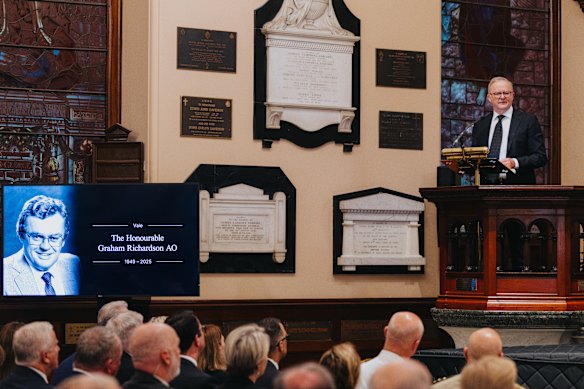
“I wanted his life celebrated to the fullest extent possible, but I know what’s in the public domain,” she said. “I’ve lived through these scandals, I know who he was.”
Growing up as Richardson’s daughter meant lying on the floor of the living room while television cameras were pointed into your house during the Marshall Islands affair, and reading on your walk to high school about your dad having sex with a prostitute on the Gold Coast.
Sometimes women would leave rambling messages on the family answering machine. Once she watched, mortified, as federal police officers rifled through her underwear drawer for documents that might prove he held shares in Offset Alpine, an over-insured printing plant that had mysteriously burnt down. Richardson knew they would not find anything. He sipped a cup of tea.
Recently, going through her papers, Ausden found a page of feedback that he had given her about 1994 for a school speech she had drafted, and noticed that it was watermarked by the Criminal Justice Commission. She had a sudden image of him as it might have occurred, doodling on her schoolwork while the CJC probed him on his involvement in a prostitute ring.
“I loved him, but part of all that was incredible ups and incredible downs. If you look at his career with all the scandals, I don’t know how he lived as long as he did. The pressure and stress of keeping it together all the time must have been enormous.
“I always knew when he was lying because he would come back so hard at you. He would scream, and then he would over-explain. It was the gaslighting Olympics.”
Now a solicitor in employment law, she recognises some of his controlling behaviour in the cases she handles.
Richardson’s relationship with Ausden and her brother Matthew became difficult due to the circumstances of their parents’ marriage break-up. But Ausden later reconciled with him, and they met at restaurants outside his neighbourhood when she visited Sydney from her home in Perth. He asked her not to ring the house he shared with his new partner, and used to call her under different numbers, which she listed in her phone as “Dad 1”, “Dad 2” and “Dad 3”. Matthew teased that he treated her like one of his low-order mistresses.
“He wanted me off to the side and staying in my lane, and the last thing he wanted was for me to have any form of relationship with his new family,” Ausden said.
She could only marvel at his expediency as he adjusted his narrative to suit his audience. In 2011, she told him she was hurt by an article in which he described his relationship with his older children as “strained”, as it followed a happy weekend they had just spent together.
He wrote to her with a convoluted explanation for his choice of words. “The last thing on my mind was causing you more pain,” he wrote. “Not a day goes by when I don’t think of you and Matthew and happier times between us.”
She came to believe that it suited Richardson to hold his adult children at a distance because they were too much part of his messy past. Yet he wanted the public to see him as the victim.
“You’ve got to understand that he had everyone in their little silo and he would tell everyone his version of the truth,” Ausden said.
“He tells you horrible things about other people and I have no doubt other people heard horrible things about me. He would move people around the chessboard the entire time. He loved it.”
The extent to which Ausden had been siloed became crushingly clear after his death.
Left in the dark as to his funeral arrangements, she Googled a generic “state funerals” email address to find out if seats might be reserved for her family, and whether she might have the chance to “say some words”.
A nameless team member responded that those who her father had nominated to speak had already been contacted and details about the event would be published in the funeral notices. “I can’t begin to tell you how I felt in that moment,” Ausden said.
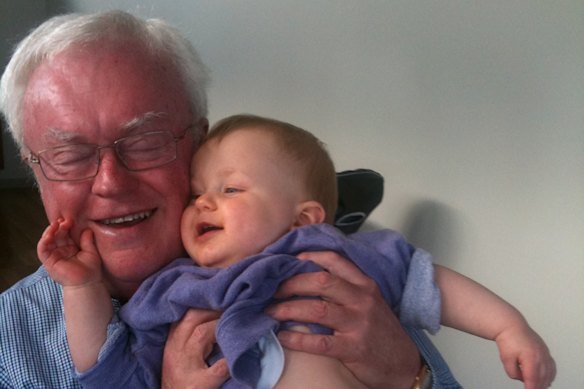
She later sent through photographs of Richardson with her son that she hoped might be included in the montage, and a letter from Richardson to Bob Hawke that he had told her he wanted to be released on his death. She was told they would be forwarded to Richardson’s widow, Amanda.
Five days later, the Daily Mail published a story that was sourced to a family spokesman acting on behalf of Amanda. The first line was: “The estranged children of late Labor powerbroker Graham Richardson are trying to intervene in how his state funeral is conducted, despite having had no contact with him for years.”
She knew then that it would be impossible to attend. Friends who watched the funeral told her that the photographs she sent were not included in the montage. Neither of the children from his first marriage, nor any of his grandchildren, were mentioned at all.
“We were completely scrubbed,” Ausden said. “I think that’s what Matthew wanted. I really did want to talk. I’m conscious of the fact that there were 40 years of his life that was just blank.”
Had she been allowed to speak, she would have tried to put across how funny Richardson was as a father, with the mad things he would do on holidays or the disgusting dinners he prepared on Sunday nights from boiled chicken, boiled cabbage and packet gravy. She might have read out the letter that Richardson sent to Hawke in the late 1980s, urging the then-PM to act on the environment, an impulse that proved prescient.
Last month, lawyers for the executors of Richardson’s estate advised Ausden’s solicitors that the estate was in deficit and required funding for its liabilities, and asked her to confirm if she agreed to share the debt with Amanda.
They also addressed Ausden’s objections to her treatment over the funeral service, saying that the executors had offered her seats, but she did not respond. “Your client could also have attended in the public area,” they wrote. “Your client chose not to attend.” (Ausden has no record of any such offer.)
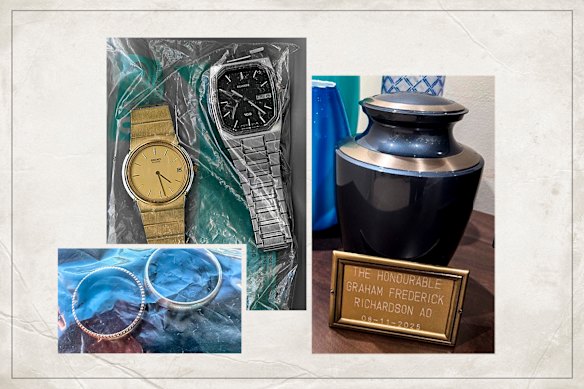
Finally, they reported that Amanda wished to give Ausden and Matthew two rings from Richardson’s marriage to their mother that were valued at $100, and two Seiko watches worth a combined $500, photographs of which they included in the correspondence. They enclosed a beneficiary acceptance form for her to sign, renouncing further claims on the estate.
They also sent her a photograph of the urn containing Richardson’s ashes.
“I did find the inclusion of the urn completely upsetting,” Ausden said. “The rings are not even from my parents’ marriage.”
Richardson’s will was a seemingly simple affair. He left two specific gifts – a $10,000 legacy for Ausden and his personal and household effects to his widow, Amanda. No provision was made for Matthew.
His residual estate was put into a testamentary trust, with Amanda and the couple’s only child, D’Arcy, named as the beneficiaries. Its terms ran to 20 pages and covered such matters as accumulated income and powers to invest the funds in property or shares.
A testamentary trust does not take effect until the person who established it dies, and the liabilities of the estate must be cleared before any assets are diverted into it. If this does not occur, the executors can be held personally liable.
Lawyers for the executors, high-profile defamation solicitor Mark O’Brien and long-standing friend Bob Miller, stated in their letter to Ausden that the trust had failed because there was no residual estate.
Miller told the Herald that Richardson’s assets had been swallowed up by his medical bills, which were “astronomical”.
“It cost thousands of dollars a month just to keep him alive, and that’s been going on since 2016,” Miller said.

Luxury items such as a Vacheron Constantin watch given to Richardson by the late stockbroker Rene Rivkin had either been given away or sold, Miller said. Rivkin helped Richardson hide millions of dollars in Swiss bank accounts during the 1990s.
There are ways that motivated individuals can protect their assets from posthumous bankruptcy, such as putting them into other people’s names, setting up discretionary trusts or bestowing them as gifts to trusted friends, which is among the methods favoured by Russian oligarchs. The gifts may not be documented, leaving no paper trail.
Richardson was famously averse to putting his business affairs in writing. He told an upper house inquiry into land deals in 2009 that he kept his diary in his head, and did not draw up contracts for his lobbying clients.
“All I need is a handshake,” he said. “If I shake their hand, it means I trust them.”
Land title records show that the four-bedroom Dover Heights house shared by the Richardsons was bought for $3.8 million in 2012 under the maiden name of Amanda, who was a secretary at Australian Consolidated Press when they became involved.
Amanda told guests at Richardson’s 70th birthday party in 2019 that she had grilled him about hidden assets shortly before he was given a general anaesthetic for a surgery he was not expected to survive.
Comedian Vince Sorrenti, who MC’d the party, retold the anecdote in the Daily Telegraph, recalling that her speech brought the house down: “As they were saying their goodbyes she whispered to Graham, ‘Is there anything you want to tell me before you go under? Any bank accounts in Switzerland I should know about?’ ‘No,’ replied Richo. ‘Are you sure Graham? Is there anything secret or financial I need to know in case you don’t make it?’ ‘No,’ repeated Graham. ‘OK,’ she said. ‘Put him under!’”
Start the day with a summary of the day’s most important and interesting stories, analysis and insights. Sign up for our Morning Edition newsletter.

















































