
 2 months ago
64
2 months ago
64
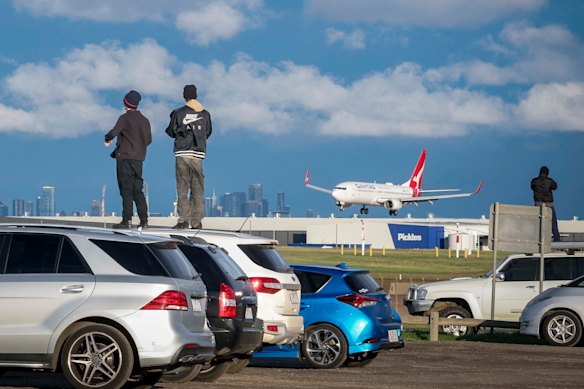
Iam out spotting plane spotters on a clear Sunday morning in Melbourne, when I luck upon one of the rarer subspecies at the edge of Operations Road on the southern perimeter of Tullamarine Airport.
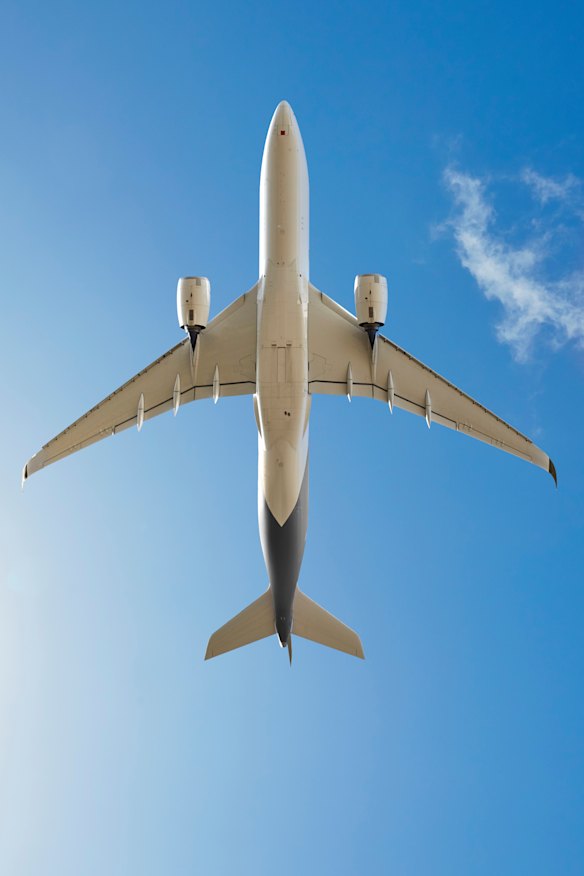
My first spotter of the day is a Bloke on a Ladder. As I approach, he balances close to the top of his retractable stepladder, holding a camera with a huge lens, and pointing it at a Delta A350-900 Airbus taking off from runway 34. I know the make and model of the aircraft because, like Bloke on the Ladder, I’m tracking Delta’s Melbourne-Los Angeles service on the Flightradar24 app, which traces live plane movements throughout the world, mainly using radio signals broadcast from cockpit transponders.
At the same time, both the Bloke on the Ladder and I are using the Live ATC website to listen to Air Traffic Control crackling in and out and offering its familiar benediction to the pilot: “Clear for take-off …” Employing the two sites and his eight-rung ladder, the spotter can build a full picture of the arc of the Airbus and gauge exactly at what point he should snap his photo.
Plane spotting has moved on since my youth, when hobbyists used to carry only a pair of binoculars, a handbook and a pen, and underline aircraft registration numbers as the jets flew overhead. Today, in Melbourne in Sydney, entire infrastructures have built up around the spotters, including designated bus stops, a memorial mound and the largest food truck I have ever seen.
Plane spotters are a helpful bunch. When the Airbus has passed, the Bloke climbs down from his Ladder and introduces himself as Kevin Alexopoulos, a genial logistics officer at LaTrobe University who seems entirely unsurprised to be waylaid by an interviewer. He tells me that his ladder gives him clearance over the fence around the runway. In the past, he used to be able to position his lens behind a “tiny hole” right up against the fence. These days, however, airside safety patrol cars perform regular sweeps of the perimeter and security guards direct spotters to move two to three metres from the boundary.
Alexopoulos lives about 25 minutes’ drive away in Melbourne’s northern suburbs and generally goes out spotting a couple of times a week. “I used to come with my dad when I was kid,” he says. “Then, when the kids were young, I used to bring the kids as well. They lost interest, so I’m back on my own.”
Alexopoulos seems pleased with the ladder. “I only bought that just before Christmas,” he says. “I used to have a four-wheel drive and it had a roof rack, so that was enough for me to jump on and clear the fence [visually]. But a tree fell on it, so I had to invest in a ladder.” When the ladder retracts, it fits comfortably in the back of his Toyota Corolla. “This is my wife’s car.”
And what does his wife think of him carting around a ladder to take pictures of planes on a Sunday morning? “She says, ‘That’s your time. Enjoy it.’ ”
He finds his hobby both involving and relaxing, almost meditative, and posts his photos on Flickr, and Facebook pages such as Aussie AV Geeks.
His 150-600mm super-telephoto lens has amazing range. “The only thing is, it’s so heavy,” he says. “Especially up on the ladder. If you’re on the ground you can support it against your chest, but up the ladder you don’t want to fall down leaning.”
Some avid plane-spotters identify as “aerosexual”: a partly parodic label for the most passionate aircraft enthusiasts. Aerosexuals love aviation to the point of obsession and nurture the sense of wonder they feel at the sound and size of jet planes.
Although the word has been around for a while, it seems to have entered the official lexicon locally in 2024 when an Indigenous songwoman at an airline leaders’ summit shared her youthful experience of aerosexuals with a room full of aviation professionals in Brisbane. (Previously, Australia’s best-known aerosexual had been one-time Queensland deputy premier Paul Lucas, who publicly admitted to aerosexual tendencies at an event for an Australian Aerospace military helicopter in 2010.)
Bourke-based photojournalist Darren Masters, who runs the Self-Confessed Aerosexual Facebook page, says: “It’s an addiction, really. It’s in your blood.”
Over the phone, Masters tells me that he had his pilot’s licence before he could put P plates on his car and worked as a flight attendant for 20 years. He has moved beyond Flightradar24 to develop a “crazy hobby of decoding aviation systems”. He has five scanners installed in his home.
“Some commercial airlines can request through the radar sites to have their flights blocked,” he explains. “Occasionally, they are carrying things like A-list celebs or military equipment. But if you run your own tracker, you can get around that.
“Until recently, police helicopters did show on several sites, but they no longer do – unless you’re running your own receiver. I can hear air traffic from pretty much everywhere: when they run out of signals on VHF they go to HF, and I can hear them on there as well. So I’ve got everything covered. I’ve got navigation charts on my wall.
“I’m fully into it,” he adds, slightly unnecessarily.
Masters defines an aerosexual as “someone who lives and breathes aeroplanes … an unusual person”. An aerosexual orientation is “not something that hits you in later life”, he says. “You either have it or you don’t.”
Far more common among spotters than either the Aerosexual or the Bloke on the Ladder are the Family on the Roof Rack, and the Dad with his iPhone. Further down Operations Road, where aircraft make their final turn before landing from the south, a father, mother and two young children sit on top of a four-wheel drive, waving their arms as if they are marshalling the planes. They are parked on a verge among half a dozen other cars, including a young spotter with P plates.
Below the clouds are soaring hawks, and brown eagles hunting for rabbit. Crows and magpies gather on fence poles. A sign in the car park warns against feeding them, which it says is bad for birds, people (due to droppings and disease) and the airport. It reads: “Since the very first death due to a bird causing an aircraft to crash (back in 1912) it has been calculated that birds have caused 56 fatal incidents involving civil aircraft, which have led to the deaths of 262 people and the loss of 103 aircraft.”
Aviation fans love statistics such as these.
Plane spotting is a surprisingly multicultural hobby. This is evident in the refreshments preferred by spotters. On Sunday morning, in the crowded clearing that is heavily signposted from the road as an Aircraft Viewing Area, waits a “large red van selling souvlaki, gözleme, dim sim and kofte, as well as jam doughnuts, wraps, ice-cream and Slurpees.
Ibrahim Akimski, a cabinet-maker from Fawkner, 12 kilometres north of the CBD, is enjoying the ice-creams with his five-year-old son, Adam. He has been coming to the car park for 20 years. “A lot of people do,” he says, “because we live in the area – or not far. We come here and we get some ice-cream, have a drink, get a bit to eat, have a laugh, watch
the planes …”
He loves planes, but not to the level of those who identify as “aerosexuals”. “A lot of non-obsessive people come here,” he says. “It’s probably a minority that is more obsessive.” He tells me that a coffee ute services the carpark in the mornings, too.
Gloriously, the clearing’s bus stop (serviced by PTV bus number 479) is named “Airport West S. C.“) That’s “S. C.” for Spotters’ Carpark.
The next day, at Airport West S. C., there’s an even bigger food truck. In fact, it’s a converted West Australian public bus trading as Airport Ice-cream & Kebabs. I have eaten in restaurants that are smaller than this bus. The business manager, Ugur Kavak, tells me his father came out from Türkiye in 1983 and bought a kebab shop in Brunswick Street, which he later sold to buy a second-hand Bedford ice-cream van.
‘Because we live in the area … we come here and we get some ice-cream, have a drink, get a bit to eat, have a laugh, watch the planes.’
Fawkner resident and plane spotter Ibrahim AkimskiHis father liked to take a break from his ice-cream round in the car park. “He used to come here to relax in the truck,” says Kavak. “He used to actually fall asleep, and people used to wake him up saying they wanted ice-cream.” He started to sell ice-cream, then branched out into hot food.
The bus was a pandemic project. “In COVID we were a bit bored and had nothing to do,” says Kavak, “so me and my dad just decided to do it.” They took out all the passenger seats, arranged the engineering work and installed hotplates, a fryer, a kebab machine, a salad bar and a SodaStream machine. They premiered the bus on the weekend when COVID-19 restrictions were finally lifted in Victoria and had “a busy couple of weeks”, says Kavak.
I’m amazed that at 5pm on a Monday afternoon, eight people are queueing at a food bus in a car park opposite a paddock. “This is nothing,” says Kavak. “We get 40-60 people waiting in line at weekends.”
I asked Kavak what he thinks about planes. “I go overseas every year,” he says. “I do like them, but I’m still a bit scared when I’m on them.”
Do he and his father watch the planes? “We do,” he says. “We have Turkish Airlines coming in. I have a look when I miss my country. My dad even knows it by the noise. He goes, ‘That’s Turkish Airlines gone past’ and you look up and it’s Turkish Airlines!”
Kavak says the food bus is great but “it comes with you everywhere … that’s the only problem you get”. He has to take his work home with him every day, when he parks the bus in front of his house.
Like Melbourne, Sydney Airport is lightly besieged by plane-spotting lookouts. One of the most popular is the carpark outside Ikea Tempe, where planes fly so low that you could almost hit them with a well-aimed Swedish meatball. The Nordic dystopia of the homeware warehouse supplies spotters with all the infrastructure they might need, from bathrooms and a coffee stand to a restaurant selling meatballs.
But Sydney’s prime officially sanctioned viewpoint lies almost in the shadow of the air traffic control tower. In fact, it used to be called Tower Mound, but became affectionately known as Shep’s Mound after the death of prominent local spotter Bruce C. Shepherd in 2005.
Self-Confessed Aerosexual Darren Masters used to visit the mound with Shep and other enthusiasts, who met for drinks at the nearby Rowers club. “Shep was like the ‘uncle’ of plane spotters,” says Masters, “and he loved to have a beer or six. He was always there, no matter what.”
The Shep’s Mound appellation was made official in 2017, when Sydney Airport installed a commemorative plaque, two raised platforms, a car park and what looks like a bus shelter. There is also a newer bench seat made from the wings of two aircraft in memory of Qantas pilot Gary Criddle, who was one of three killed in a mid-air collision with another plane in October 2024.
The plaque includes a dedication to Shepherd and “the many plane spotters and aviation enthusiasts who visit Sydney Airport”, an acknowledgement of the spotters’ part in the airport’s complex ecosystem.
It is on Shep’s Mound that I spot what might be the rarest of all plane spotters: the Childless Young Female in Sunglasses.
She is sitting with her partner, who has a small camera by his side. The couple turn out to be Klaus and Sara, Italians from the city of Rimini and now living in Woolloomooloo.
Although there is a bus shelter at Shep’s Mound, there is no actual bus stop. It’s like the Potemkin bus shelters in the grounds of care homes, where elderly dementia sufferers wait patiently for buses that will never arrive – except that the Shep’s Mound shelter is decorated with illustrations and museum-style text panels telling the history of aviation in Australia.
In the absence of a bus, Klaus and Sara have walked 35 minutes from Mascot. “He likes to look at planes,” explains Sara. “I … don’t, that much.” She smiles. “But I know he loves it.”
Shep’s Mound is not at its best in the afternoon light. Klaus prefers the view from Ikea. “You can have a coffee, and you can see a plane landing,” he says. “It’s so close.”
And does Sara just try to think of something else?
“I actually don’t dislike it,” she says, carefully. “I would never come here on my own, but it’s not too bad. It’s relaxing.”
How often would she see other women there?
“Oh, I don’t think I’ve ever seen any,” she says.
As I turn to leave, a wide-bodied, twin-engine passenger jet lifts into the air. “It’s an A330,” says Klaus. “Sri Lankan Airlines. Singapore to Colombo.”
Did he read that on the livery?
“I checked Flightradar24,” he says.
Of course.
Get the best of Good Weekend delivered to your inbox every Saturday morning. Sign up for our newsletter.
Read more from Good Weekend:

















































