3 months ago
19
3 months ago
19
In this series, we explore all you need to know about Australia’s first treaty, between Victoria and its Indigenous peoples.
See all 17 stories.As Rueben Berg sat at the same, intimate table as the Victorian premier to sign Australia’s first treaty with its First Peoples, he was struck by a powerful yet simple thought about what the agreement was about.
This was a moment the Victorian government had been working towards for a decade, and Indigenous people much longer, one that unfolded early on Thursday morning within the 19th-century-era grandeur of the State Drawing Room of the governor’s mansion and witnessed by representatives of the state, parliament and the King.
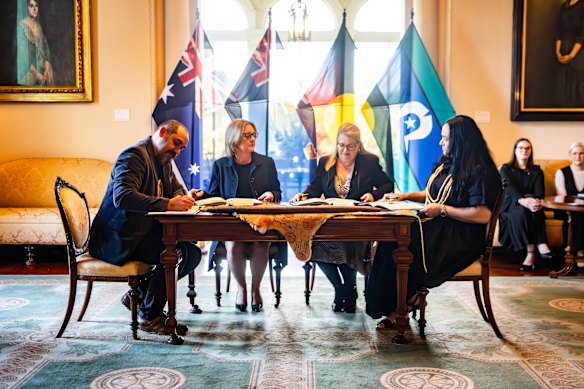
From right to left: First Peoples’ Assembly co-chair Rueben Berg, Premier Jacinta Allan, Minister for Treaty Natalie Hutchinson and assembly co-chair Ngarra Murray sign Victoria’s statewide treaty at Government House.Credit: Justin McManus
Yet for Berg, fellow First Peoples’ Assembly co-chair Ngarra Murray and the other assembly members whose names had already been inked on the agreement, it was the realisation of something more essential.
“To my mind, we sat here as equals,” he said. “That is fundamentally what this process has been about – recognising our equal status to be able to sit at that table.
“Importantly though, the concept of equality is also significant here because we still lack that equality in terms of outcomes for our people.”
This twin theme – of something historic achieved yet much more to do – was laced throughout a ceremony where the signatures of Berg, Murray, Premier Jacinta Allan and Minister for Treaty and First Peoples Natalie Hutchins were added to the treaty agreement and Governor Margaret Gardner gave her royal assent to the enacting legislation.
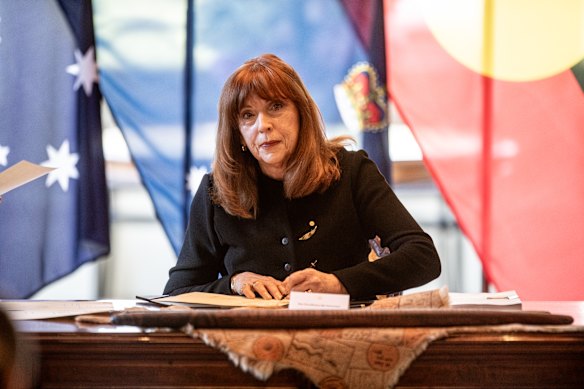
Governor Margaret Gardner gives Victoria’s treaty legislation royal assent.Credit: Justin McManus
The governor, whose part in the legislative process is normally performed without speeches or much ado, was the first to leap to her feet in applause when treaty was signed. She spoke of the beginning of a new relationship between the First Peoples and the state government, “through a profoundly democratic and practical expression from the people of Victoria”.
Allan, in paying tribute to Aboriginal leaders, elders, assembly members, Yoorrook Justice Commissioners and other First Peoples whose passion and persistence had driven the treaty process, spoke of “the gravity and the importance of this moment” and the work ahead.
“Today marks a new chapter in the story of our state, a chapter that brings together the oldest continuing cultures on Earth with the more modern institutions of our state,” she said.
Hutchinson spoke of embarking on a new treaty era, “one rooted in respect, heeling and justice”.
Murray described the morning’s ceremony as signifying recognition and renewal. “It is a promise that the future will written together,” she said.
There are four signed copies of Victoria’s statewide treaty. One will be held by the state, another by the First Peoples’ Assembly, a third by the Treaty Authority and a fourth will go on public display. The agreement takes legal effect on December 12, when it will receive a further “cultural assent” at a public ceremony and concert at Federation Square.
The signing page of the treaty document, which carries the names of all members of the First Peoples’ Assembly and Allan and Hutchinson, features a map of Victoria comprising five Aboriginal artworks commissioned from each of the assembly’s regions and a motif of the Bunjil, a wedge-tailed eagle totem shared by the Wurundjeri and other Victorian mobs.
On the signing table, a Victorian-era blackwood side table crafted for the then governor’s private boudoir, were two message sticks created at key junctures on the path to treaty and a kangaroo pelt which carries messages of support for the treaty process from 2018 and 2019, when the Victorian Treaty Advancement Commission chaired by Jill Gallagher was consulting with people across the state about what it might achieve.
Loading
Aunty Jill was one of dozens of Aboriginal elders who cheered and whooped as treaty received its finishing touches. The previous evening, they gathered at Birrarung Wilam, a “common ground” meeting place on the banks of the Yarra, to watch the general members of the assembly sign the agreement while their kids and grandkids played in the grass and AC/DC fans streamed past on the way to a concert at the MCG.
Once the formalities were done on Thursday, they walked onto the sunlit lawn of Government House for a team photograph. Off to one side, Treaty Authority chair Jidah Clark and Yoorrook Justice Commissioner Travis Lovett posed for a selfie while government ministers Gabrielle Williams, Lizzie Blandthorn and Sonya Kilkenny mingled with Greens leader Ellen Sandell and the state’s top bureaucrat Jeremi Moule.
Much has been said, inside parliament and out, about the historic nature of this agreement and the circumstances, made painfully clear in the enduring gaps between black and white education rates, health outcomes, imprisonment rates and life expectancies it is intended to close.
Such words, said Berg, are cheap. The words that matter, each one hard fought for, are those now fixed in treaty and underpinned by law. “These words cannot disappear,” he said. “These words will not disappear.”
Start the day with a summary of the day’s most important and interesting stories, analysis and insights. Sign up for our Morning Edition newsletter.
Most Viewed in Politics
Loading