3 months ago
20
3 months ago
20
When students at Central Coast Grammar walk into their classroom each morning, a single word is beamed to them.
“Every single day, in every single classroom, there’s a TV screen, and it will have the word of the day,” says the school’s head of English, Cassandra Kennedy.
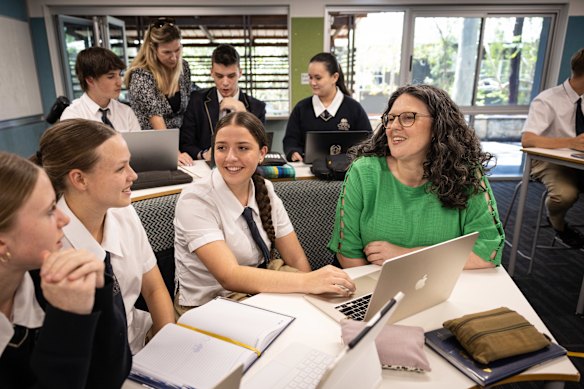
Teachers work collaboratively and promote literacy and a love of reading across the school.Credit: Wolter Peeters
Last year, it was placed in the top 20 schools in the state for HSC English advanced and extension results – a feat staff attribute to the strong reading culture at the school.
NAPLAN results released today reveal that while some top-performing HSC schools show strong year 9 results, others show significant growth before the final years of high school.
Central Coast Grammar head of teaching and learning Damon Cooper said cultivating a love of reading and writing that went beyond the English classroom was key to their students’ success.
Students who read more than 100 books in a year have their photograph up on a wall in the library. There is also a principal’s reading challenge. Teachers, alongside students, read for 10 minutes on Thursday, and every teacher received a book at the start of the year.
Damon said that inside English classrooms, teaching was very much a team effort.
“All of our teachers work in teams– that means that outside of the classroom, they’re planning, they’re building their professional knowledge, they’re developing programs and assessment tasks together,” he said.
“In a world where there are so many voices, we actually are explicitly teaching our children in a coherent way across [year] 7 to 12 English how to navigate those voices, and, most importantly, how to find their own.”
An analysis of NAPLAN results data conducted by the NSW Department of Education previously found NAPLAN writing scores were a better predictor of HSC success than students’ numeracy or reading marks.
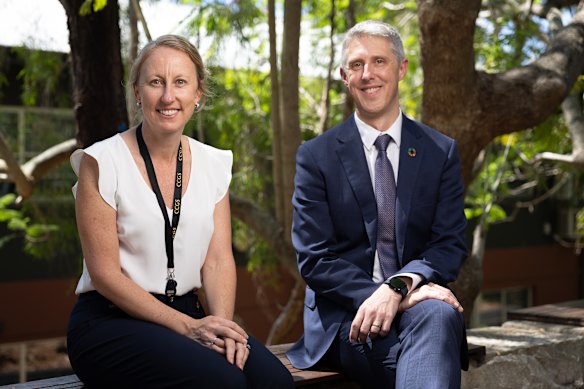
Central Coast Grammar’s head of English, Cassandra Kennedy, and the school’s head of teaching and learning, Damon Cooper.Credit: Wolter Peeters
Greta Beaumont-Kennedy, head of English at girls’ school Kambala, which placed first in HSC English last year, pointed out that NAPLAN and the HSC measured different skills.
“Strong HSC performance is not based on teaching to the test or rote learning,” she said. “It’s based on nurturing collaboration, critical thinking and connecting to the real world. That’s a real focus for us.”
Kambala’s high school students have fortnightly reading lessons in which students choose from selected novels and engage in reflection, dialogue and critique in small groups.
Loading
“Encouraging choice is really important there, and we find that creates a lot of buy-in,” Beaumont-Kennedy said.
“People are quite surprised when I say now, students love their reading lessons. Finding a passion and finding a peer dialogue is what gets them hooked … I think it is that essential ingredient that then translates to our HSC success.”
Hornsby Girls High head of English Dr Richard Strauss said there was a similar dynamic at play at his school, where teachers tried to not solely focus on exam success, which could rob students of the ability to enjoy English.
Principal Dianne Donatiello said staff worked as a team to deliver effective lessons, in stark contrast to her first experience of teaching.
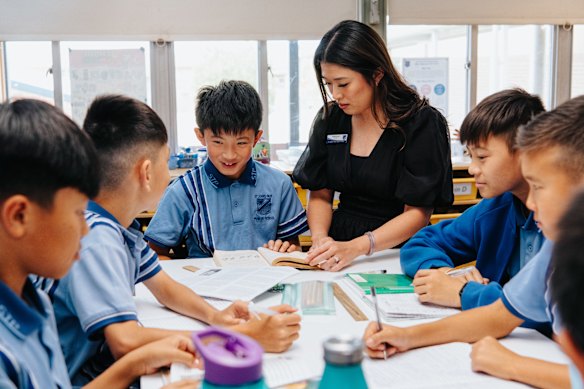
Assistant principal at St John’s Park Public School Helena Lee says teachers work together to improve lesson delivery.Credit: James Brickwood
“You’re not working on your own,” she said.
“It’s not like the olden days, when I first started teaching, where you basically closed the door of my room [and would think] ‘what am I doing?’ and trying to remember everything that I learned at uni.”
Assistant principal Helena Lee said they were clear with students about the assessment schedule of tests: every two weeks for maths and every five weeks for literacy.
“It’s high expectations. It’s not hiding the learning from the students. It is saying, in five weeks’ time, this is what I’m grading you on,” she said.
The school runs regular observation lessons for teachers and supports them to teach in a way that works, she said.
“The assistant principal will give a lesson demonstration to show you what best practice looks like, and then the next step is, now you’ve seen it, let’s team-teach it together.
“That whole cycle helps with the consistency of teaching practice at our school.”
The Morning Edition newsletter is our guide to the day’s most important and interesting stories, analysis and insights. Sign up here.
Most Viewed in National
Loading