3 months ago
26
3 months ago
26
Stewart Copeland wants to clear up one misconception about his old band, The Police. “We did not ever fight in anger, physically, ever,” he insists. “We found much more effective ways of hurting each other with mental scalpels, and cudgels, and swords, and arrows, and clubs…”
…and lawyers. In London’s High Court in November, Copeland and guitarist Andy Summers filed suit against frontman Sting for millions in allegedly unpaid royalties. The machinations of the art-punk-pop phenomenon that conquered the world between 1977 and 1984 are hence, for interview purposes, under explicit quarantine.
But as he enters the fourth year of his Have I Said Too Much? conversation tour, that no-go zone seems more opportune than inconvenient. From a childhood in global espionage to championship polo to film scoring, books, podcasts and opera, the many strings to this drummer’s bow are constantly unfurling.
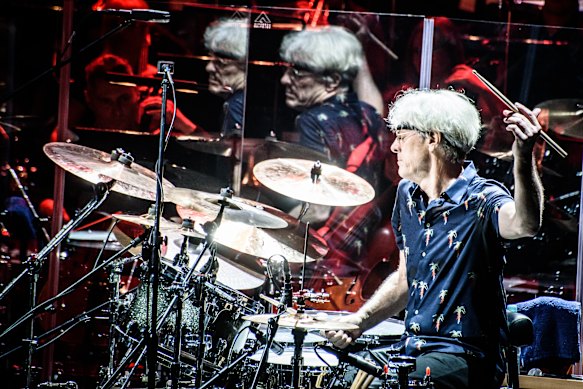
Copeland on stage with his beloved kit.Credit: Dariusz Gackowski
“I’m sort of getting the hang of it and I like it,” he says of this latest caper. “It’s not as exciting for me as an actual concert where I’m banging shit, but it has a different fun factor, which is just getting laughs.” His favourite review so far described him as “your most hyperactive mate with the best stories at the pub”.
Even relaxing at home in Los Angeles, the H-factor is striking. His lanky frame is in perpetual motion, eyes alight and arms twitching as his grinning face zooms in and out of a head-high camera. “This is the Sacred Grove, where I have the world’s largest collection of the cheapest instruments money can buy,” he enthuses, spinning his screen to reveal a large wood-panelled loft crammed with musical technology.
“Everything is permanently mic’d, line-checked and ready to record. So whether it’s Snoop Dogg or Danny Carey or [the late] Neil Peart or whoever, we just jam along in here… and there’s cameras all around capturing every moment.”
A decade’s worth of these all-star collisions can be sampled for free on the Sacred Grove YouTube channel. There’s nothing to plug, nothing to buy, the ringleader stresses: it’s not a supergroup shopfront but an open laboratory for the musically curious.
It speaks to Copeland’s distinction as a rock legend. His delightfully frank reflections range from memoir (Strange Things Happen) to investigative podcast (My Dad the Spy) to the documentary on The Police, Does Everyone Stare. What they share is a rare anthropological detachment: a bemused, almost alien perspective on the trajectory of his somewhat bizarre life.
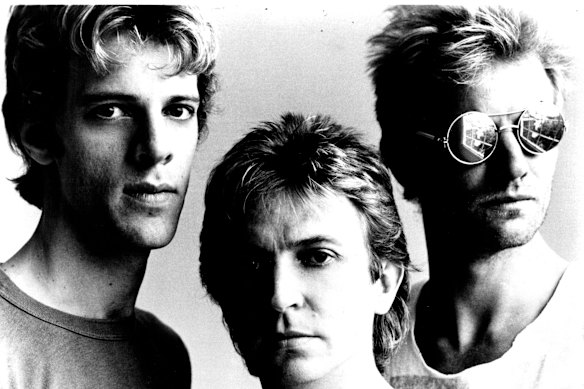
Where it all began. Copeland, left, with fellow members of The Police, Andy Summers and Sting.
“I think musicians in general experience otherness. We are not like other people,” Copeland says. “If you have success as a musician, you become a rock star and there’s a sense of otherness that just is a part of that. You walk into a room, you don’t know a single person in there, but they all know you. There’s kind of a social vertigo. Your words ring too loud. You’ve got a neon sign on you all the time. You f--- up, it’s going to be in the newspapers.”
This curious human condition is the subject of his next book, How to Survive Your Mojo: an insiders’ study of the psycho-social impact of fame. “I’ve talked to everyone from Carly Simon to Gene Simmons to John Lydon. What happens when suddenly you’re not just a normal person, you’re larger than life, but you’ve still got to put your pants on in the morning?
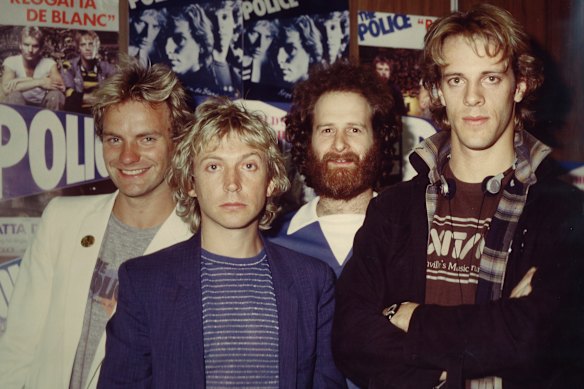
Mushroom founder Michael Gudinski with The Police in 1981.
“You need to put up a wall. That’s the instinctive thing. And of course, you’ve got your old friends, so you’ve gotta give them keys to the castle, but so often people are isolated. You’re tempted to be ungrateful!” he thunders comically. “We’re getting what we wanted, and we should feel blessed for this attention and love, but the weird thing about the human psyche is there is such a thing as too much adoration.
“People go through cultish-type behaviour with regard to rock stars. But we are not gods. For one thing… we’re gonna die. And then when you do, your avatar is actually gonna get a rejuvenating boost and live forever!”
Copeland’s perennial outsider viewpoint formed early. Though born in America, he grew up in Beirut, where his father, Miles Axe Copeland II, conducted highly consequential CIA operations in the 1950s – a story so historically and philosophically substantial that that podcast runs to nine gripping episodes.
“His favourite word was ‘amoral’,” Copeland says. “Immoral is when you know that you’re a bastard. Amoral is when you’re just doing your shit and nobody told you there was anything wrong with deposing an elected official and replacing him with a dictator.”
TAKE 7: THE ANSWERS ACCORDING TO STEWART COPELAND
- Worst habit? Oh, shit! None of your business.
- Greatest fear? Falling off the back of an ocean liner.
- The line that has stayed with you? ”Don’t let your crocodile mouth bite your tadpole tail” — my big brother [and former Police manager Miles Copeland III].
- Biggest regret? Just dumb shit. You know, you’re driving home from the party: “Oh my God, I can’t believe I said that.” But it’s obviously all worked out OK.
- Favourite book? This Is Your Brain on Music Why do Homo Sapiens do music? I think Daniel Levitin was one of the first to get into the science of it.
- The artwork or song that you wish was yours? Don’t Worry, Be Happy (Bobby McFerrin).
- If you could time travel, where would you choose to go? The year of our lord, 2026. I’m sorry, but I wouldn’t be equipped for the future. I’m already a 70-year-old in a 25-year-old’s world. And I don’t want to go back in time, because dentistry.
His dislocated upbringing naturally skewed his sense of cultural belonging. “Although I’m green-eyed and blond, a big part of me is Arabic,” he says. Come 1977, the fabulous otherness of The Police would owe a great deal to “the signature drop-kick on the third beat of the bar” in Arabic music, “which it shares with reggae”.
Though always encouraged by his jazzer dad, the third of four Copeland children committed to music at the age of 12 for his own, more visceral reasons. “Making Janet McRoberts dance was my first inkling that there’s something rather curious about this thing,” he explains. “Music is unique among all the arts in that it physically usurps motor control of your body. Shakespeare and Rembrandt will affect your heart and your mind, but music actually causes you to twitch weirdly. It makes you do weird shit.
“And what weird twitching does it induce? Overt sexual display! Thrusting your pudenda in public: behaviour for which you would be arrested without music. Shakespeare doesn’t do that.”
His later stint in the choir of Wells Cathedral boarding school in Somerset added a quasi-spiritual dimension to the mystery: a sense of service to a higher power that was beneficial as rock stardom attempted to inflame his ego. His ironic response to obscene wealth and fame was to retire to a country estate to play polo against the Prince of Wales and his ilk.
Loading
But fame has its own agenda. Francis Ford Coppola was the first filmmaker to assume the guy from The Police could write a decent strings chart, and the score of Rumblefish was born. “Thus, decades of a love affair with the orchestra derived from that one directive from my boss,” Copeland says. “The good part about the harsh yoke of cruel employ is that you learn shit.”
Later, opera offered a more appealing hierarchy. “In opera, I am the boss,” he says. “It’s a composer’s medium.” He came to it reluctantly, but soon “drank the Kool-Aid”. He’s now written operas about Edgar Allan Poe, Nikola Tesla and other obsessive figures, drawn to the form’s capacity to combine story, music and spectacle. “The opera house has a pit where you put the orcs… and a front office to make it all happen. It’s just a beautiful cluster of assets.”
His current project, an opera based on James Joyce’s famously unreadable novel Finnegans Wake may be his most audacious yet. “The common response is, ‘Are you f---ing out of your mind?’” He leers into his screen, grinning like he might well be.
Asked at last how, given his long legacy of disparate successes, he measures a life well lived, he opts for a decidedly anthropological response.
“Seven kids. My mother was an archaeologist and scientist and anthropologist somewhat as well,” he says. “As I sat at her deathbed, we counted up her progeny, and her last words were: ‘Well, I have propagated successfully’.”
Stewart Copeland’s Have I Said Too Much? is at Forum II, Melbourne, on Jan 14 and State Theatre, Sydney, on Jan 16.