3 months ago
37
3 months ago
37
Australian Open with 4K on Stan Sport.
Every match, live & on demand.
Play will be suspended and roofs closed on major courts if Saturday’s soaring temperatures put player safety at risk.
The temperature is expected to hit 40 degrees by 5pm on day seven of the tournament in a development that could turn this year’s Australian Open into a war of attrition.
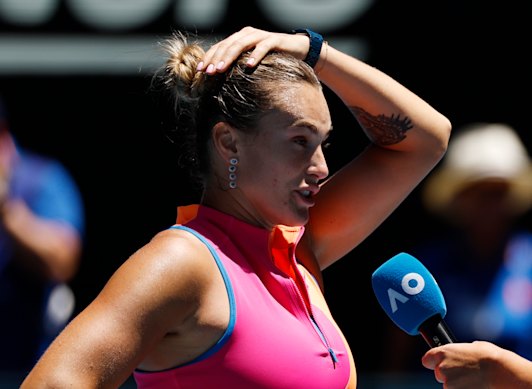
Aryna Sabalenka shows her relief after a tough win over Anastasia Potapova. By winning tie-breakers in both seats, Sabalenka managed to avoid her match going to three sets.Credit: Getty Images
Australian Open organisers announced that Saturday matches would start earlier to dodge the afternoon heat.
“Play is starting early tomorrow because of the weather – 10.30[am] for all courts except juniors, which are already set for 10am,” an AO spokeswoman said.
Stars scheduled to play in Saturday’s third round of singles matches include world No.2 Jannik Sinner, 10-time winner Novak Djokovic, women’s second seed Iga Swiatek and Australian Maddison Inglis, who takes on Naomi Osaka.
Loading
Tournament referee Wayne McKewen is charged with implementing the extreme heat protocols, using a “heat stress” scale first introduced in 2019.
Four factors are taken into account – air temperature, radiant heat, humidity and wind speed – to generate a reading between one and five. It is not determined by temperature alone.
If the scale hits five, play is suspended on outdoor courts, while the roofs are closed on Rod Laver Arena, John Cain Arena and Margaret Court Arena before matches can continue.
McKewen then monitors conditions before deciding when play can resume.
The tournament referee can also introduce 10-minute cooling breaks – between the second and third sets for women’s matches, and between the third and fourth sets for men’s singles – to help players cope with the conditions.
Women’s No.1 seed Aryna Sabalenka will dodge Saturday’s scorcher, having won her third round match against Anastasia Potapova 7-6, 7-6 on Friday, but could face extreme temperatures that have been forecast for Tuesday if she advances to the quarter-finals.
The two-time Australian Open champion welcomed the heat rule “because I think it’s too much on our bodies” to play in stifling conditions.
She said the fluctuating Melbourne temperatures this week, including rain on Wednesday afternoon, had already caused headaches for players.
“The weather is being crazy,” she said. “It’s a lot of adjustment on the strings, on your approach to the match … it’s going like a roller coaster. So yeah, we’ll see who adjusts better these next days.”
Temperatures are forecast to hit 35 degrees by 1pm and rise to a peak of 40 degrees by 5pm, according to the Bureau of Meteorology website.
Tennis fans will be expected to seek their own refuge during the day. Water stations are scattered throughout the precinct, free sunblock is handed out and several huge shade cloth have been erected at Melbourne Park.
The heat has already taken a toll this week. On Monday, Canadian Marina Stakusic retired during the third set against Australian Priscilla Hon because of cramping and exhaustion and was taken from the court in a wheelchair.
“It was definitely warm out there, and I think as well with the nerves, the stress levels, it just all impacts it,” Hon said of the 31-degree conditions.
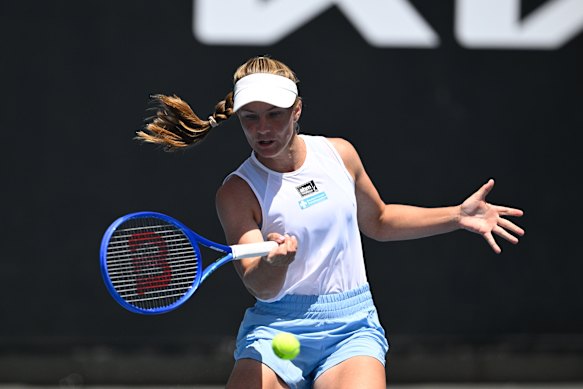
Maddison Inglis plays her third-round match against Naomi Osaka on Saturday.Credit: Chris Hopkins
“Obviously, everyone’s really stressed with playing in a grand slam, so it doesn’t help in that way.”
A day earlier, a ball girl collapsed during a match on 1573 Arena and was helped from the court by Turkish player Zeynep Sonmez. At that stage, the temperature was only hovering around the high 20s.
In 2014, outside matches were suspended for four hours and almost 1000 tennis fans were treated for heat exhaustion on day four of the tournament because of extreme temperatures.
In that year, McEwen deemed conditions unsafe for players and applied the extreme heat policy between 1.52pm and 6pm when the mercury hit 43.3 degrees.
Matches on Rod Laver Arena and John Cain Arena continued once the roofs on both courts had been closed.
In 2009, the tournament was suspended on consecutive days with temperatures reaching as high as 45 degrees.
The latest heat policy was developed with the Thermal Ergonomics Laboratory at the University of Sydney.
The scale takes into account a player’s ability to disperse heat from their body.
Loading
One study that monitored elite tennis players during a simulated match found that, after about two hours of play in hot conditions, their core temperature jumped to 39.4 degrees.
The risk of heatstroke starts to increase when your core temperature rises above 40 degrees. Heatstroke is an acute body-wide inflammatory reaction that can lead to multi-organ failure and death.
Most Viewed in Sport
Loading