2 months ago
16
2 months ago
16
It was a busy night for police in the northern region, with one officer writing in her handover notes that staff “got smashed between 6pm and 10pm”.
This strain was an ongoing issue, with officers telling the commission that staffing levels had been consistently reduced, with part-time staff often replacing full-time roles.
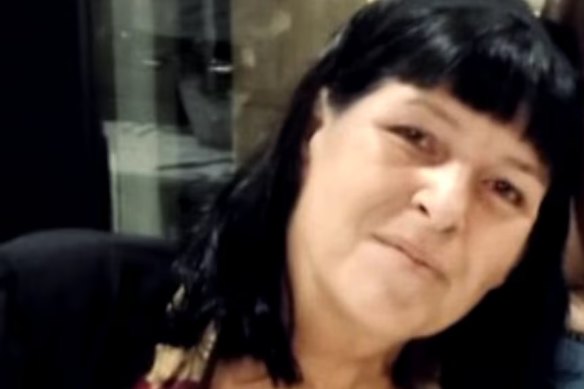
Lindy Lucena died less than 600 metres from the Ballina police station.
“Policing as a whole … is starting to be dealt with as a business, as opposed to an emergency service,” the responding senior communications officer said.
“We need to be at full strength, and we’re not. We rarely are.”
7.55pm – Initial police response
It took police 52 minutes to arrive at the Salvation Army building. Officers were responding to a mental health incident and a road accident where a car had smashed into a tree on the highway. But both jobs were priority three. Lucena’s assault was the only high-urgency incident in Ballina between 6.38pm and 7.41pm.
One officer told the commission he prioritised the crash, saying he was concerned about road fatalities as the crash was on a blind corner on a highway with speeds of 110 kilometres per hour. The commission also heard that an assault required two officers to attend for their safety. The officer was unaware that priority two jobs should be responded to before lower-priority jobs.
When the two officers finally arrived, nearly an hour after the initial call, they drove their separate vehicles without lights and sirens, as so much time had already passed without further calls.
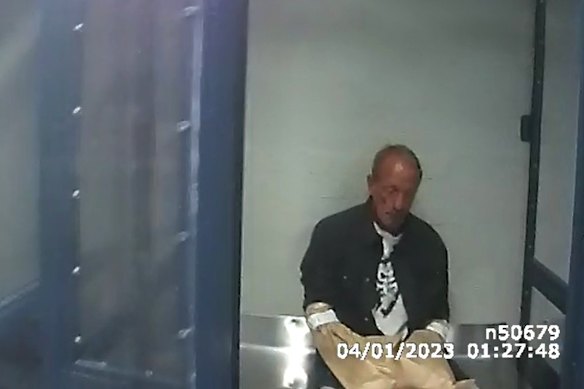
Police body camera footage of Robert Huber on the night he was arrested.Credit: Coffs Harbour Supreme Court
They patrolled slowly around the site, never leaving their cars. Lucena’s body, located closer to the building and behind a metal fence, couldn’t be seen from the road. Within three minutes, they determined there was nothing to respond to and left the scene.
“[With] the benefit of hindsight … I wish I’d looked over that fence. But I didn’t,” one officer told the commission.
It’s not known if Lucena was still alive as police drove past her body.
7.20-9.30pm – Time of death
Two experts gave two different opinions as to Lucena’s time of death at Huber’s manslaughter trial. One said she probably died at 7.20pm, and the other around 9.30pm.
The court found the cause of death was the beating, which, combined with her coronary heart disease and possibly the effect of a small amount of methadone in her system, caused her heart to stop. The time and cause of her death will be analysed at a future coronial inquest.
12.30am – Police return to the scene
Huber arrived barefoot at Ballina police station around 12.30am and told the same officer who had driven past Lucena’s body that his “missus is dead”.
The officer took Huber back to the Salvation Army building in a police car. Bodycam footage showed Huber leading police to the charity donation bins behind a white metal gate.
Counsel assisting the commission Emma Sullivan described Lucena’s body as being found “amongst items of clothing, baggage and other bric-a-brac strewn around”.
“I just woke up and I seen her there and I tried to wake her up. She wouldn’t wake up,” Huber was heard saying on the police bodycam footage shown to the court during his manslaughter trial. “She doesn’t look good, does she?”
Loading
He had blood on his hands and shirt. Police noted Lucena had bruising to her face. Huber was arrested at 1.21am on January 4 for suspected murder.
1am – Top brass informed
Shortly after Huber presented to the police, Superintendent Scott Tanner’s phone rang, waking him, and he was told about Lucena’s death. He arrived at the scene within 20 minutes and texted Acting Assistant Commissioner Tracy Chapman.
Tanner and Chapman agreed the death and response delays did not meet the criteria for a critical incident, which would have triggered an independent police investigation.
“Declaring a critical incident also places a lot of stress and pressure on the police that are involved … [there’s] the assertion that they’ve done something wrong,” Tanner told the commission.
The pair also believed subsequent coronial and criminal investigations, as well as a State Crime Command domestic violence homicide review, would provide sufficient oversight.
“The lesson is we need more staff. We need more people to join our organisation. You know, Ballina is a community of over 35,000 people. It still has the same first response it had in 1985,” Tanner said.
The police watchdog was contacted by Greens MP Sue Higginson in July this year, prompting the public examination.