
 2 months ago
53
2 months ago
53
There’s Bubba in the US, Bodhi in Malaysia, Bazza in London and Bruce back home in Australia. Nobody can say high-tech entrepreneur Matt Lamont is orthodox when it comes to naming his DUG data centres, one part of a global technology business that began in an unorthodox way in a shed he built in his own family backyard in Perth.
Innovation was the driving force behind Lamont’s entry into high-performance computing, seismic processing and imaging, as well as operating data centres. DownUnder GeoSolutions, now called DUG Technology, began in 2003 after Lamont had returned from the heartland of high-tech start-ups in the United States to the more prosaic setting of his hometown Perth.
His aim was to create a start-up to process seismic data for resource companies, which use sound waves to map the Earth’s subsurface. But first he needed serious computing power.
“I invited a friend, Troy Thompson, to join me, and the first thing we did was finish a backyard shed behind my home in Subiaco, dig a trench, put in a big power cable and build a data centre,” he says. “It was probably one of the largest computers in Western Australia at the time – in our shed. And we worked out of there for quite a few years.
“We had no money, so we just bought the pieces and built it all, including a unique cooling system and metal racks. We had to figure out how to do it cheaply. That’s the start of a lot of innovation – no money.”
The computer chips inside racks of servers run hot; if they overheat, they can malfunction or physically degrade. So some form of cooling was essential.
“I had the idea that we could just treat each computer rack as a chimney. So we turned the computers on their sides, then I bought exhaust fans and filled the entire ceiling with them. We then put a curtain from the louvres down to the bottom of the racks, the idea being that it would suck the hot air up through the racks and out the ceiling. Hey presto! It was an early version that sort of worked.”
A few years later, in order to avoid the cost of refrigerated cooling, DUG’s then chief technical officer, Stuart Midgley, adopted liquid immersion to keep the computers cool, with the added bonus that it wouldn’t require large quantities of potable water. “We’d seen others do it,” says Lamont, referring to US supercomputing pioneer Seymour Cray, who had submerged dense circuit boards in a clear fluorocarbon liquid, often described as “oil immersion”.
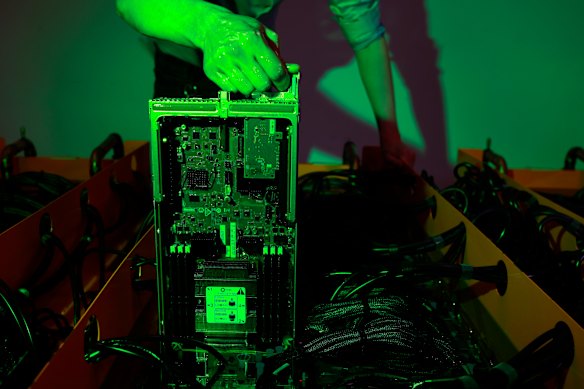
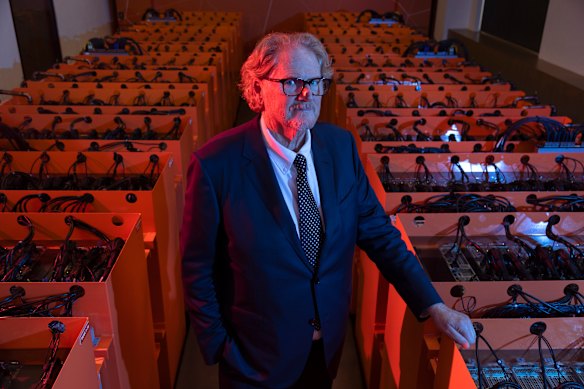
DUG’s version, called DUG Cool, is on display at DUG headquarters, on a leafy city corner near Kings Park in Perth. Inside the large building is “Bruce”, DUG’s Australian data centre where Lamont and I stand between long rows of computers. They are housed in DUG-designed tanks that contain an oil-like, non-toxic fluid that ripples if disturbed.
Oil has more than 1000 times the heat absorption capacity of air, explains Lamont. “Because of that thermal capacity, you can keep computers at the same working temperature range with oil at, say 33 degrees, as you can with air at 13 degrees. So it’s a very simple notion, very sound and easy to work with.”
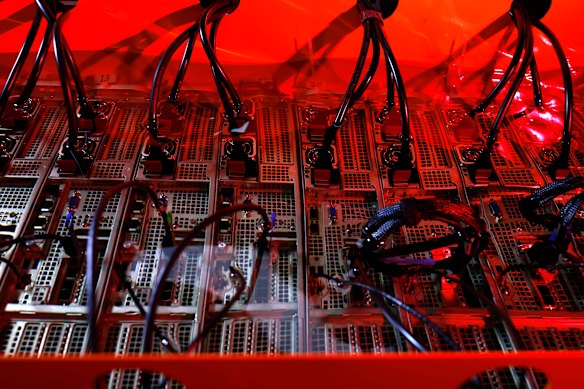
And noticeably quiet – our conversation is easily conducted inside the server hall, due to a lack of noisy extractor fans or hefty air-conditioning units. “We now spend about 3 per cent of our power on cooling. We save power from both the cooling side and the computer side, and that gets us to around 50 per cent power savings over traditional cooling infrastructure. It also saves water as well.” A staffer later tells me that DUG Cool has reduced overall water usage by more than 25 per cent.
“The most important thing is that it’s enabled us to put in data centres cheaper than others,” Lamont tells me. “And because of the oil, you don’t get hot spots or corrosion or dust. We’ve got computers that are over 10 years old still running.”
The relevance of DUG’s innovation is obvious as data centres proliferate in Australia – there are about 270, including existing ones and those in the pipeline – and alarm grows about their insatiable appetite for power and water. The Australian Energy Market Operator has warned of increasing strain on the nation’s electricity grid as demand for AI processing and cloud computing grows. It says data centres currently consume about 2 per cent of all electricity and that this could grow to about 12 per cent by 2050, raising concerns about how clusters of large digital facilities could affect the grid’s stability.
Water Services Association of Australia predicts a large growth in water demand from the current moderate use by data centres. Estimates for Sydney alone range from 1.9 per cent of water supply in 2030, to about 15-20 per cent of supply in 2035.
Globally, the concerns over water and energy use are similar. In the UK, environmental charity Global Action Plan predicts that roughly 84 per cent of proposed data-centre developments are situated in areas projected to face severe water stress by 2040.
DUG’s immersion cooling system is now sold around the world, although these days Lamont’s regular travel between Perth and the DUG offices in London, Houston, Kuala Lumpur, Abu Dhabi and Rio de Janeiro is related to other services the company has developed. DUG Cool technology has been licensed to Baltimore Aircoil Company (BAC), a large American manufacturer that makes 90 per cent of the cooling towers in the US for factories, shopping centres and data centres, and supplies 50 per cent of the world’s demand for cooling towers.
“BAC has 500 channel partners around the world, and they put in a whole research and development facility just for immersion cooling,” explains Lamont. “We needed a much bigger company than us to take the technology to the world.”
Belinda Dennett, CEO of peak body Data Centres Australia, says Australia is well positioned to drive such technological innovation. “It is great to see an Australian company offering solutions to the global market,” she says. “Energy is the bottleneck to building AI factories and data centres to support the technological wave we are seeing. Our members are focused on sustainability and innovation that reduces the energy required.” Reducing water use is another imperative, she says. “We are seeing a lot of new developments – whether that is in liquid-to-chip cooling, immersion technology or closed-loop systems.”
IN HIS youth, Lamont wasn’t your typical computer geek glued to his keyboard. Nor did he go straight into the tech industry. After leaving school early, he went to work as a farmhand, then a forest ranger. His leaving certificate was completed as an adult at a technical college. “I started a woodworking business in solid timber furniture, but that wasn’t so good. I sold that and went to teachers college, studying maths, physics and chemistry.”
Within two years, Lamont had switched to geophysics at Curtin University, where he eventually gained a PhD. After a job with gas giant Woodside, Lamont found himself working for BHP in its Houston offices, doing computer-based research on seismic data. It was after he had returned from the US with his young family that he decided to strike out with Thompson and launch DUG.
So how did a small, WA-based company manage to come up with a data-centre solution now sold around the world to a burgeoning market? “That’s just in the DNA of us, always trying to do things better,” says Lamont, with a shrug. “We were always playing around, trying to do stuff. Thanks to our R&D team, what we did was to make it simple, efficient and robust.
“It’s the only way to house computers. You put them in, you forget them. Very few moving parts, very simple, and extremely low maintenance. When we first did it, we bought a synthetic oil. Now there are specific fluids for immersion that are a bit better.”
Lamont concedes that DUG’s technology is up against other competitors in the field. One is direct-to-chip cooling, which uses a cold plate sitting on top of each chip while coolant flows through the plate to absorb and remove heat. “Nvidia [the US leader in AI computing] is going down that route, so at the moment they are winning the war,” he says. “But I can’t fathom why companies would not see that immersion cooling is so simple, so robust, so effective. I think that ultimately it’s got to win, but maybe it won’t.”
Ask Lamont about support for innovation in Australia and you’ll get some blunt answers. “Australia has not been the best at supporting small start-up companies and innovation,” he says. “Yet combine harvesters and artificial ice were invented here – the list of inventions is huge and most of them go overseas. For several years, we got no work in Perth until a US company took us on.”
His criticism comes from personal experience in another sphere of DUG activity, a technique that integrates seismic data with rock physics models to predict rock types and the oil or gas they may contain deep beneath the surface of the Earth. “Troy and I wrote the first algorithm for what’s technically called ‘probabilistic lithology and fluid prediction’. It’s basically a new way to analyse a seismic data set.”
He says they tried to sell it around Australia. “People wouldn’t even open the doors for us. So I hopped on a plane and went to Houston, and on the third day I sold it. We’re now the third-largest seismic processing and imaging company in the world for proprietary processing, or data owned by a company. In terms of absolute processing, we’re probably the fourth.”
Another question that elicits a blunt answer from Lamont is about oil and gas exploration. “We’ve virtually shut it down in Australia,” he says. “At our peak we had 35 geophysicists here. Today, we have a much smaller local team, with more of our geoscience work now supporting international projects. The challenge is that it has become very difficult to get drilling permits, and in many areas it is also extremely difficult to acquire new seismic data.”
He accepts that in time, transitioning to renewable energy is inevitable. “It’s just about being pragmatic and allowing the science to catch up to be able to transition. There’s no lack of willingness in the oil and gas industry to transition. It’s just about timing.”
DUG DATA centres Bubba, Bodhi, Bazza and Bruce have been joined by DUG Nomad, a mobile data centre built inside a standard shipping container and using DUG’s patented immersion-cooling technology.
Lamont’s claim is that it can be deployed anywhere, no matter how rugged the landscape. “We can ship it anywhere, plonk it down and turn it on. There are countries where you aren’t allowed to take seismic data out of the country [without government permission], like India and Indonesia. So our solution was DUG Nomad: a 10-foot sea container into which we can put 80 kilowatts of computing power as well as the cooling unit. You can plug it in and turn it on while on the back of a truck, if you’ve got the power. There is also a 40-foot container that can take one megawatt of computing power.”
Nomad, he adds, is one possible antidote to the unpopularity of large data centres. “You can put a lot more computing power in a rack with immersion cooling.”
In May, OpenAI’s CEO Sam Altman – who launched the generative AI chatbot ChatGPT – said Australia’s abundant clean energy and stable society could make it a “data centre capital of the world”. For now, Lamont says Australia’s high-performance computing infrastructure is already overwhelmed by people clamouring to use supercomputing power. Quite simply, demand is outstripping supply.
Innovation could be turbocharged in Australia by creating more high-performance computing and AI and by changing the funding model for scientists to use supercomputers, says Lamont. “They need to be able to choose where they take their data processing, not just to the two national high-performance computing facilities: the Pawsey Supercomputing Research Centre in Perth and the National Computational Infrastructure (NCI) in Canberra.
“They both have their place. But if the playing field was more level, if the current scheme [the National Computational Merit Allocation Scheme, which grants access to computing resources] gave out tokens for supercomputing that could be spent with any outfit, you would turbocharge science and help lots of little innovative start-ups.
“The way Australia funds supercomputing has fallen behind the rest of the world. There are other companies that can do really great supercomputing for different applications. It won’t just be DUG, there’ll be a whole landscape of start-ups doing different things for different people.
“In the US, they’ve allowed that to happen. Germany has, even England has, but Australia is not there yet despite us lobbying for years. So my advice? Level the playing field.”
Get the best of Good Weekend delivered to your inbox every Saturday morning. Sign up for our newsletter.
Read more from Good Weekend:

















































