3 months ago
34
3 months ago
34
Asmall group of children gathers quietly around a former soldier who has returned from the war in Ukraine. Their faces flicker from curiosity to caution as he introduces himself and holds up his right hand in the universal language of a high-five hello. Some of them retreat, just a little; they are not yet in school and are shy around strangers. But one of them steps forward for a hug, and soon the others overcome their amazement. Slowly, they reach out to his robotic hand.
Zakhar Biryukov, 38, knows what to expect when he meets young visitors. He has a mechanical right leg, an artificial right eye and a flattened nose from facial surgery. He has two robotic arms that are fitted with sensors so he can control his two moulded hands. “Children get multiple reactions,” he tells me. “Some might feel interest, some might feel afraid, disgust even. But when I finish talking to them, all of them are left with a positive emotion.”
We are in the lobby of a medical centre in Lviv, in western Ukraine, where surgeons and scientists are pushing the limits of what it is to be human. Soldiers and civilians come here to be rebuilt after suffering life-changing injuries from Russian missile strikes and drone attacks. Forced by war, Ukraine is using electronics and robotics to give its people new lives.
This facility, called the Superhumans Centre, does more than fit prosthetic arms and legs to people who have lost their limbs. It is on a mission to motivate the wounded, change attitudes in society and make sure those it helps really are “superhuman” because of what they can survive and what they can do.
Another centre in Lviv, called Unbroken, has several floors of surgeries and wards with hundreds of patients. Its corridors are busy with new patients on crutches and in wheelchairs, while its physical therapy rooms are full of men and women learning to use their new arms and legs. After four years of war, Ukraine has become, by hideous necessity, a world leader in this extraordinary medical care.
Life changed for Biryukov when he stepped from a helicopter in July 2022 and came under fire from Russian soldiers, setting off an explosion that ripped him apart. He has undergone more than 20 operations, some of them during a year in Germany, and is now something of an ambassador for Superhumans. To those who have just arrived, he proves what is possible.
He seems to be relentlessly positive. “It starts with a smile,” he once told the Kyiv Post. “If you choose to be positive, it leads to good things. If you choose to be negative, it leads only to depression and no future.”
But his approach is not just about positive thinking. When we talk at Superhumans, he reveals his discipline and perseverance. It took him two weeks to learn to use the muscles in his remaining left arm to operate the sensors in his robotic limb, he says. “But to use them properly, I needed one year.”
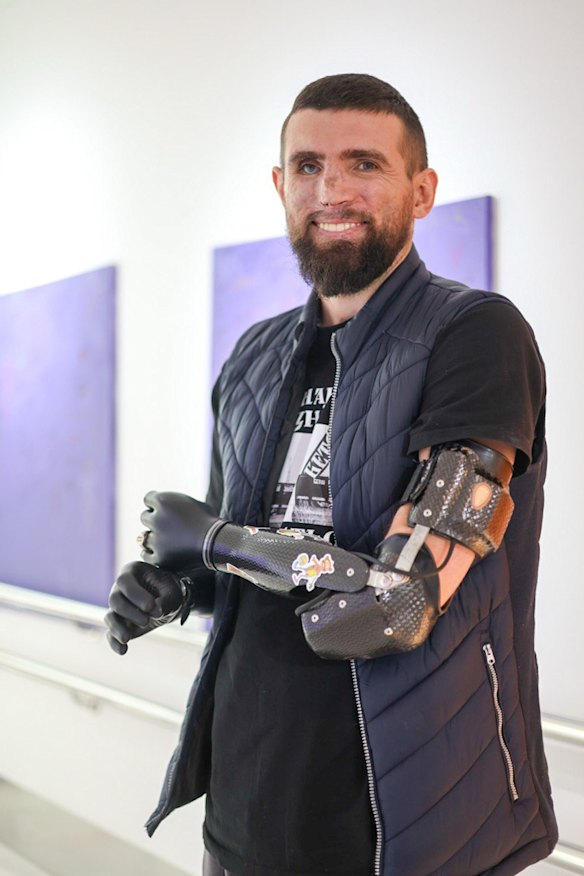
Thousands of people now follow Biryukov in learning to live a new way after horrendous injuries, and this puts centres like Superhumans and Unbroken at the forefront of global work on reconstruction and rehabilitation.
It is hard to be certain about the number of Ukrainians who need artificial limbs as a result of the war, but the country’s health ministry says it is more than than 50,000. More than 41,000 civilians have been wounded in Ukraine since Russia launched its full-scale invasion in February 2022, says the United Nations Human Rights Monitoring Mission in Ukraine, and another 15,000 civilians have been killed.
Ukraine’s military casualties are a closely guarded secret, but the Centre for Strategic and International Studies (CSIS) in Washington, D. C. estimates that as many as 600,000 soldiers have been killed, wounded or gone missing, including up to 140,000 deaths. (CSIS estimates Russian casualties at 1.2 million, including up to 325,000 killed.)
The government’s spending on health is constrained in a war economy that puts a priority on air defence and weaponry, so the medical advances in Ukraine depend on outside help. The Superhumans Centre began with a culture of innovation and gained momentum in its early months with a $US16.3 million (about $23 million) donation from The Howard G. Buffett Foundation in the US, led by the son of legendary investor Warren Buffett. The centre also has support from rock star Sting and his wife Trudie Styler, Virgin founder Richard Branson and actor Liev Schreiber. Prince Harry visited last year to hear from war veterans.
On the other side of Lviv, Unbroken grew out of a major public hospital with the help of charities from Europe and the United States. The medical care is free for patients and impossible without foreign donations. In Australia, the centre has support from the Ukraine Crisis Appeal, a charity led by the Australian Federation of Ukrainian Organisations.
“We can do what we do thanks to our colleagues from all over the world,” says Oleh Biliansky, the director of Unbroken. “From the first day after the beginning of the war, colleagues proposed their help in sharing their knowledge, helping with aid and so on. We’re trying to do the best rehabilitation for Ukrainians in Ukraine, so we do not have to send people to other countries.”
The knowledge flows both ways. Ukraine is doing this work at a scale few nations have known – and, with luck, will never need to experience. It is pushing the limits of medical science, not just in how it designs and fits prosthetic limbs, but in how it designs its physical and mental support services so its patients can return to society.
I meet Iryna Nakonechna in the lobby of the Superhumans Centre on a day of celebration for dozens of people who are about to leave with their new prosthetics after weeks or months of treatment. Patients are gathering with their families while music blasts from a speaker system and Superhumans staff prepare to call up each of the “graduates” to share their stories about what they have achieved. It is incredibly positive and supportive.
Nakonechna, 50, adjusts her wheelchair while we find a quiet place to talk. She is here because of a Russian missile strike on her home city of Kryvyi Rih, in the southern region of the country and about 60 to 70 kilometres west of the Russian army. In the first weeks of March last year, the Russians attacked the city with missiles and drones that demolished two hotels and a restaurant. Six civilians were killed, says the monthly United Nations report on the war, and another 60 civilians were injured.
Nakonechna was one of them. On the night of March 5, she was walking with her husband outside a city hotel when the building exploded beside them, covering the pavement in debris. Ambulance crews rushed her husband to one hospital, while she was taken to another. She did not see him alive again.
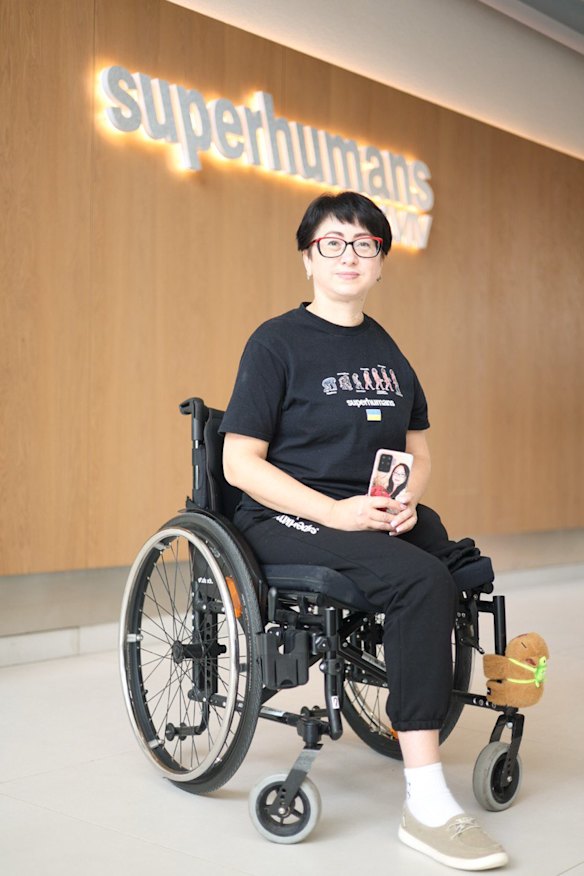
Now she is on a long journey to recover from that night. Shrapnel wounds damaged her shoulders and her collarbone, narrowly missing the main artery in her neck. Her left leg was crushed in the hotel wreckage, leaving surgeons no choice but to amputate above the knee.
“The first month was extremely tough,” she tells me. “I had two operations per week. I needed vacuum systems to prevent infection spreading through my body and then, after the surgery, I had part of my skin transplanted to the stump. When everything healed, I started rehab.”
Nakonechna has impeccably trimmed, dark hair that is so pristine it almost glows. She wears glittering earrings and stylish glasses, in black frames with a touch of red. But her eyes well up when I ask her husband’s name. It is Serhiiy, who had retired on a pension by the time of the attack last year. His wounds from the Russian attack were so severe he could not be saved.
Their son is fighting in the war, while their daughter-in-law is raising a young toddler, Tymofiy. Her eyes clear when she mentions her grandson. “He’s marvellous,” she says. Speaking to me with the help of a translator, she tells me how Tymofiy is getting used to her prosthetic leg when they play. He touches one leg and then taps the other. “He knows they are different.”
Only after a long recovery in hospital and at home did she get to a stage where she could use a prosthetic leg. First came the operations. Then, with great effort, she could sit up and use a wheelchair. Then came the “incredible feeling” of being able to stand with a prosthetic limb.
“When you are given an opportunity to stand, I cannot tell you the emotions,” she says. “It is just: ‘Wow. Standing is incredible.’ ” Like many others, however, she had to contend with complications as she became accustomed to her new leg at home. Her body changed; the leg stump and prosthetic no longer fit so well. She had to go back to Superhumans for more surgery.
Now she is waiting for the stump to heal again, so she can have a new prosthetic fitted and realise her next ambition: getting an upgrade to an electronic knee.
“If you take the stairs with a mechanical leg, you need to go one step at a time going down – your healthy leg first, then the other,” she says. “If you’re going up, you need to push first with your prosthetic leg and then with your healthy one. With the electric knee, it feels almost like using your own leg. You can walk normally.”
Then she laughs. “But it’s very important not to forget to charge it, because if the battery dies, it keeps straight all the time.”
Does she feel like a superhuman after surviving a missile strike and embarking on a future with a high-tech body? “I think the super humans are the people who went through the war,” she says. “I haven’t been in service. I cannot compare myself to the guys who fought.”
There are moments of darkness, however, when people adjust to their injuries, and their treatment needs to be about mental health, not just physical recovery. For good reason, some do not want to talk about what they have seen in the war. When a patient at Unbroken stops me in the corridor and shakes my hand, I ask him about the injury that has brought him here. “I tripped and fell over,” he says with a smile. He has prosthetic arms and hands and is known as the comedian of the ward.
One patient at Unbroken spent 18 months in captivity, and was tortured by Russians, before he returned home in a prisoner exchange. Upon his arrival at the rehabilitation centre, he rarely spoke and refused to do any therapy, until he finally relented and began drawing. Maryna Yaremchuk, a project manager at Unbroken, shows me his work, starting with sketches of dismembered bodies. One, in red and black crayon, shows an anguished face in a howl of pain. Can someone who has been through captivity and torture ever be wholly cured? “Part of their soul might always be like this,” she says.
The rehabilitation takes on many forms. Unbroken has a theatre group for patients to stage plays, and it uses traditional craft in its mental health ward. A wooden weaving machine stands in the corner of one room, fitted with spools of coloured wool to make rugs. Yaremchuk says the returned soldiers dismiss it at first, but find it calming once they sit and weave. The task requires total focus while they use their hands and feet.
The nature of the medical support has changed with the war. Biliansky, an expert in physical therapy before she started working at Unbroken, was accustomed to working with amputees before the war, when many of the patients had lost limbs due to diabetes or car accidents.
“Now, we have a challenge,” he says. “Most of our patients are young. They’re motivated. And we have new technologies with the prosthetics. So, the goals of the patients change over time. One wants to go back to his previous work. Another wants to go back to the front line. Another wants to do some something interesting: paint, for example, or work in a front-line hospital with bionic hands to help other soldiers. One wants to go hiking in the mountains, or skiing, or just playing football with his son.
“It’s a new challenge for the prosthetic specialists. We are pushing the limits because we want, always, to reach the goal of the patient. We are now not just
a medical institution. We become like a social medical institution. We become a bridge between the medical institution and the return to society.”
Everyone comes to these centres with a different experience of the war and a different ambition for life after their recovery. At Superhumans, I meet a big, bearded man who introduces himself by his military call sign, Mario. He is 36 and was a security guard in Kyiv before the war, but he signed up after the 2022 invasion and was sent to the front. Last year, his vehicle was struck by a Russian drone as he drove a small group of soldiers through a forest near the front. He heard the drone at the last moment, but he did not see it before it emerged from the trees and exploded.
“I was blown out of the car. I lay on the ground, and it took nine hours to evacuate me,” he says. The soldier beside him was killed. “Three guys tried to evacuate me immediately, but more drones with bombs started appearing, and they had to escape. Maybe the weather saved me, because later in the evening a small drizzle started, and the drones weren’t too frequent. Sometimes they would fly and freeze there, and I could hear them, but I was lying still with my eyes closed.”
Only much later, when his comrades returned under artillery fire, could Mario be evacuated. Every hour that passed in the forest made it harder to save him. His first surgery was at a government hospital, where his legs were amputated below the knees, but his bones kept growing and he needed further surgery. “When someone touched me on the stump, I would feel extreme pain,” he says.
Now, finally, he has his prosthetic legs. But he is still learning this new way of walking, and he has set himself another goal when he improves his balance: to extend his metal legs. “My height used to be 180 centimetres, now it’s only 174,” he says. “I will correct that later.”
Volodymyr Soroka, 55, was a builder before the war. He has a wife, a son, and a one-year-old granddaughter. And he has a dream of going home to the Volyn region, near the Polish border, to resume his hobby of keeping beehives. He joined the army in 2023; his call sign is Grandpa.
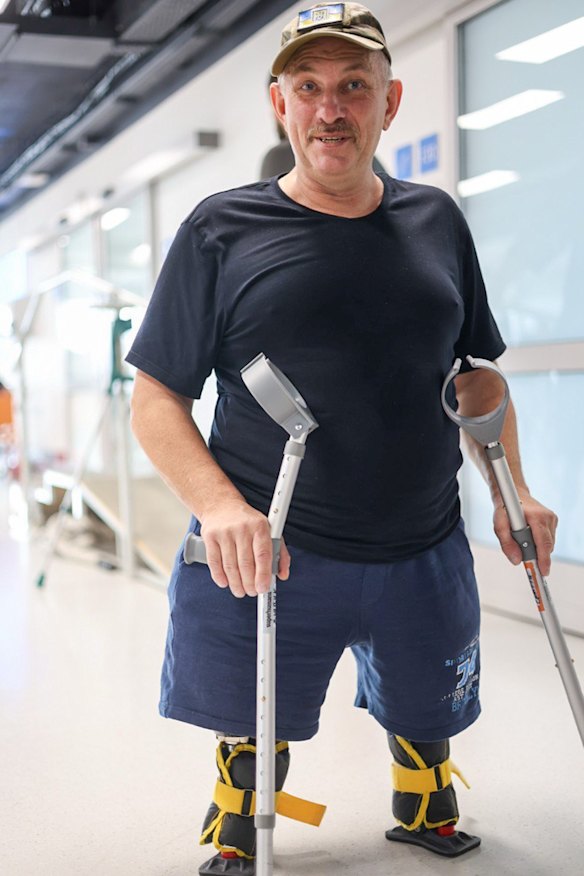
Soroka was in a trench near Kupiansk in October 2024 when his group was hit by mortar shells. He was taken to a hospital within an hour, but his legs could not be saved and his recovery has taken time. “I’m walking much better, lately,” he says. “I don’t use crutches any more. Over the past three weeks I’ve been using prosthetics and the progress happened only recently. It isn’t easy for me, so for now I just use the small prosthetics.”
“The prosthetics make the stumps sore, and it’s painful … But you need to have the right mindset, to continue, to not give up.”
Age is a factor. For now, Soroka stands on small artificial feet that give him the height of a young child, helping him to learn to balance. “I know I will need to adjust my capacities,” he says. Others tell him he may need to train on these prosthetics for six months before he can use the large ones.
“I wouldn’t say that the mental component is too important,” he says. “I would say that the physical part is more difficult because of the stumps. The prosthetics make the stumps sore, and it’s painful, so you need to overcome that physical challenge. But you need to have the right mindset, to continue, to not give up.” One day, he believes, he will make honey again.
A young man is waiting nearby for the graduation ceremony, sitting quietly with two prosthetic feet on his shortened legs. Andrii, 24, first came to Superhumans in June last year, and then returned in August to be fitted with new prosthetics. His call sign, Naruto, is the name of a fictional Japanese ninja, and he is recovering from wounds he suffered in February 2025, when he was with troops in Chernihiv and stepped on a landmine.
“The first stage was really tough, but with each attempt it became easier, and I could go longer distances,” he says. “And to get the big prosthetics with electronic knees, you need to wait. It’s a long queue, so sometimes it takes a few months.” The hardest part, he says, is enduring the pain when the prosthetics put pressure on the residual stump.
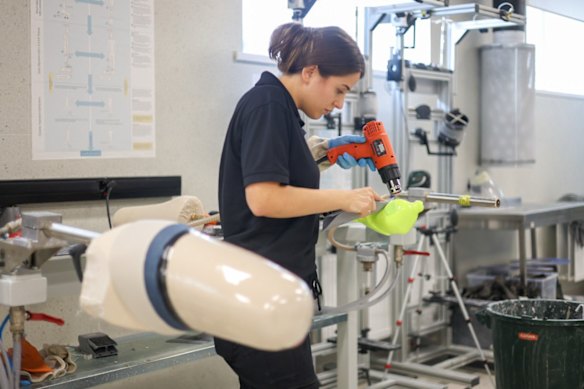
That is why Viktoriia Faryna, a physical therapist, puts so much into her job in the workshops at Superhumans. Making a prosthetic looks like sculpture: moulding shapes, bending plastics and using air driers to get the right finish. Every prosthetic is different, and every little adjustment can make it more comfortable for its new owner. “It’s like you can see the results of your work,” she tells me. When one patient needed a change to the socket of his prosthetic, she says, he raved about the results. Suddenly, it was easier for him to drive his car. “When patients come, and you can see what they can do, it’s amazing.”
The sheer scale of this work has put the Ukrainian centres in a class of their own. Ryan Winters, a surgeon based in Newcastle, NSW, has made six visits to Ukraine over the past three years to volunteer at charities and medical groups, and has seen the clinics and operating theatres at Unbroken and Superhumans. He says the medical work can be similar to trauma surgery in Australia or elsewhere, but the volume is totally different. “You’re not seeing one patient with a completely life-changing injury,” he says. “You’re seeing 50 every day. There’s an emotional toll to that, and it’s very easy to get quite overwhelmed.
“Related to that, and sort of heartbreakingly inspiring, is that you’ll meet some of these people, and you’ll do some reconstructive surgery on them, and their first question is: ‘When can I go back to the front line?’ ”
The challenge is staggering, but so is the tenacity. That is what sets Ukraine apart, he says. “It’s the enormity of it.”
Get the best of Good Weekend delivered to your inbox every Saturday morning. Sign up for our newsletter.